
Battery Energy Storage Systems (BESS) have moved well beyond their original role as grid support assets. In Australia's National Electricity Market (NEM), utility-scale batteries are now active commercial participants. They’re generating revenue through competitive electricity markets, not just providing backup capability.
For developers, investors, and engineers evaluating BESS projects, understanding how batteries make money is foundational to building a bankable business case.
The revenue model is more complex than it first appears, and the engineering decisions made early in a project directly determine how much of that revenue is actually achievable.
This article explains the two primary revenue streams for BESS in Australia, how they are calculated, how they are combined, and what limits real-world outcomes.
What Are the Two Primary Revenue Streams for BESS in Australia?
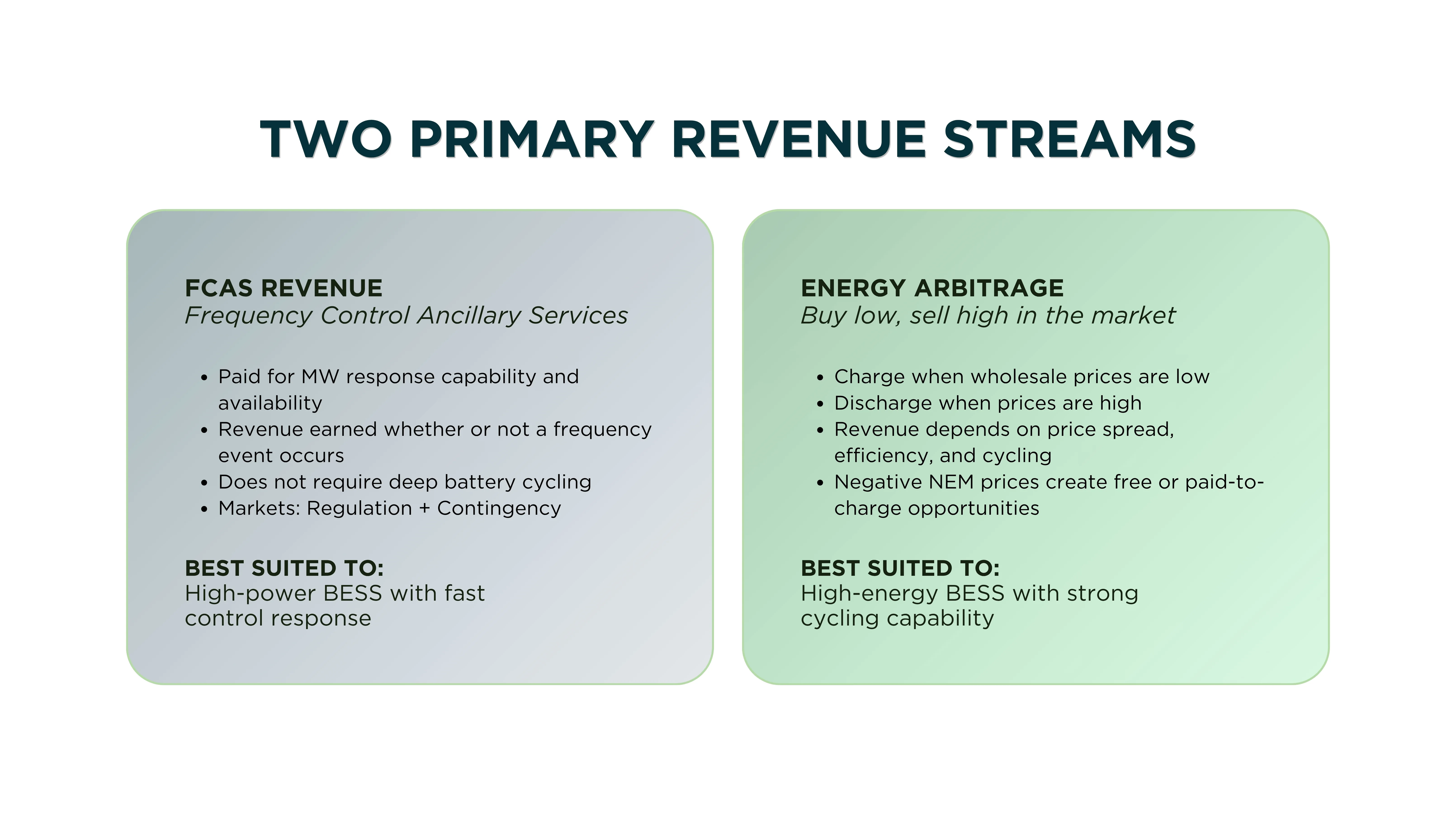
Battery Energy Storage Systems in Australia generate revenue through two main mechanisms:
- Frequency Control Ancillary Services (FCAS): Earning payments for the ability and availability to respond to frequency deviations in real time.
- Energy Arbitrage: Charging when wholesale electricity prices are low and discharging when prices are high.
Most grid-scale BESS projects aim to stack both revenue streams simultaneously. In practice, doing this well requires deliberate engineering and operating strategy
What Is FCAS and Why Do Batteries Earn Money from It?
The NEM operates at a nominal frequency of 50 Hz. When supply and demand are out of balance, system frequency moves away from 50 Hz. If left unaddressed, these large frequency deviations can trigger protection systems and cause cascading outages.
AEMO procures Frequency Control Ancillary Services (FCAS) to manage these. FCAS providers are paid to be available and responsive to inject or absorb active power quickly enough to arrest and correct frequency movements.
Batteries are exceptionally well suited to FCAS. They can respond in milliseconds, far faster than gas turbines or hydro units that dominate traditional FCAS markets.
As Australia's grid adds more inverter-based renewable generation and loses synchronous inertia, the value of fast-responding assets like BESS increases.
Why Are FCAS Markets Growing in Importance?
Australia's renewable energy transition is accelerating. Higher penetrations of solar and wind generation reduce the natural inertia that previously stabilised system frequency. This means frequency deviations occur more quickly and require faster response to arrest.
AEMO's introduction of the Very Fast FCAS market reflects this reality directly. Batteries dominate this market because no other technology can match their response speed.
The structural trend toward more renewable generation means FCAS markets will remain commercially significant for BESS for the foreseeable future.
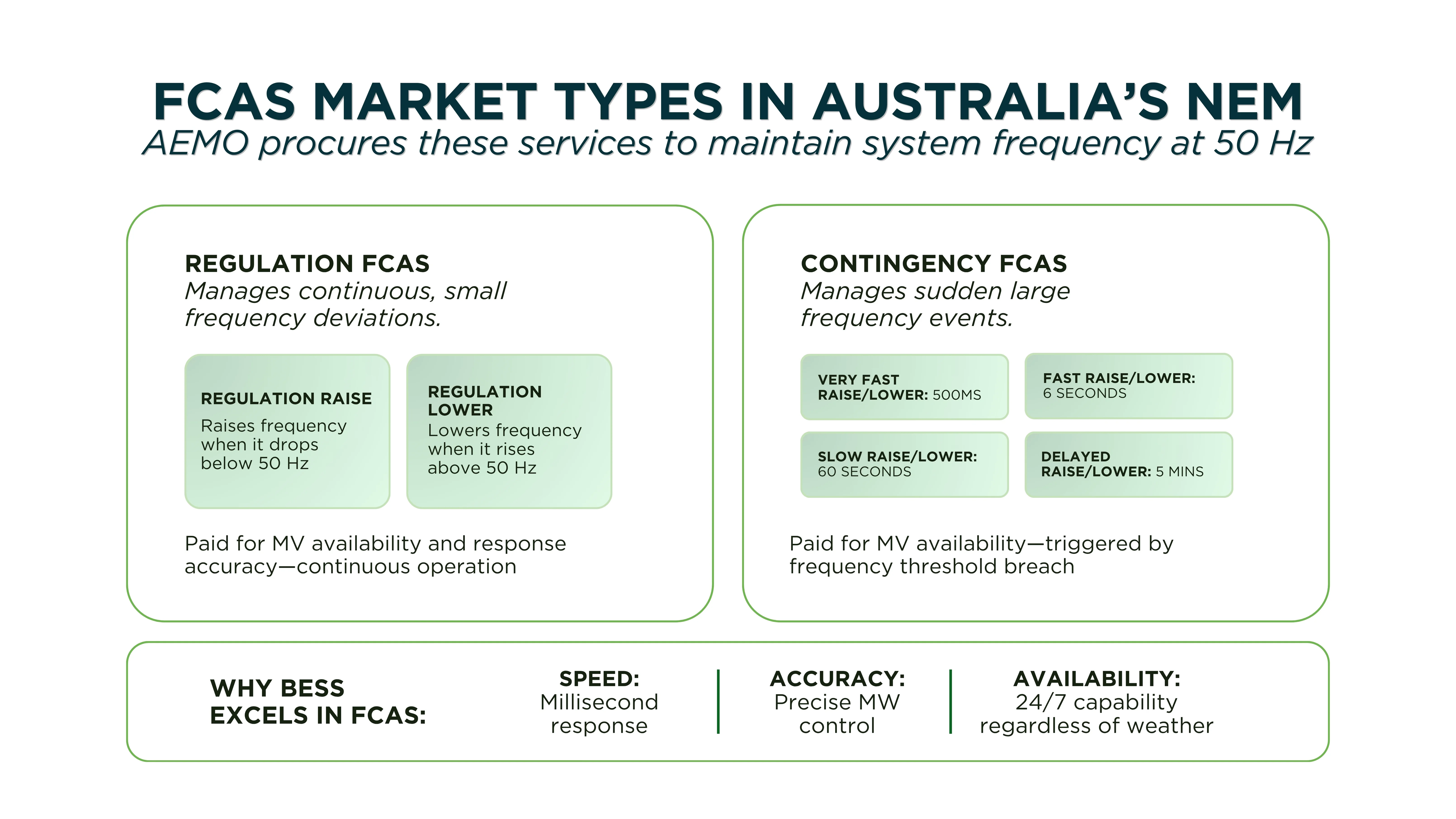
What Are the Two Categories of FCAS?
- Regulation FCAS. It operates as an automatic response to fine-tune frequency in real time as conditions vary throughout the day. Regulation services require sustained availability and accurate, proportional response.[Text Wrapping Break]
- Contingency FCAS. It’s designed to arrest frequency movement quickly enough to prevent it from reaching dangerous levels. They are further divided by response speed and direction:
- Raise services inject active power to arrest frequency drops
- Lower services absorb active power to arrest frequency rises
- Response times spanning Fast, Slow, and Delayed categories
Each FCAS market is cleared separately by AEMO and carries its own price. A battery can be enabled simultaneously in multiple FCAS markets, which is how FCAS stacking works within the ancillary services framework.
How Is FCAS Revenue Calculated?
FCAS revenue is primarily power-driven. It is based on MW capability and availability, not on how much energy the battery charges and discharges. This is commercially important: a battery can earn significant FCAS revenue without deep cycling, which preserves battery life compared with high-throughput arbitrage operation.
The key variables that determine FCAS revenue in practice are:
- Enabled FCAS Capacity (MW): The amount of power available for FCAS responses
- FCAS Market Prices ($/MW/hr): This varies by market type and changes in real time
- Availability Factor: The percentage of time the battery is enabled and compliant
- Control System Performance: Whether the battery’s response meets AEMO’s verification requirements under the Market Ancillary Services Specifications (MASS)
What Is Energy Arbitrage and How Does It Work for BESS?
Energy arbitrage is straightforward in concept: charge the battery when wholesale electricity prices are low, discharge when prices are high. The profit is the difference between the buy price and the sell price, minus losses from the battery’s round-trip efficiency.
In the NEM, wholesale prices vary by dispatch interval and by region. The high price volatility creates substantial arbitrage opportunities for fast-responding storage assets.
Typical Daily Price Pattern and Battery Response
The most reliable arbitrage pattern in Australia’s NEM is driven by the solar generation profile.
Negative prices during the middle of the day have become increasingly common in the NEM. Batteries can charge for free (or be paid to charge) during these periods, then discharge at significantly higher evening prices.
Arbitrage Revenue Calculation
Arbitrage revenue is energy-driven. It’s based on MWh throughput, round-trip efficiency, and the price spread captured. The key variables are:
- Usable Energy (MWh): The capacity available for arbitrage cycles
- Round-Trip Efficiency: Typically 85-92% for lithium-ion BESS
- Average Price Spread ($/MWh): The difference between charge and discharge prices
- Cycles Per Year: How frequently the battery completes full charge-discharge cycles
Revenue Stacking: Combining FCAS and Arbitrage
Most grid-scale batteries target both revenue streams simultaneously. In theory, this doubles the commercial opportunity. In practice, it requires deliberate management of the battery's state of charge (SoC) and operating envelope.
An optimised battery management system and plant controller is what makes stacking work in practice. The control system must balance FCAS obligations, SoC constraints, forecast price signals, and degradation limits in real time, across every dispatch interval.
How Does Power-to-Energy Ratio Shape BESS Revenue?
One of the most commercially significant design decisions in any BESS project is the power-to-energy ratio.
FCAS is a power market. A battery's FCAS capability is limited by its MW rating, not its MWh capacity. A high-power, short-duration battery can earn more FCAS revenue than a low-power, long-duration battery with the same energy capacity.
Arbitrage is an energy market. More MWh means more arbitrage opportunities per cycle. A long-duration battery can shift more energy per day and capture larger cumulative price spreads over a year.
Selecting the wrong power-to-energy ratio for the intended market strategy reduces revenue potential from both streams. This is why revenue modelling and system design must be developed together, not sequentially.
What Limits BESS Revenue in Real Projects?
Understanding how Battery Energy Storage Systems make money also requires understanding what prevents them from realising their full theoretical revenue potential.
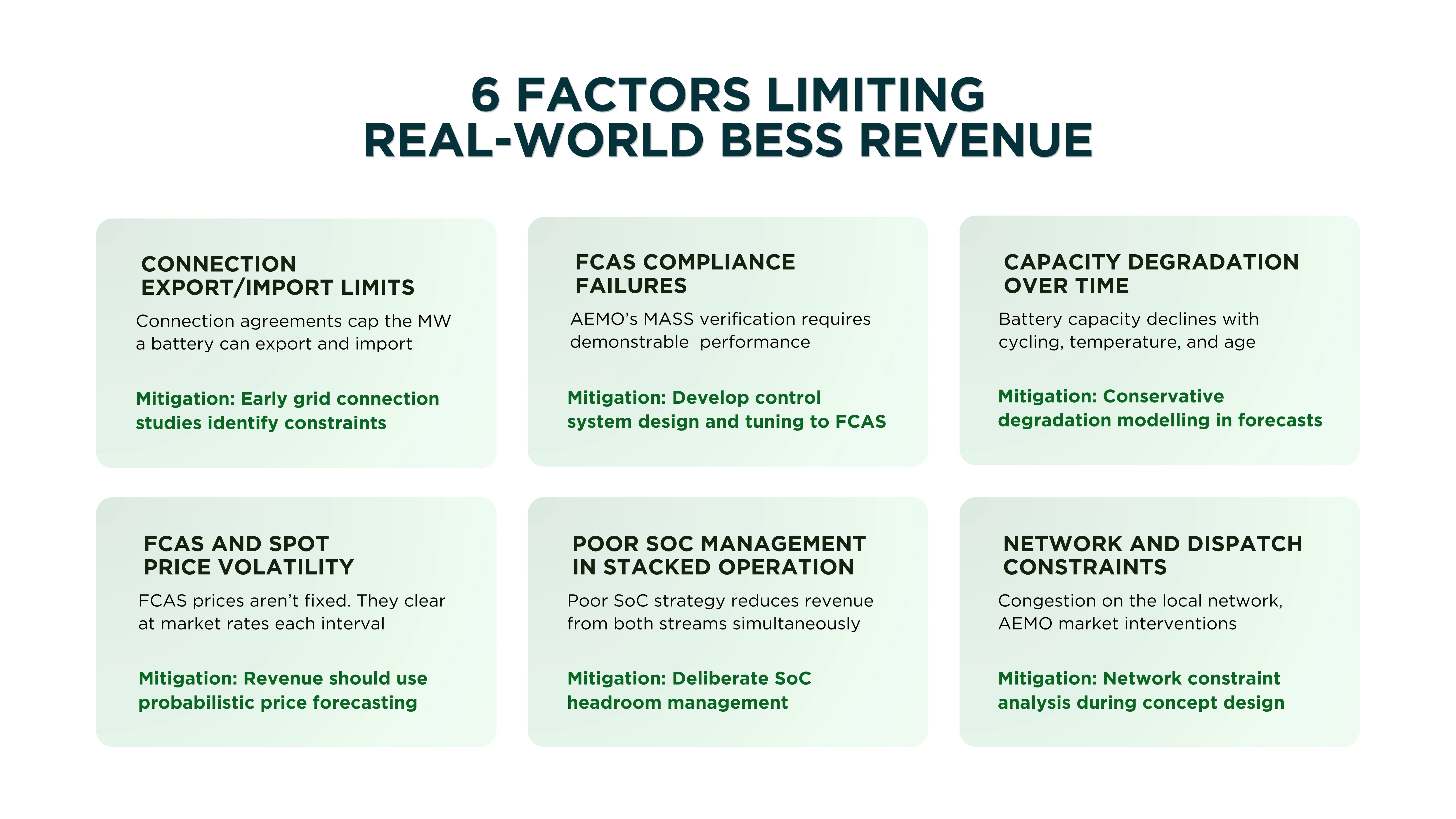
Grid Connection Constraints
Connection agreements with network service providers set limits on the maximum export and import power at the connection point. A battery sized at 50 MW may be constrained to 40 MW under its connection agreement, capping both FCAS enablement and arbitrage capacity.
Early engagement with the network connection process is the most effective way to identify and mitigate connection constraints before they become fixed project limitations.
Control System Performance and FCAS Compliance
AEMO's FCAS verification process requires batteries to demonstrate that their control systems can deliver the response they are enabled to provide. A battery that passes verification testing but then underperforms in service will have its enablement reduced.
These details need to be designed and validated as part of the project delivery process and can’t be left to commissioning:
- Control system tuning
- Inverter response settings
- Compliance with the Market Ancillary Services Specifications (MASS)
Degradation and Cycling Constraints
Battery capacity degrades over time. A BESS project modelled on 40 MWh usable energy in year one may deliver 35 MWh by year five. How much it degrades depends on:
- Cycling frequency
- Depth of discharge
- Operating temperature
- Chemistry
Conservative degradation modelling is essential for accurate long-term revenue forecasting. Projects that assume flat capacity over a 15–20 year project life routinely overstate bankable revenue.
Market Conditions and Price Volatility
FCAS market prices are not fixed. They are set by supply and demand in each dispatch interval. Periods of high price volatility can produce substantial earnings. Extended periods of low volatility compress margins significantly. Similarly, arbitrage spreads depend on the overall NEM price environment, which changes when:
- New generation capacity enters the market
- Interconnectors are upgraded
- Demand patterns evolve
Partner with ElectraGlobe to Maximise Your BESS Revenue Potential
Understanding how Battery Energy Storage Systems make money is one thing. Engineering a project that actually captures that revenue is another.
ElectraGlobe is an Australian renewable energy engineering consultancy specialising in utility-scale BESS, solar farms, and hybrid projects. Our services span:
- Concept design
- Detailed electrical engineering
- Grid connection studies
- AEMO GPS applications
- Power system studies
- Owner's engineering
We work with developers, investors, and asset owners who need engineering that translates commercial strategy into technically bankable projects.
Ready to develop a BESS project with confidence? Contact the ElectraGlobe team to discuss your project's engineering requirements.
FAQ
How do Battery Energy Storage Systems make money without selling electricity?
BESS generates revenue through FCAS markets by being paid for availability and response capability. FCAS is a power-based market: a battery earns FCAS revenue when it’s enabled and compliant, regardless of whether a frequency event actually occurs.
What is the most profitable revenue stream for BESS in Australia—FCAS or arbitrage?
Neither is universally more profitable. It depends on the battery’s power-to-energy ratio, market conditions, and operating strategy. FCAS has historically offered strong returns for fast-responding batteries. Arbitrage returns depend on the NEM’s price volatility and the spread between charge and discharge prices.
How does grid connection affect how much money a BESS project can make?
Grid connection constraints directly cap the MW a battery can export and import, which also caps both FCAS enablement and arbitrage capacity.