
In 2025, Australia commissioned 4.9 GWh of grid-scale batteries, matching the combined output of all storage projects commissioned between 2017 and 2024. The final quarter of 2025 was particularly significant, with four projects becoming operational, contributing 1 GW / 2.3 GWh.
Driving this growth is a combination of policy support, falling technology costs, and a NEM that is increasingly desperate for this dispatchable capacity.
However, the pipeline statistic that matters most is how much is trying to get built. And the defining challenge for Australia's BESS project development sector is not technology or capital. It is the ability to navigate the development process:
- Site selection
- Planning approval
- Grid connection
- GPS compliance
- Construction
- Commissioning
This guide walks through every phase of BESS project development in Australia, with current market data, regulatory requirements, and the engineering decisions that determine whether a project reaches commercial operation on time and on budget.
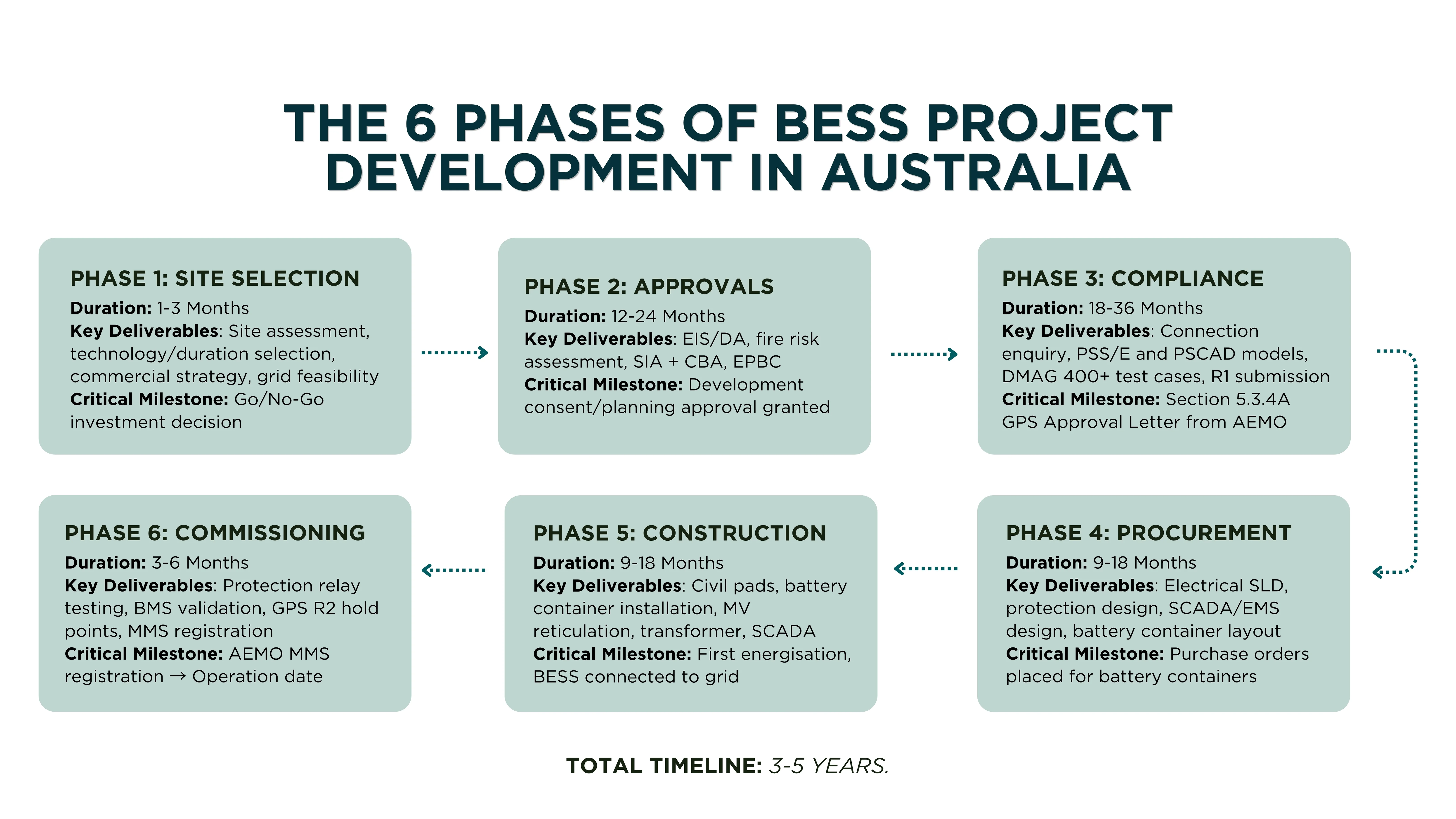
Phase 1: Concept Development and Site Selection
Every BESS project begins with a question: where should the system be located?
During this phase the site is selected based on criteria such as proximity to existing electrical infrastructure, environmental impact, land use, and community acceptance. For a standalone BESS (not co-located with a solar farm), the primary site selection criteria are:
- Grid Connection Proximity. Unlike solar farms, a BESS can theoretically be located anywhere within reasonable distance of viable grid infrastructure. The site selection decision is therefore dependent on: which connection point offers the best combination of available capacity, manageable curtailment risk, and lowest connection cost?
- Network Service Value. BESS projects that provide high-value network support services command premium commercial arrangements with NSPs. Identifying these high-value service locations requires network analysis at the concept stage.
- Technology and Duration Selection. The NEM's market structure increasingly rewards longer-duration storage. Prior to December 2025, all batteries coming online in the NEM had been two hours or less in duration. However, with the commissioning of Melbourne Renewable Energy Hub A3, the NEM's first 4-hour BESS unit began trading.
The concept phase must also establish the project's commercial strategy: pure merchant exposure to NEM spot and FCAS prices, a Capacity Investment Scheme (CIS) contract, a network support agreement with an NSP, or a combination of these.
Phase 2: Planning and Environmental Approvals
Developing a battery system in Australia requires extensive studies, assessments and engagement with community and other stakeholders before submitting a planning application.
BESS projects have historically benefited from a simpler planning approval pathway than utility-scale solar farms. However, this advantage is eroding. The key planning considerations for BESS development in Australia:
- New South Wales: Large BESS projects (typically above 30 MW) are assessed as State Significant Development under the EP&A Act, with the NSW Department of Planning as the consent authority.
- Queensland: The Planning Act reforms extended impact assessment requirements to all energy storage projects. BESS projects in Queensland must now include a Social Impact Assessment and Community Benefit Agreement before DA lodgement.
- Victoria: Large BESS projects, even flagship-scale, in Victoria may require an Environment Effects Statement.
- South Australia: BESS projects are assessed under the Planning and Design Code as Impact Assessed Development. Clements Gap BESS in SA commenced commissioning in December 2025 following a structured approval and construction process.
The planning approval phase for a large BESS project typically takes 12 to 24 months in NSW and Victoria, and may be longer following Queensland's 2025 reforms. Environmental studies required commonly include:
- Noise assessment
- Visual impact assessment
- Bushfire risk management
- Electromagnetic interference studies
- Stormwater and drainage management plan
Fire risk and safety assessment has become a mandatory element of BESS planning applications following several high-profile battery fires globally. Applicants must demonstrate that the fire suppression, thermal management, and battery management systems meet Australian standards and international best practice.
Phase 3: Grid Connection and GPS Compliance
Grid connection is the technical backbone of every BESS project development in Australia, and the phase that most consistently determines whether a project reaches commercial operation within its planned timeline.
For standalone BESS projects, the grid connection process involves:
- Connection Enquiry and R0 Submission: The developer submits a connection enquiry to the relevant NSP, establishing the project's preliminary GPS framework and obtaining indicative connection conditions.
- AEMO IRS Registration: Under the National Electricity Amendment Rule 2021, all BESS systems above 5 MW connecting to the NEM are classified as Integrated Resource Systems (IRS) and must register as Integrated Resource Providers (IRPs). This classification requires GPS compliance across both the import (charging) and export (discharging) operating modes.
- GPS R1 Submission and AEMO Technical Due Diligence: The R1 package must include validated PSS/E and PSCAD models covering all BESS operating mode combinations, the DMAG pre-qualification test results (400+ PSCAD simulation cases), and GPS compliance evidence for all applicable NER Schedule 5.2 clauses.
For complex, large-scale BESS projects, GPS R1 approval timelines of 18 to 36 months are realistic. The August 2025 AEMC Package 1 access standard reforms updated GPS requirements for BESS projects. Projects that received their connection enquiry response after 21 August 2025 must comply with the new access standards from the outset.
Phase 4: Engineering Design and Procurement
BESS project engineering design spans electrical, civil, structural, mechanical, fire protection, and SCADA/EMS disciplines.
The key engineering deliverables for a utility-scale BESS project include:
- Battery System Configuration: The number of battery containers, inverter/PCS units, transformers, and MV switchgear must be established in detailed design. Battery system sites include containers that house the components necessary for operation such as inverters, transformers, cooling and fire suppression systems, and switch rooms.
- SCADA and EMS Design: The EMS is the intelligence that determines when the BESS charges and discharges, at what rate, and in response to which market signals. SCADA must interface with AEMO's market management system for bid dispatch, with the NSP's network management system for frequency and voltage control, and with the battery manufacturer's BMS for safe operating envelope enforcement.
- Protection Relay Design: BESS projects introduce bidirectional power flow through the MV reticulation and substation, requiring protection relay coordination for both export (discharging) and import (charging) modes. Reverse power flow scenarios, islanding detection, and rate-of-change-of-frequency (ROCOF) protection must be addressed in the protection philosophy.
- Procurement Lead Times: Battery containers, PCS/inverter units, transformers, and MV switchgear all have significant lead times, commonly 16 to 26 weeks for battery containers and longer for large power transformers. Procurement must be initiated sufficiently in advance of the construction programme to avoid schedule impact.
Phase 5: Construction
The construction phase involves the physical delivery of the BESS, including site preparation, civil and electrical works, equipment installation, and grid connection. Strict attention is paid to safety, quality control, and construction timelines. Throughout this stage, the project team works closely with the construction contractor, equipment suppliers, and the connecting NSP.
The typical construction sequence for a utility-scale BESS project:
- Civil Works: Site preparation, civil pads for battery containers and auxiliary buildings, access roads, drainage, fire suppression water storage, stormwater management.
- Electrical Installation: MV reticulation cabling, transformer installation, MV switchgear installation, low-voltage auxiliary power, earthing and lightning protection, communications infrastructure.
- Battery System Installation: Battery container delivery and placement, container interconnection, BMS commissioning, thermal management system installation and testing.
- SCADA and Communications: EMS configuration, AEMO market systems integration, NSP telemetry interface, remote monitoring and control platform commissioning.
Construction timelines for a utility-scale standalone BESS project of 100–300 MW typically range from 9 to 18 months, depending on project complexity and supply chain conditions.
Phase 6: Commissioning and AEMO Registration
Commissioning is where the BESS project's technical performance is validated against the approved GPS and the EMS is configured for market participation.
First energisation confirms the system has been safely connected to the grid and is able to receive and store electricity, representing a major technical achievement. Commissioning then takes place in stages, with careful testing to ensure the battery operates safely and reliably.
The commissioning programme for a NEM-connected BESS must be agreed with AEMO and the connecting NSP and covers:
- Protection System Testing: All protection relay settings verified against the approved protection philosophy and GPS requirements.
- BMS Performance Testing: Charge and discharge tests across the full state-of-charge range, thermal management system validation, and cell balancing verification.
- GPS R2 On-Site Validation: Physical BESS performance must match the approved R1 PSS/E and PSCAD models within ±10% across all GPS parameters and all operating mode combinations. The project progresses through Hold Points at 0%, 10%, 50%, and 100% of capacity.
- EMS Market Integration Testing: Bid dispatch testing, FCAS response testing, and AEMO market management system interface validation.
AEMO Market Management System (MMS) registration is the final step before commercial operation, confirming the BESS is authorised to participate in NEM dispatch and settlement.
Deliver Your BESS Project With Confidence. Partner With ElectraGlobe
BESS project development in Australia is a multi-phase process that demands specialist expertise across power systems engineering, regulatory compliance, and project delivery.
ElectraGlobe provides end-to-end BESS engineering, from concept-stage grid connection feasibility and technology selection, to GPS IRS modelling in PSS/E and PSCAD, detailed electrical and protection design, Owner's Engineering oversight during construction, and R2 commissioning support through to AEMO MMS registration.
Whether you are at the concept stage of your first standalone BESS project or navigating the GPS R1 submission for a large-scale hybrid development, our team has the technical depth and regulatory knowledge to deliver. Contact ElectraGlobe for your BESS project development.
FAQ
How long does BESS project development take in Australia from concept to commissioning?
The total development timeline for a utility-scale standalone BESS project in Australia typically ranges from 3 to 5 years from concept to commissioning, depending on project scale, state planning pathway, and grid connection complexity.
What planning approvals does a BESS project need in Australia?
In NSW, large BESS projects are assessed as State Significant Development under the EP&A Act, requiring an Environmental Impact Statement. In Queensland, the July 2025 Planning Act reforms require all energy storage projects to undergo impact assessment, with a Social Impact Assessment and Community Benefit Agreement required before DA lodgement. In Victoria, large projects may require an Environment Effects Statement. In South Australia, BESS projects are assessed as Impact Assessed Development under the Planning and Design Code.
What is AEMO IRS registration and why does every BESS project need it?
IRS classification recognises that BESS systems are fundamentally different from conventional generators: they can both import (charge from the grid) and export (discharge to the grid) electricity, and their operating behaviour in each mode must be separately demonstrated to comply with Generator Performance Standards.