
Securing grid connection is the single most technically demanding milestone in the development of a utility-scale solar farm in Australia. It is also consistently the step that catches developers off guard because of its complexity, duration, and technical depth.
For any solar farm connecting to Australia's National Electricity Market (NEM), solar farm grid connection is governed by:
- Australian Energy Market Operator (AEMO)
- Network Service Provider (NSP)
- National Electricity Rules (NER)
The process spans six formal stages and involves hundreds of technical simulations. It can take anywhere from two months to over two years, depending on project scale, connection point availability, and the quality of technical submissions.
This step-by-step guide explains every stage of the solar farm grid connection process in Australia, the key players involved, and what developers must do.
Who Governs Solar Farm Grid Connection in Australia?
Before walking through the steps, it's essential to understand the three parties that control the connection process:
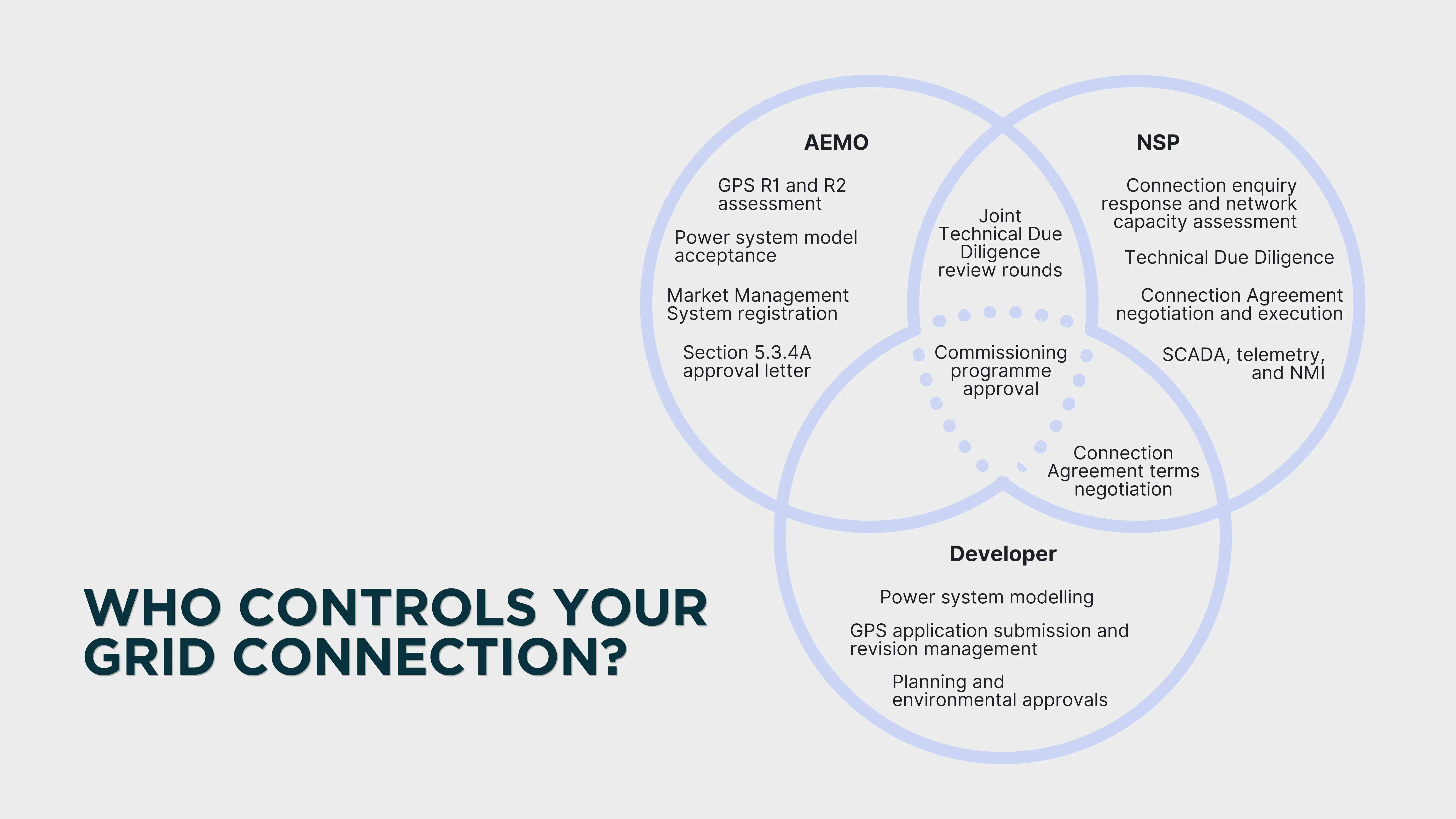
AEMO (Australian Energy Market Operator)
AEMO manages the NEM and is responsible for accepting and assessing Generator Performance Standards (GPS) submissions. It is also responsible for approving power system models and registering generating units in its Market Management System (MMS).
NSP (Network Service Providers)
NSPs own and operate the transmission and distribution infrastructure to which solar farms connect. NSPs include:
- Transgrid (NSW)
- Powerlink (QLD)
- ElectraNet (SA)
- AusNet (VIC)
- TasNetworks (TAS)
- Western Power (WA)
Each NSP has its own technical requirements, additional studies, and compliance standards that sit on top of AEMO's baseline requirements. Developers must satisfy both simultaneously.
AEMC (Australian Energy Market Commission)
The AEMC sets the rules that govern the connection process through the National Electricity Rules. Recently, the AEMC implemented the most significant overhaul of NEM access standards since 2018 under rule change ERC0393.
What Are the Stages of Solar Farm Grid Connection in Australia?
Stage 1: Pre-Application and Connection Feasibility
Before formally engaging AEMO or an NSP, experienced developers conduct a connection feasibility assessment. This is an internal analysis of candidate connection points, available network capacity, likely connection costs, and potential access constraints.
This stage uses publicly available tools including:
- AEMO's Connection Scorecard
- Integrated System Plan (ISP)
- NSP network development plans
Early feasibility work should also assess curtailment risk, particularly in constrained regions such as South Australia and parts of the NSW transmission network. These areas are where output limits imposed by the NSP can materially reduce energy yield and project revenue.
The investment made in rigorous pre-application analysis pays direct dividends. Projects that commence a formal connection enquiry with a well-researched connection point and a prepared technical team move through subsequent stages faster and with fewer costly revisions.
Stage 2: Connection Enquiry
The formal grid connection process begins with a Connection Enquiry submitted to the relevant NSP. The enquiry provides preliminary project details:
- Proposed location
- Installed capacity
- Generation technology type
- Intended connection point
This stage also requests indicative information about network capacity, technical requirements, and connection costs. During the enquiry stage, the Connection Applicant submits enquiries and data requests to AEMO and the connecting NSP. It also progresses other project planning activities such as government approvals addressing licensing, environmental, and land use matters.
This parallel activity is critical. Planning and environmental approvals can take 12 to 36 months in some states. Commencing both tracks simultaneously avoids sequential delays that can add years to a development programme. The NSP responds to the enquiry with indicative connection conditions, available capacity, and the technical studies required to proceed.
Key developer actions at Stage 2:
- Confirm the preferred connection point and voltage level
- Engage a power systems engineering consultant to begin preliminary modelling
- Initiate the NSP's network impact assessment (if required before the formal application)
- Progress planning and environmental approvals in parallel
Stage 3: Connection Application and GPS R0 Studies
The Connection Application is the most technically intensive stage of the solar farm grid connection process in Australia. It requires the developer to submit a comprehensive technical package about how the project will perform across a wide range of network conditions.
The centerpiece of this submission is the Generator Performance Standards (GPS) application. It defines the agreed technical performance standards a solar farm must achieve across key parameters including:
- Reactive power capability
- Voltage ride-through
- Frequency response
- Active power control
- Protection relay performance
- Power quality
The NEM Grid Connection Application requires the proponent to provide a GPS R0 model in accordance with the AEMO Dynamic Model Acceptance Test Guideline. This includes more than 200 individual simulations to confirm the design meets AEMO's assessment.
A strong GPS submission usually requires two rounds of Technical Due Diligence (TDD) by AEMO and the Transmission Network Service Provider (TNSP). In Round 1, the proponent submits the application, and AEMO and the TNSP review it and provide an issue tracker with comments. In Round 2, the consultant addresses these comments and resubmits. After these the project can progress to the Full Impact Assessment (FIA) stage and then to the Connection Agreement.
Stage 4: Connection Agreement
Once GPS approval is granted, the developer and NSP negotiate and execute a Connection Agreement. This is the legally binding contract that sets out the technical conditions of the connection, the rights and obligations of each party, the network access terms, and any conditions precedent to energisation.
The Connection Agreement incorporates the agreed Generator Performance Standards. It specifies the maximum export capacity, defines any operational restrictions or curtailment obligations, and establishes the commercial terms for use of the network.
This agreement also triggers the NSP's obligation to construct any required augmentation works. Where significant network augmentation is required, the developer may be required to contribute to its cost, adding both capital expenditure and timeline risk.
Stage 5: Detailed Design (R1)
Following execution of the Connection Agreement, the project progresses into detailed design. During this stage, the high-level concepts developed during the connection process are translated into a complete engineering design package suitable for procurement, construction, and commissioning. Typical activities include preparation of detailed single-line diagrams, protection and control philosophies, earthing design, cable sizing and routing, equipment specifications, communications architecture, SCADA design, civil interfaces, and development of Issued for Construction (IFC) documentation.
The detailed design must remain consistent with the agreed Generator Performance Standards (GPS) and the assumptions used within the connection studies. Any material deviation from the approved design, such as changes to inverter technology, transformer configuration, control systems, or plant capacity, may require reassessment by the NSP and AEMO and could trigger additional connection studies. As a result, close coordination between the design team, equipment suppliers, NSP, and AEMO is essential throughout this stage to minimise project risk and avoid delays to energisation.
Stage 6: Construction and GPS R2 Validation
With the Connection Agreement executed, the project enters construction, but the grid connection process doesn't pause. During construction, the developer must continue to engage AEMO and the NSP on several critical workstreams.
SCADA and Telemetry. The solar farm's Supervisory Control and Data Acquisition (SCADA) system must be configured to provide AEMO with real-time visibility. SCADA requirements for transmission-connected solar farms are detailed and must be validated.
National Metering Identifier. The developer must obtain an NMI from the connecting NSP. This is the unique identifier that enables the project to participate in NEM market dispatch and settlement.
Commissioning Programme. The commissioning programme must be agreed with the connecting NSP and AEMO. This must be achieved at least three months before commissioning starts, and at least one month before for distribution connections. If there are material changes to the simulation model or other aspects of system design, AEMO and the NSP need to review and reassess the performance standards.
GPS R2 On-Site Validation. After energisation, the project must demonstrate that its actual on-site performance matches the approved R1 simulation model. R2 validation is one of the most technically challenging and commercially sensitive phases of the entire connection process. Projects that fail to match their R1 model performance face output restrictions at lower Hold Points. This translates directly to lost generation revenue during the commissioning period.
Stage 7: AEMO Market Registration and Commercial Operation
The final stage of the solar farm grid connection process in Australia is registration in AEMO's Market Management System (MMS). This is the central registry for all generating units participating in the NEM.
The MMS registration process represents formal acknowledgement that the project has met AEMO's technical and operational requirements for grid connection to the NEM. It requires comprehensive documentation, grid connection studies, and compliance verification.
Once complete and the commissioning programme is satisfied, the project achieves Commercial Operation Date (COD). This triggers offtake obligations under Power Purchase Agreements. It also commences Large-scale Generation Certificate (LGC) accrual under the Renewable Energy Target, and begins the project's contracted revenue stream.
GPS R1 vs R2 at a Glance
| GPS R1 | GPS R2 | |
|---|---|---|
| When | Before construction | After energisation |
| What is tested | Simulation model performance | Physical plant performance |
| Software required | PSS®E and PSCAD™ | On-site measurement and testing |
| Number of simulations | 200+ | Hold points at 0%, 10%, 50%, 100% capacity |
| Pass criteria | AEMO and NSP model acceptance | ±10% match between R1 model and actual behaviour |
| Milestone unlocked | Section 5.3.4A letter — construction can proceed | Full output authorised — COD achieved |
| Typical duration | 12–36 months | 3 months post-energisation |
How Long Does Solar Farm Grid Connection Take in Australia?
Timeline is the most variable and most frequently underestimated aspect of solar farm grid connection in Australia. AEMO's advice is that the entire process may require a duration from 2 to 24 months. Early engagement with the NSP is also considered critical.
For utility-scale transmission-connected solar farms, the realistic timeline from connection enquiry to GPS approval is commonly 18 to 36 months. This duration factors in model iterations, NSP studies, and AEMO review cycles. The GPS R2 validation period adds a further three to six months post-energisation.
The overall grid connection timeline is one of the primary schedule drivers for project development. It must be sequenced carefully against planning approvals, financing milestones, and construction contracts.
How to Accelerate Solar Farm Grid Connection in Australia
The most consistent advice we at ElectraGlobe promote is to begin NSP engagement before the formal connection enquiry. This way you have a clear understanding of the operator's priorities, current connection queue, and preferred technical approaches before submissions.
Other than this, here's what ElectraGlobe advises to accelerate the process:
- Invest in high-quality power system modelling. GPS submissions that require multiple rounds of AEMO and NSP review are the primary source of delays. Projects that engage power system engineers with experience on NEM connection applications consistently achieve faster approval.
- Treat R2 validation as a project risk. The gap between R1 simulation model performance and actual on-site plant behaviour is a known risk. Developers who conduct hardware-in-the-loop testing prior to energisation, or who work closely with equipment vendors, are better positioned to pass R2 validation easily.
- Run planning and grid connection in parallel. Grid connection and planning approvals are both long-lead activities. Sequential execution can add two to four years to a project. Experienced developers run both tracks simultaneously, accepting that one may be secured before the other.
- Stay current with regulatory changes. The NEM connection framework is evolving rapidly. Developers and their advisors must maintain current knowledge of the regulatory environment to ensure their connection applications are structured correctly.
Secure Your Solar Farm Grid Connection with ElectraGlobe
Solar farm grid connection in Australia is a multi-stage, technically intensive process that demands specialist expertise, early engagement, and disciplined programme management.
From the initial connection feasibility assessment through to AEMO MMS registration and Commercial Operation Date, the process involves:
- Hundreds of technical simulations
- Bilateral negotiations with NSPs
- Staged commissioning validation
- Ongoing regulatory compliance
All of these must align with the project's financing, planning, and construction timelines.
For developers navigating solar farm grid connection in Australia, ElectraGlobe can support you throughout the process. We'll provide you with transparent engagement and a realistic programme that treats grid connection as a critical path.
Need expert support for your grid connection application? Contact our power systems engineering team for end-to-end connection process management.
Frequently Asked Questions
What is the difference between GPS R1 and GPS R2 testing?
R1 and R2 refer to the staged validation phases of GPS compliance. R1 testing is the pre-construction modelling phase: the developer submits detailed power system simulation models to demonstrate that the proposed design will meet the requirements. R2 testing is the post-construction on-site validation phase: once the solar farm is built and energised, the developer must demonstrate that actual on-site plant performance matches the R1 model.
What is curtailment and how does it affect solar farm grid connection decisions?
Curtailment is the intentional reduction of a solar farm's output below what it is technically capable of producing. This is imposed by the NSP or driven by negative electricity spot prices that make generation commercially unviable.
Can a solar farm connect to the grid without a Power Purchase Agreement (PPA) in place?
Yes, grid connection and a PPA are separate processes governed by different parties. However, in practice, most project financiers require a PPA or equivalent revenue support mechanism to be in place before committing debt finance.