
The standalone solar farm is no longer the default project structure in Australia's utility-scale energy market. The numbers tell the story.
In Australia's record 64 GW development pipeline:
- 46% account for battery storage projects
- 19.7% account for hybrid solar battery projects
This brings the total battery storage component to approximately 42 GW. More than half of the winning bids in the federal government's most recent Capacity Investment Scheme tender were for solar-plus-storage sites. The market has spoken: hybrid solar BESS in Australia is not a premium option. It is the mainstream project structure.
Why? What does adding a battery system to a solar farm actually do for project returns? And how does co-location change the technical engineering requirements?
This guide answers those questions with the current data and technical depth they deserve.
What Is a Hybrid Solar BESS Project?
A hybrid solar BESS project is a utility-scale solar farm and battery energy storage system developed on the same site, sharing grid infrastructure. In many cases, sharing inverters, transformers, and grid connection works.
The two components can be coupled in two fundamentally different ways:
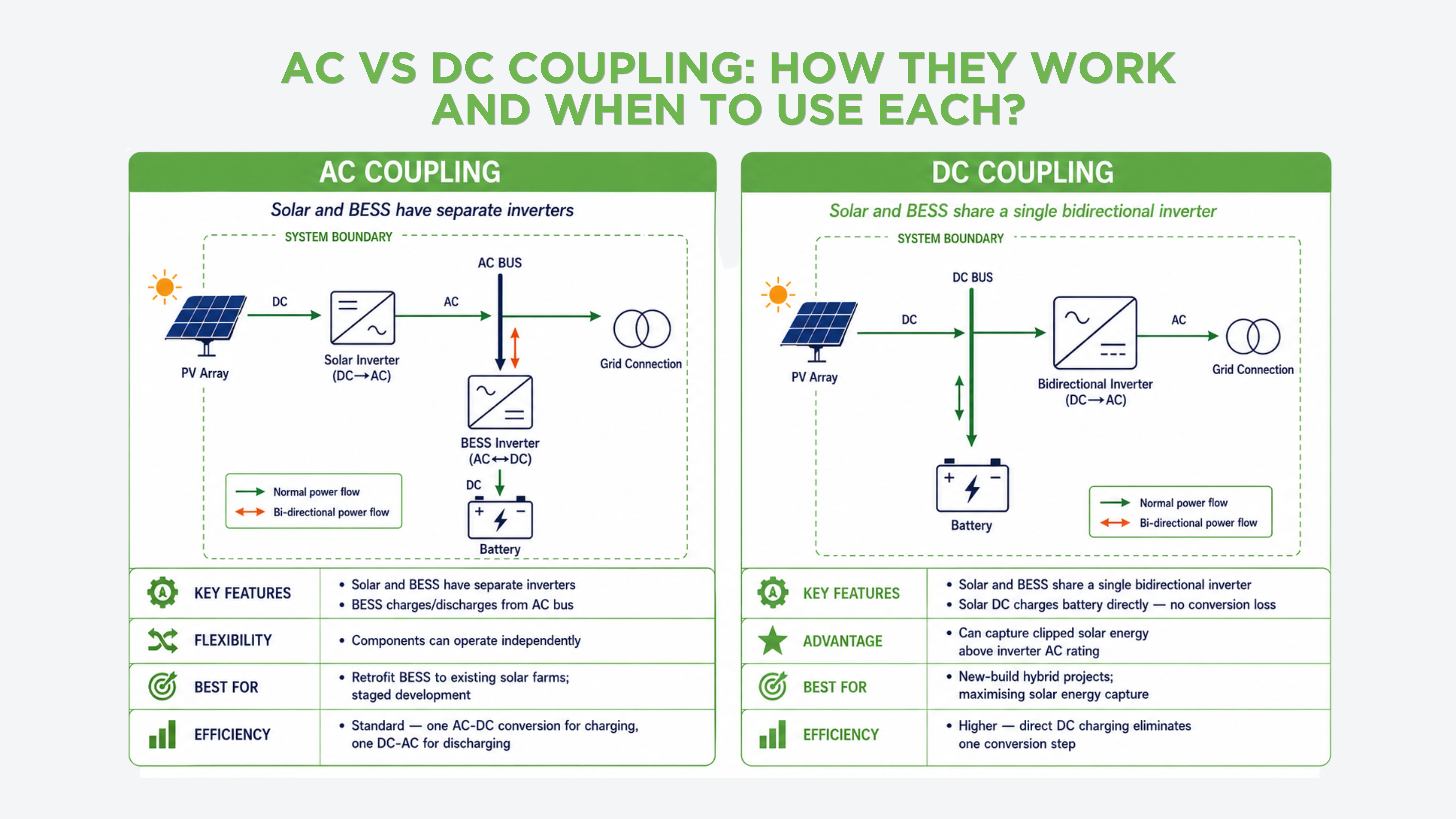
- AC Coupling: The solar farm and BESS each have their own inverters and connect to the site's AC bus independently. The BESS charges from the AC bus and discharges back to the AC bus. AC coupling is more flexible for retrofitting BESS to existing solar farms and for situations where the solar and storage components are developed.
- DC Coupling: The solar panels and the BESS share the same inverter. Solar DC output charges the battery directly before conversion to AC, eliminating one conversion step and improving round-trip efficiency. DC coupling is generally preferred for new-build hybrid projects where both components are developed simultaneously.
The coupling architecture determines how the BESS charges and discharges relative to solar generation. It also affects how effectively the project can capture the revenue opportunities that make hybrid projects financially superior to standalone assets.
How Does Hybrid Solar BESS Outperform Standalone Solar in Australia?
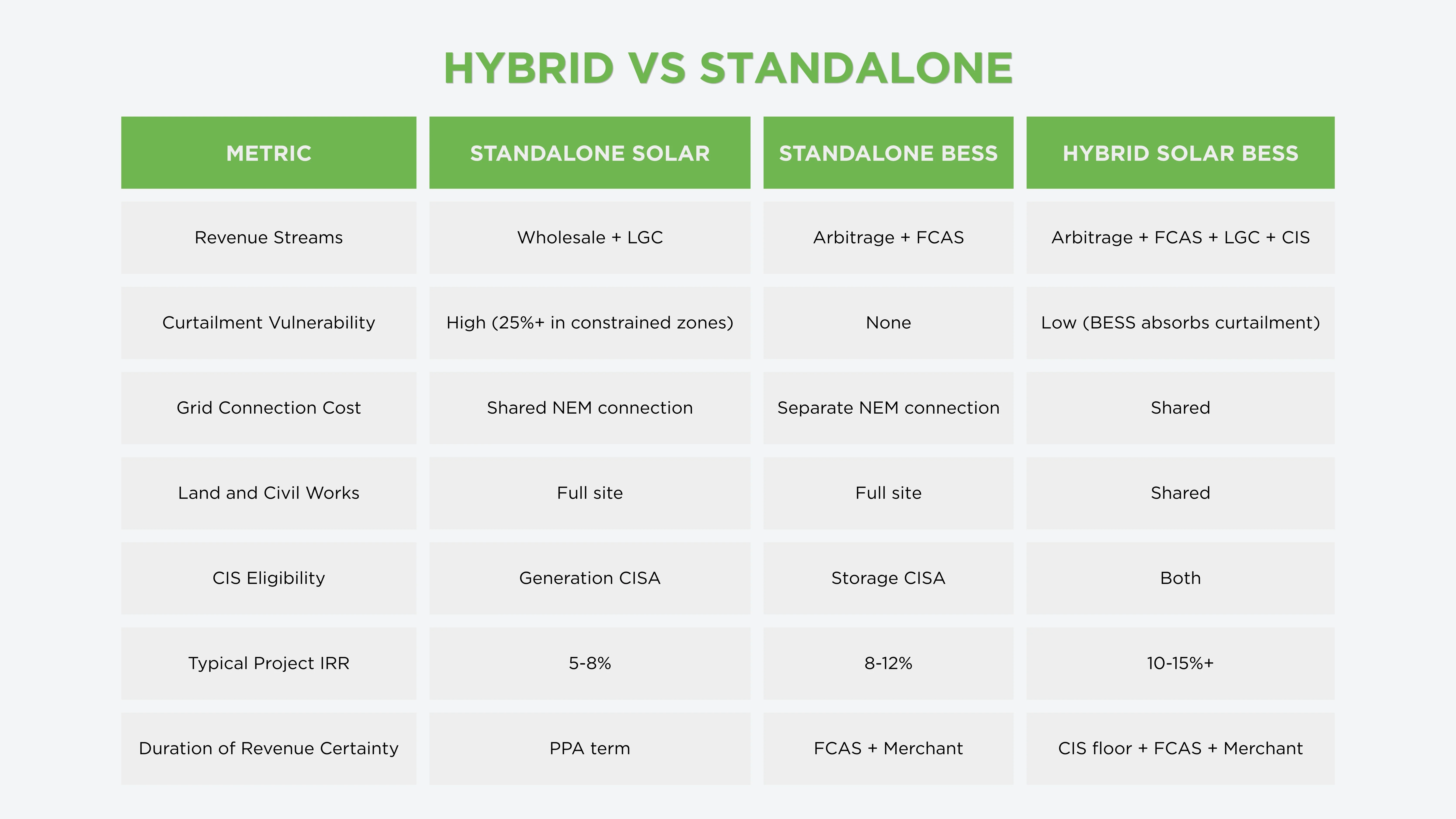
The Duck Curve Is Now the Profit Driver
Australia's NEM has one of the most volatile electricity spot prices in the world. It continues to hold its title as one of the planet's most volatile energy-only markets.
This volatility is driven by the duck curve. The daily pattern where solar generation floods the grid at midday, driving prices to zero or negative, then collapses in the evening as demand peaks and prices spike.
- For Standalone Solar Farms: The duck curve is a problem. Negative pricing has become entrenched, with negative prices hitting 31% of NEM intervals in Q4 2025. A solar farm operating without storage is forced to either curtail output or generate during negative price periods, destroying value both ways.
- For Hybrid Solar BESS Projects: The duck curve is the core profit driver. Solar-plus-storage hybrids use on-site generation for effectively free charging before exporting premium-priced energy during the evening. Recent data shows increasing evening spreads, with batteries discharging at all-time quarterly highs.
Curtailment Reduction and Network Access
Curtailment is the forced reduction of a solar farm's output when the network reaches its capacity limits. Curtailment of solar projects in Australia has become a serious issue, with AEMO identifying some solar farms seeing rates above 25% in 2024.
A hybrid BESS fundamentally changes the curtailment equation. When the network would otherwise curtail the solar farm's output, the BESS absorbs the excess generation rather than losing it. The curtailed energy is stored and dispatched during periods of lower network congestion, recovering revenue that a standalone solar farm would have lost entirely.
Value Stacking Across Multiple Revenue Streams
The defining commercial advantage of a hybrid solar BESS project in Australia is value stacking or capturing multiple revenue streams simultaneously from the same asset.
The core revenue streams to a hybrid solar BESS project in the NEM are:
- Energy Arbitrage: Charge during negative or low-price periods; discharge during high-price evening peaks.
- Frequency Control Ancillary Services (FCAS): The BESS provides frequency regulation services to AEMO. FCAS revenue is earned continuously, providing a baseload revenue layer on top of arbitrage.
- Capacity Investment Scheme (CIS) Contracts: The CIS provides revenue floor contracts for qualifying hybrid projects, underwriting the minimum revenue needed to support project financing.
- Cap Contracts: Cap contracts are a financial derivative that protect buyers from energy price volatility. When the wholesale price exceeds the strike price (typically $300/MWh), the seller returns the difference to the buyer in exchange for an upfront premium.
- Grid Stability Services: As coal plants retire and synchronous generation declines, AEMO is increasingly contracting hybrid projects for system strength, inertia replacement, and voltage control services.
What Are the Technical Complexities of Hybrid Solar BESS Projects?
The commercial case for hybrid solar BESS in Australia is compelling. The engineering execution is materially more complex than either standalone solar or standalone BESS.
The key technical engineering challenges specific to hybrid projects are:
AEMO Integrated Resource System (IRS) Registration
IRS registration requires GPS compliance evidence across both the solar generation function and the storage function of the system. This includes:
- Bidirectional power flow of the BESS
- Interaction between solar charging and BESS discharging in the power system
- Combined reactive power and frequency response capability of the integrated system
The GPS application for a hybrid project requires models in both PSS®E and PSCAD™ that accurately represent all operating modes.
Power System Modelling Complexity
For a standalone solar farm, the power system model represents the solar inverters, power plant controller, transformer, and protection systems.
For a hybrid project, the model must additionally represent:
- BESS Battery Management System (BMS) Behavior: Including state-of-charge constraints that limit available power at partial charge
- Bidirectional Inverter Control: The control strategy that switches between charging and discharging mode, and how it responds to grid disturbances during each mode
- Energy Management System (EMS) Dispatch Logic: How the EMS controls the split between solar export and battery charging in real time.
- DC Bus Interaction: For DC-coupled projects, the shared DC bus creates electrical interactions between the PV array and BESS that must be accurately captured in the EMT model.
The validation requirement is substantially harder to achieve for a hybrid project than for standalone solar, because the number of operating modes and system interactions is significantly greater.
Grid Connection and Interconnection Design
A hybrid project's grid connection agreement must specify the maximum export capacity and the technical operating envelope for the combined system.
The interconnection design must accommodate bidirectional power flow through the MV reticulation and substation. This is a requirement that adds complexity to protection relay coordination, particularly for reverse power flow scenarios during BESS charging from the grid.
Which Configuration Maximises Returns?
The choice between AC and DC coupling has both financial and engineering implications.
DC
DC coupling delivers better round-trip efficiency. For a large hybrid project, this efficiency gain compounds significantly over the asset’s 25-year life. DC coupling also allows the BESS to be charged from clipped solar energy, which would be lost in an AC-coupled system but can be stored in a DC-coupled BESS.
AC
AC coupling provides more operational flexibility. The solar farm and BESS can be dispatched independently. AC coupling also simplifies the AEMO IRS modelling requirement slightly, as the solar and BESS functions have separate inverters with clearly defined electrical boundaries.
For new-build hybrid projects in Australia, DC coupling is increasingly the preferred architecture, particularly where the developer is optimising for maximum energy capture from the solar resource and minimum interconnection cost through shared grid infrastructure.
Partner With Specialists in Hybrid Solar BESS Engineering
Hybrid solar BESS projects in Australia deliver superior returns, but they require engineering expertise that standalone solar projects do not. The technical requirements of a hybrid project demand a consultancy with proven experience across both solar and BESS engineering.
ElectraGlobe is Australia's specialist renewable energy engineering consultancy, with 2.5+ GW designed across utility-scale solar, BESS, and hybrid energy projects.
Our power systems engineering team provides end-to-end hybrid project engineering, from grid connection strategy and GPS IRS application through to detailed electrical design, Owner's Engineering oversight, and R2 commissioning support.
If you are developing a hybrid solar BESS project in Australia and want to ensure the foundation is right from day one, contact ElectraGlobe to discuss your project needs.
FAQ
What is a hybrid solar BESS project and how is it different from standalone solar or standalone BESS?
A hybrid solar BESS project combines a utility-scale solar PV farm and a battery energy storage system on the same site, sharing grid infrastructure and the same bidirectional inverter. Compared to standalone solar, the hybrid project is dispatchable. Compared to standalone BESS, the hybrid project has a lower effective charging cost.
What is the Capacity Investment Scheme and how does it support hybrid solar BESS projects in Australia?
The Capacity Investment Scheme is the Australian federal government's primary mechanism for supporting new renewable energy and storage capacity. It provides revenue support contracts that underwrite a floor price for electricity generated or capacity provided.
What are the key engineering differences between a hybrid solar BESS project and a standalone solar farm in Australia?
The engineering complexity of a hybrid solar BESS project is substantially greater than a standalone solar farm across several dimensions. First, AEMO registration: hybrid projects are classified as Integrated Resource Systems under the NEM rules, requiring GPS compliance modelling that covers all combinations of solar and BESS operating modes. Second, power system modelling: the GPS application requires PSS®E and PSCAD™ models that accurately represent the bidirectional inverter, BMS behaviour, EMS dispatch logic, and DC bus interactions.