
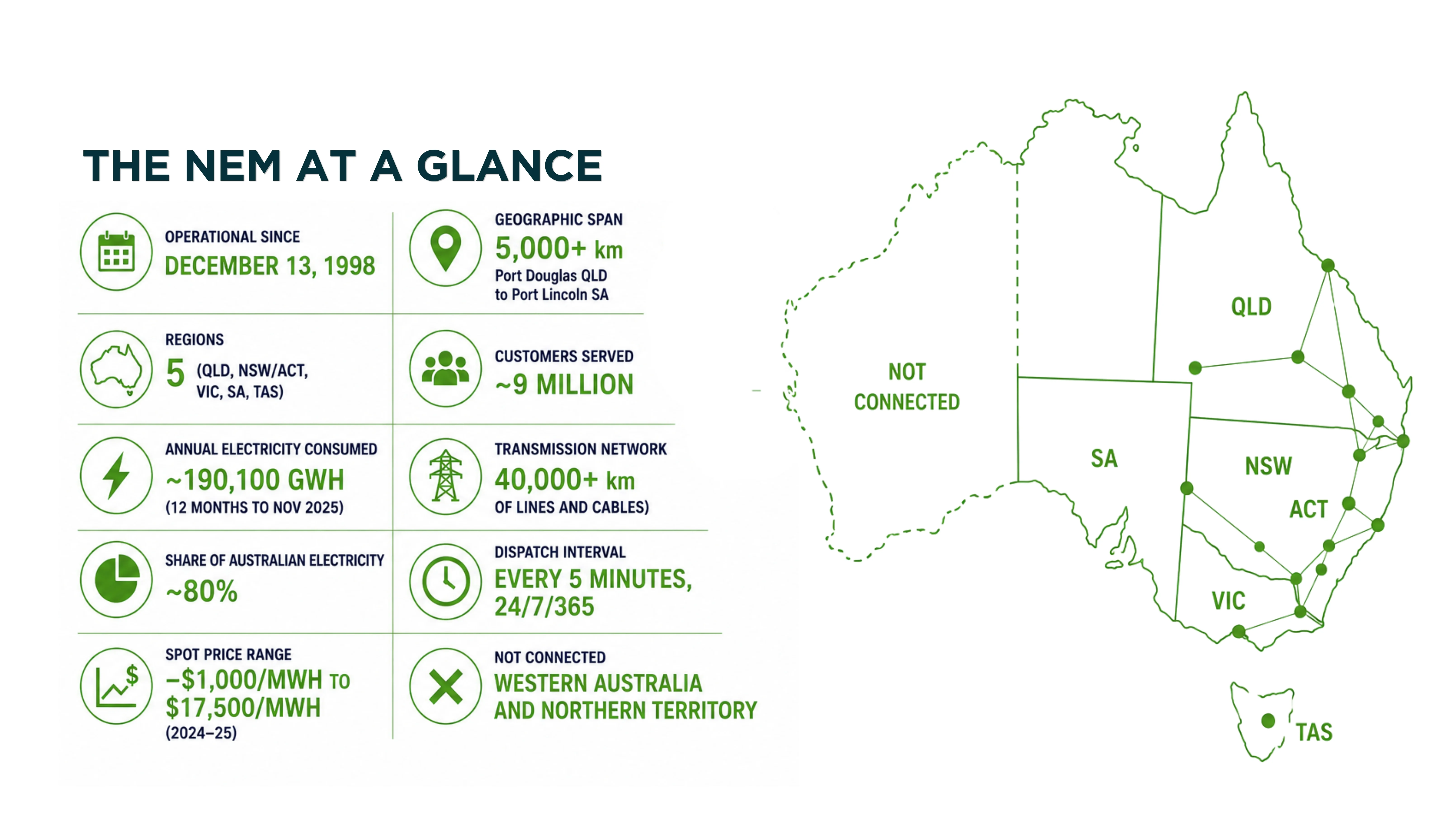
Australia's electricity system is unlike almost any other in the world. It spans more than 5,000 km, making it one of the longest interconnected alternating current power systems on Earth.
At the centre of this system is the National Electricity Market. This is the wholesale electricity market, physical transmission network, and regulatory framework that determines how electricity is generated, priced, traded, and delivered to roughly 9 million customers across eastern and southern Australia.
Understanding how the NEM works is essential for anyone developing, financing, or operating generation assets in Australia. This guide explains the NEM from first principles, how prices are set, who the key players are, and how the market is changing.
What Is the National Electricity Market?
The National Electricity Market is an arrangement in Australia's electricity sector for the connection of the electricity transmission grids of the eastern and southern Australian states and territories to create a cross-state wholesale electricity market.
The NEM commenced operation as a wholesale spot market in December 1998. It interconnects five regional market jurisdictions:
- Queensland
- New South Wales
- Victoria
- South Australia
- Tasmania
Western Australia and the Northern Territory are not connected to the NEM. They operate under separate electricity systems and regulatory frameworks.
It’s also important to note what the NEM is not. The NEM is not a physical building or a single organisation. The pool is not a physical thing, but a set of procedures that AEMO manages in line with the National Electricity Law and National Electricity Rules.
How Does the NEM Work?
At the heart of the NEM is a wholesale electricity market. This market operates as a 'spot market' or 'pool,' matching electricity supply and demand at five-minute intervals. The Australian Energy Market Operator (AEMO) manages this centralised process, coordinating the dispatch of electricity to meet consumer demand.
Here is how it works, step by step:
Step 1: Generators Submit Bids
Power stations across the NEM regions submit offers to the market, specifying how much electricity they are willing to generate and at what price for each five-minute interval. These generators include coal, gas, hydro, wind, and solar plants, among others. Energy storage systems, such as pumped hydro and battery storage, also participate in this bidding process.
Step 2: AEMO Runs the Dispatch Engine
The NEM Dispatch Engine (NEMDE) determines the combination of generation and demand response required to meet demand in each five-minute interval. It considers generator bids, demand, and transmission constraints across the five interconnected NEM regions.
NEMDE dispatches the lowest-priced offers first and progressively selects higher-priced offers until sufficient supply is secured.
Step 3: The Spot Price Is Set
The highest offer accepted by AEMO during each five-minute period becomes the 'dispatch price' for that interval. Every generator whose electricity is dispatched during that period is paid the same dispatch price, regardless of the price they initially offered.
This "pay-as-cleared" mechanism means a solar farm bidding at $0/MWh receives the same spot price as a gas peaker bidding at $300/MWh, if both are dispatched in the same interval.
Step 4: The Process Repeats
This dispatch cycle runs every five minutes, 24 hours a day, 365 days a year. As the power system operator, AEMO uses forecasting and monitoring tools to track electricity demand, generator bidding, and network capability to determine which generators should be dispatched to produce electricity. It repeats this exercise every 5 minutes for every region.
How Is the Spot Price Determined, and Why Is It Volatile?
There is no market for forward energy in the NEM. AEMO operates the entire market via a single 5-minute spot market. There is also no capacity market, which means the energy and ancillary services market is expected to deliver the required revenues for generation to be built. This combination of features results in significant price volatility.
The NEM spot price has both a floor and a cap:
- Market Floor Price: –$1,000/MWh—generators can pay to remain online during oversupply events rather than incurring the cost of shutting down and restarting
- Market Price Cap: Escalating from $17,500/MWh in 2024–25 to $18,600/MWh in 2025–26, $20,700/MWh in 2026–27, and $22,800/MWh in 2027–28—these increases better support new entrant investment and reliability over the long term
Once rare, spot prices above $300 per MWh have become more common. Price volatility is a natural feature of energy markets that can signal to the market that investment in new generation is needed.
The duck curve is now the defining feature of the NEM's daily price profile. Managing this volatility is what makes battery storage so commercially valuable in Australia's current market.
Who Are the Key Players in the NEM?
Understanding the NEM requires understanding the roles of its key institutional participants.
AEMO: Australian Energy Market Operator
AEMO aims to ensure reliable and efficient energy supply for all users by operating the NEM, WEM, and various gas markets. It monitors, forecasts, and manages system performance, plans for future needs, and coordinates emergency responses to maintain stability and restore operations during energy disruptions.
AEMO is the market operator, the system operator, and the central planning authority:
- Operating the dispatch engine
- Managing real-time system security
- Publishing the Integrated System Plan
- Administering the generator registration and GPS compliance processes
AEMC: Australian Energy Market Commission
The Australian Energy Market Commission develops and maintains the Australian National Electricity Rules (NER), which have the force of law in the states and territories in the NEM.
The AEMC is the rule-maker. When the August 2025 grid access standards reforms came into effect, it was the AEMC that developed and implemented the rule change. Any change to how the NEM operates goes through the AEMC's rule change process.
AER: Australian Energy Regulator
The AER enforces the National Electricity Rules, regulates network businesses (including the transmission and distribution networks that physical electricity flows through), and monitors market behaviour to prevent anti-competitive conduct.
Network Service Providers (NSPs)
The transmission network service providers are operators of the high-voltage electricity transmission networks. There are five state-based TNSPs servicing each of the regions in the NEM, with crossborder interconnectors linking the state grids at state borders to allow electricity to flow from one state to another.
- Transgrid (NSW)
- Powerlink (QLD)
- ElectraNet (SA)
- AusNet (VIC)
- TasNetworks (TAS)
Generators, Retailers, and Large Industrials
Generators produce electricity and bid it into the market. Retailers purchase wholesale electricity and sell it to residential and commercial customers at retail prices. Large industrial consumers may participate directly in the market as market customers, managing their own wholesale price exposure.
How Do the Regions Trade With Each Other?
Interconnectors are the physical links that allow electricity to flow between NEM regions when price differences make cross-border trade beneficial.
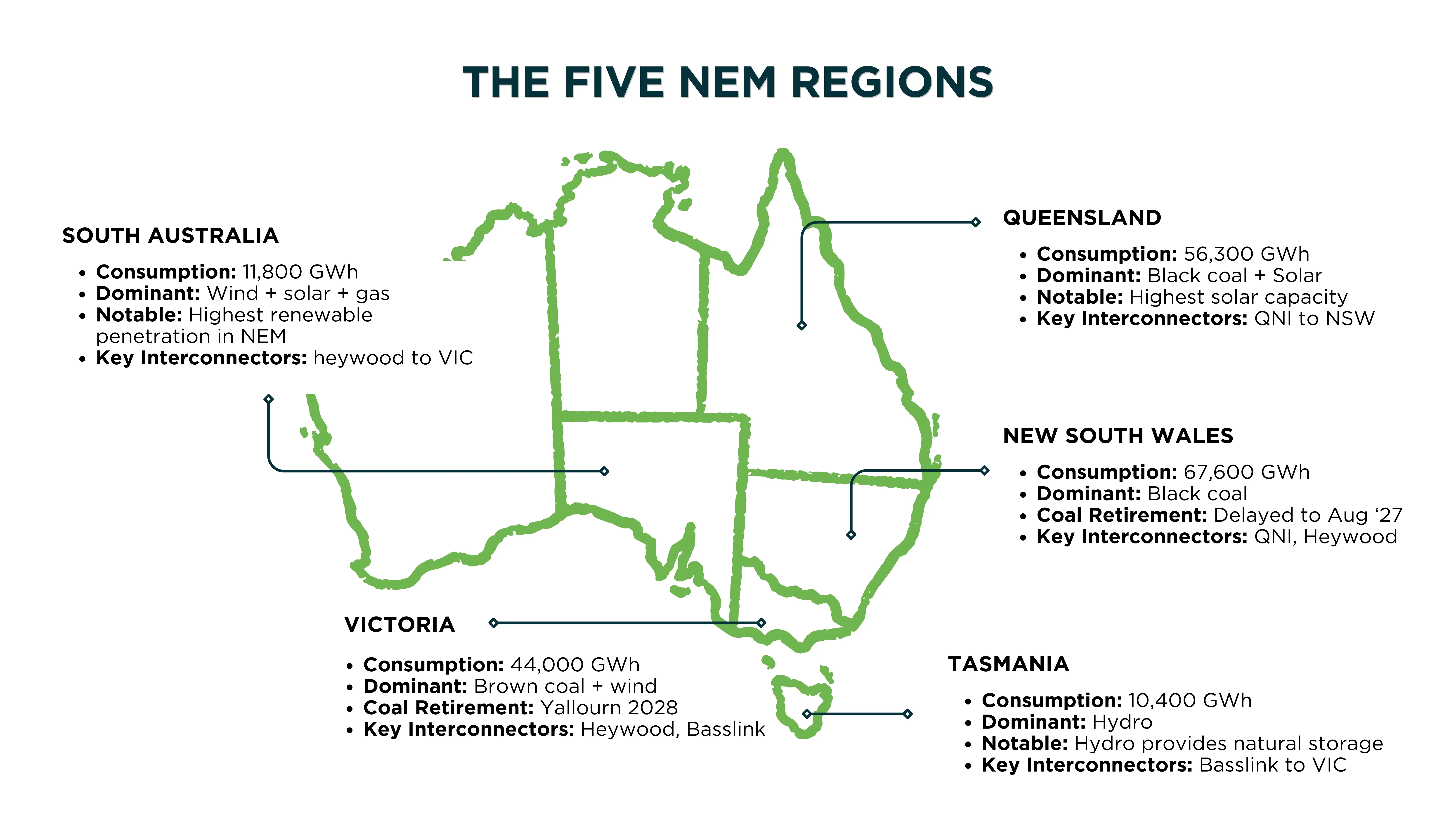
Interconnectors allow electricity to flow from low-price regions to higher-price regions, smoothing out supply imbalances. However, when these interconnectors reach their capacity, price differences between regions can widen, and more expensive local generation may need to be dispatched. Key NEM interconnectors include:
- QNI (Queensland–New South Wales Interconnector): Allows solar-rich Queensland generation to flow south during high-demand periods, and Queensland to import from NSW during supply shortfalls
- Heywood and Murraylink (SA–VIC): Critical for South Australia's security given its high renewable penetration
- Basslink (TAS–VIC): Connects Tasmania's hydro-dominant system to the mainland
- Project EnergyConnect (SA–NSW): A major new interconnector commissioned in stages from 2024–2025, significantly increasing capacity between South Australia and New South Wales
Navigate the NEM With Confidence. Partner With ElectraGlobe
The National Electricity Market is not a background constraint for renewable energy development in Australia. It is the central environment in which every project must operate.
ElectraGlobe is Australia's specialist renewable energy engineering consultancy, with 2.5+ GW designed across utility-scale solar, BESS, and hybrid energy projects. Our team works at the intersection of engineering and the NEM.
- Navigating GPS compliance and AEMO registration
- Advising on grid connection strategy and curtailment risk
- Modelling power system interactions
- Providing the technical expertise that developers need to connect confidently
If you are developing a renewable energy project in Australia and want to ensure your technical and market strategy is aligned with how the NEM actually works, our team has the depth and experience to guide you. Contact ElectraGlobe to discuss your project.
FAQ
What states are part of the National Electricity Market in Australia?
The NEM interconnects Queensland, New South Wales (including the Australian Capital Territory), Victoria, South Australia, and Tasmania. Each region operates as a separate price zone within the NEM, with interconnectors allowing electricity to flow between regions when price differences make cross-border trade beneficial.
How is the spot price determined in the National Electricity Market?
The NEM Dispatch Engine (NEMDE) determines the combination of generation and demand response required to meet demand in each five-minute interval. It considers generator bids, demand, and transmission constraints across the five interconnected NEM regions.
How does renewable energy connect to and participate in the NEM?
Renewable energy generators above 5 MW connect to the NEM through a formal process governed by AEMO and the relevant Network Service Provider (NSP). The connection process involves a Generator Performance Standards (GPS) application, a Connection Agreement with the NSP, and registration in AEMO's Market Management System (MMS).