
When a developer commissions an EPC contractor to build a utility-scale solar farm or battery energy storage system, they face a fundamental problem.
- The EPC is incentivised to deliver a project that satisfies the contract.
- The developer needs a project that performs reliably for 25 to 35 years, complies with every regulatory obligation, and delivers the financial returns that underpin their financing arrangements.
Bridging that gap is the role of the Owner's Engineer.
Owner's Engineering in renewable energy has become one of the most important professional services in the sector. As projects become larger, more technically complex, and more capital intensive, the need for independent technical oversight has grown from a "nice to have" into a non-negotiable requirement for sophisticated developers, lenders, and asset owners.
What Is an Owner’s Engineer?
An Owner's Engineer is an independent technical advisor appointed by the asset owner or developer to represent their interests throughout the lifecycle of a renewable energy project.
The key word is independent.
Owner’s Engineering is a professional service that represents the project owner's interests throughout the lifecycle of a renewable energy project.
Unlike Engineering, Procurement, and Construction (EPC) contractors, Owner's Engineers act as the technical authority for the owner. They verify that engineering designs, procurement strategies, and construction activities meet project objectives, regulatory obligations, and contractual requirements.
Why Does Owner’s Engineering Matter on Renewable Energy Projects?
Renewable energy projects are not straightforward construction exercises. Grid constraints, evolving planning regimes, tighter construction programmes and increasing merchant exposure all place greater pressure on developers, utilities and Independent Power Producers (IPPs) to deliver assets that perform exactly as expected.
The consequences of poor technical oversight compound over decades. A solar farm with underperforming inverters doesn't just have a bad first year. It underperforms for 25 years.
This is particularly important for projects that involve large capital investment, multiple contractors, or utility interconnection. For solar farms and battery energy storage systems (BESS), technical assurance ensures reliable operation and compliance with performance guarantees over the asset's lifespan.
The Owner's Engineer is the mechanism by which technical risk is identified early, rather than late, when it is expensive.
When Should You Engage an Owner’s Engineer?
The earlier an Owner's Engineer is engaged, the more value they deliver. Early engagement reduces design errors, cost overruns, and compliance risks.
Many of the most significant risks in a renewable energy project are locked in during the development phase. Decisions around site layout, technology selection, yield assessment and grid strategy all have long-term implications for performance and bankability.
Engaging an Owner's Engineer only at construction means that technology selection, EPC contract terms, equipment specifications, and grid connection strategy have already been locked in. The Owner's Engineer can still add value at construction, but the leverage is significantly reduced compared to early-phase engagement.
What Does an Owner’s Engineer Do?
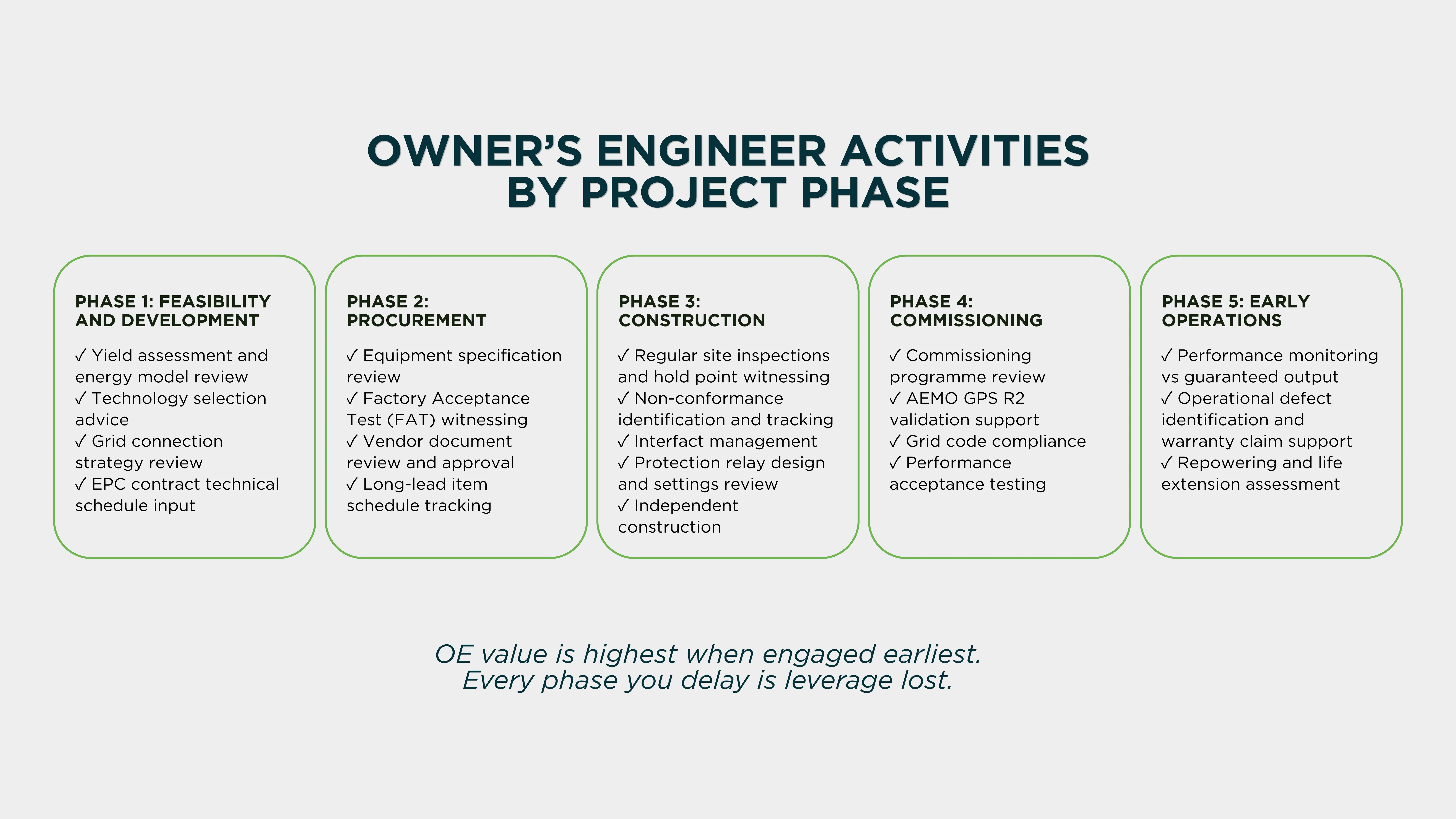
Here’s a phase-by-phase breakdown of an Owner’s Engineer’s responsibilities.
Development and Feasibility Phase
At the development stage, the Owner's Engineer provides the independent technical scrutiny that turns a development concept into a bankable project. Key activities include:
- Yield Assessment and Energy Modelling Review. Reviewing the P50 and P90 energy yield assessments produced by the developer's solar resource consultants
✓ Checking the assumptions
✓ Validating the methodology
✓ Identifying any optimism bias
- Technology Selection and Equipment Review. Providing independent advice on PV module, inverter, tracker, and BESS technology selection, assessing cost and:
✓ Long-term performance
✓ Warranty terms
✓ Manufacturer financial strength
✓ Grid connection requirements’ compatibility
- Grid Connection Technical Review. Reviewing the preliminary grid connection strategy, connection point selection, and GPS compliance approach.
- EPC Contract Technical Input. Reviewing EPC contract technical schedules, performance guarantees, commissioning requirements, and defects liability provisions.
Procurement Phase
During procurement, the Owner's Engineer shifts focus to equipment and contractor selection.
- Technical Specification Review. Reviewing the EPC contractor's equipment specifications to confirm they meet the design intent and the requirements of the grid connection agreement, planning approvals, and lender technical requirements.
- Factory Acceptance Test (FAT) Witnessing. Attending and witnessing FATs for critical equipment before it leaves the factory.
- Vendor Document Review. Reviewing vendor data sheets, installation manuals, and commissioning procedures for compliance with project specifications.
Construction Phase
Construction is where the Owner's Engineer becomes the "eyes and ears" on the ground.
- Site Inspections and Hold Point Witnessing. Conducting regular site inspections to verify that construction is proceeding in accordance with the Issued for Construction documentation and witnessing defined quality hold points.
- Non-Conformance Management. Identifying and formally recording non-conformances and tracking their resolution through the contractor’s corrective action process.
- Interface Management. Interface management ensures coordination between PV arrays, inverters, BESS, substations, SCADA, and grid interconnection systems to prevent operational conflicts.
- Protection System Review. The OE ensures protection relay mis-settings are avoided by reviewing:
✓ Relay settings
✓ Coordination studies
✓ Fault current calculations
✓ Protection philosophies
- Progress and Quality Reporting. Providing the developer with independent, regular written reports on construction progress, quality performance, outstanding non-conformances, and risks to schedule and cost.
Commissioning Phase
The OE witnesses key commissioning tests, including inverter performance, battery charging/discharging, protection relay settings, and grid compliance testing. For projects connecting to the NEM, the commissioning phase includes AEMO's GPS R2 validation, which the OE provides independent technical oversight of.
The Owner’s Engineer confirms that the project will operate reliably within the NEM’s technical requirements by reviewing:
✓ Grid-code compliance testing
✓ Ride-through capability
✓ Harmonic distortion
✓ Dynamic response under system disturbances
- Performance Acceptance Testing. At the end of commissioning, the Owner’s Engineer verifies the project’s performance against the EPC contract’s guaranteed output figures.
What Is the Difference Between Owner’s Engineering and Independent Engineering?
These two roles are frequently confused — and understanding the distinction matters.
As the renewable energy industry continues to mature and expand, the roles of Independent Engineers (IEs) and Owner's Engineers (OEs) are becoming increasingly distinct.
Independent Engineering remains a cornerstone for project finance. The primary value of IEs is to provide third-party assessments that validate whether a project is technically sound, compliant with relevant standards, and financially viable from a lender's perspective.
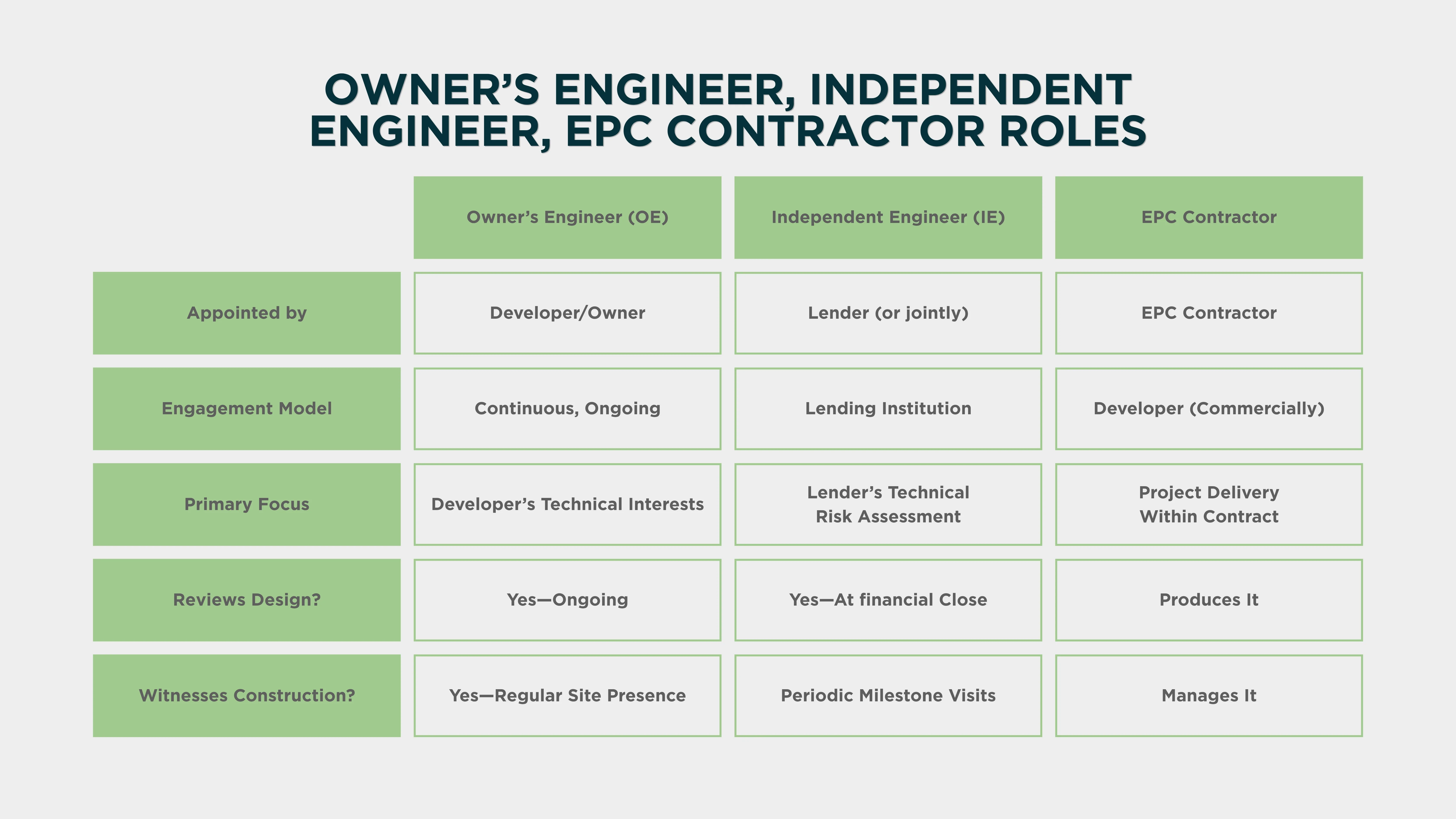
The key distinction is who the client is and what the purpose is:
- Owner’s Engineer
- Appointed by and accountable to the project developer or owner.
- Provides continuous, ongoing technical oversight throughout the project.
- Projects the developer’s technical interests in all interactions with other parties.
- Independent Engineer
- Appointed by the lender or jointly by the developer and lender.
- Provides periodic, milestone-driven technical assessments to confirm the project is technically sound enough for the lender to advance funds.
Who Needs Owner’s Engineering Services?
Owner's Engineering is valuable across a wide range of project types and client profiles:
- Developers Without In-House Technical Teams. The Owner's Engineer provides the technical expertise the developer needs to manage EPC contractors credibly and protect their investment.
- Developers Entering New Technology Types. A developer who is developing their first BESS needs Owner's Engineering support to navigate the additional technical complexity of the battery storage process.
- Financiers and Equity Investors. Lenders and equity investors increasingly require an Owner's Engineer to be in place as a condition of financial close.
- Asset Owners Managing Long-Term Performance. For operational assets entering their fifth year, an Owner's Engineer provides the independent technical assessment contract compliance that asset managers need to make informed investment decisions.
Owner's Engineering is valuable for developers, investors, and asset managers seeking certainty in renewable energy project delivery. The OE team protects the owner's interests through technical due diligence, site inspections, and interface management.
Owner’s Engineering for Solar and BESS Projects in Australia
ElectraGlobe provides specialised Owner's Engineering services for solar PV and BESS projects across Australia. Our engineers bring multidisciplinary expertise, detailed regulatory knowledge, and extensive field experience to support renewable energy engineering.
Whether you are entering the development phase of your first solar farm and want early-stage technical assurance, or you are heading into construction on a hybrid solar-plus-BESS project and need independent technical oversight through commissioning, ElectraGlobe has the experience, regulatory knowledge, and technical depth to protect your investment.
Contact ElectraGlobe to discuss Owner's Engineering support for your next renewable project.
FAQ
What is the difference between an Owner’s Engineer and an EPC contractor in renewable energy?
An EPC (Engineering, Procurement, and Construction) contractor is the party responsible for designing and building the project. An Owner's Engineer is an independent technical representative of the project developer.
At what stage of a renewable energy project should an Owner’s Engineer be engaged?
The earlier an Owner's Engineer is engaged, the greater the value they deliver. Many of the most significant risks in a renewable energy project are locked in during the development phase. Engaging an Owner's Engineer at the development stage allows the OE to influence technology selection, EPC contract technical schedules, GPS compliance strategy, and yield assessment methodology while those decisions are still open.
Do lenders require an Owner’s Engineer on renewable energy projects?
Often yes. Lenders rely on independent OE validation to assess technical risk before financing large renewable energy projects.