
Planning approval is one of the longest and most complex milestones in solar farm development. It can take as little as 12 months on a well-prepared, low-sensitivity project, and three to five years on projects where the following factors derail the process:
- Environmental constraints
- Community opposition
- Inadequate documentation
Solar farms account for 46% of Australia’s renewable energy project approvals under NSW’s Electricity Infrastructure Roadmap. But behind each of those approvals sits a complex development approval process.
This guide covers every major solar farm development approval pathway in Australia.
What Is the EPBC Act?
Before engaging any state planning authority, every solar farm developer must assess whether a federal referral is required under the Environment Protection and Biodiversity Conservation Act 1999 (EPBC Act).
The EPBC Act protects matters of national environmental significance (MNES):
- Listed threatened species and ecological communities
- Migratory birds
- Ramsar wetlands
- World Heritage areas
- Commonwealth marine areas
If a proposed solar farm is likely to have a significant impact on any of these matters, the project must be referred to the Federal Minister for the Environment. The referral process determines whether the project is a controlled action (requiring assessment which can take 12 to 24 months) or not a controlled action (clearance to proceed).
Many states operate under bilateral agreements with the Commonwealth that allow the state EIS process to satisfy both state and federal assessment requirements simultaneously.
New South Wales: State Significant Development
NSW has the most mature and active solar farm approval framework in Australia. Under the Electricity Infrastructure Roadmap, NSW targets at least 12 GW of new renewable energy generation and 2 GW of long-duration storage by 2030.
The SSD Pathway
Solar farms above approximately 30 MW in NSW are classified as State Significant Development (SSD) and assessed by the NSW Department of Planning, Housing and Infrastructure (DPHI) under the Large-Scale Solar Energy Guideline.
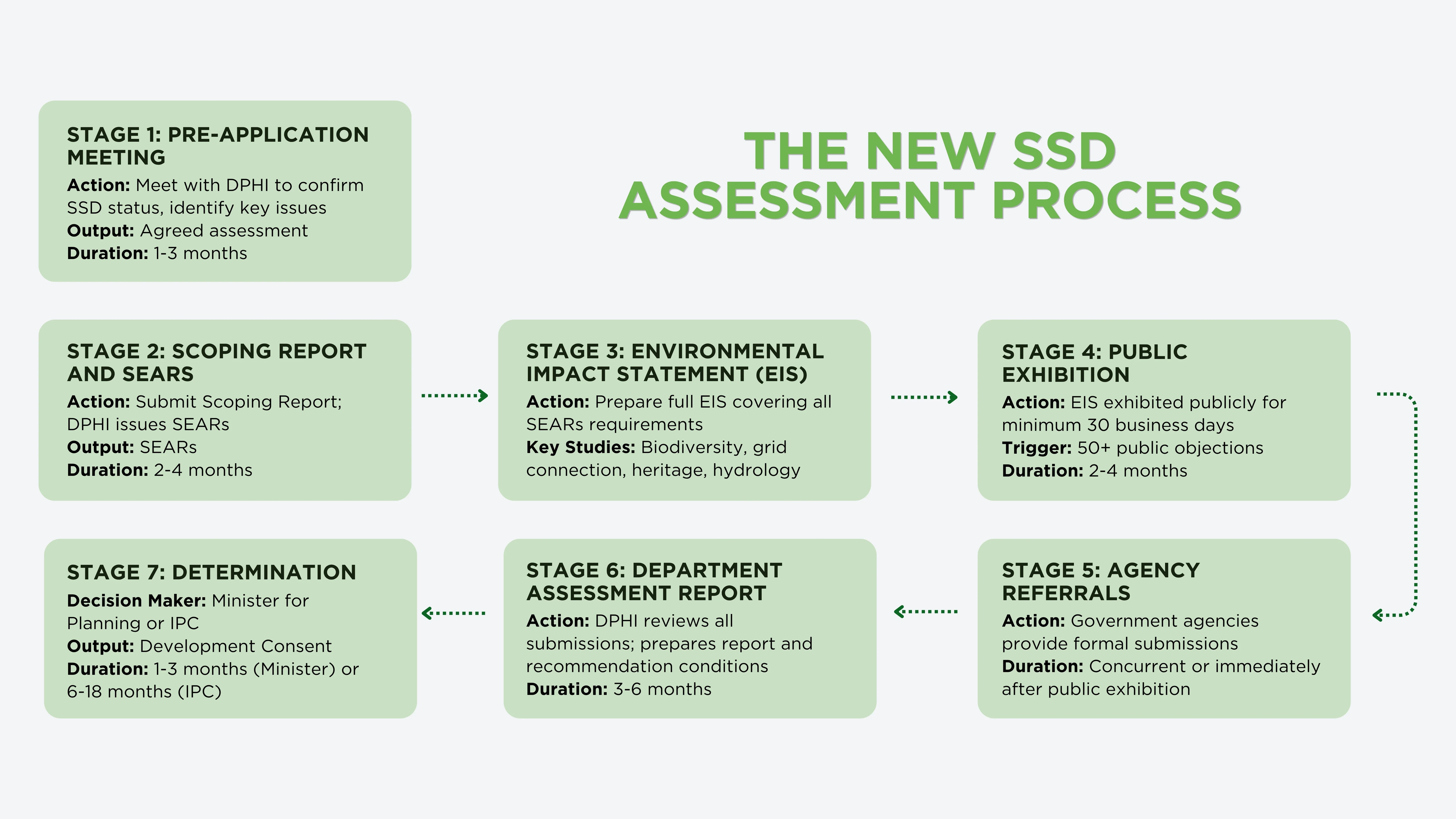
The SSD assessment process involves:
- Pre-Application Meeting (DPHI) — Confirm the assessment pathway, identify key issues, and agree on the scope of the Environmental Impact Statement (EIS).
- Scoping Report — Submitted to DPHI to determine the Secretary's Environmental Assessment Requirements (SEARs), which specify exactly what the EIS must cover.
- Environmental Impact Statement (EIS) — The core assessment document, addressing biodiversity, visual impact, noise, heritage, hydrology, traffic, socioeconomic impacts, and grid connection.
- Public Exhibition — Minimum 30 business days for public submissions on the EIS.
- Agency Referrals — Government agencies (Transport for NSW, Heritage NSW, the biodiversity assessment authority) provide formal submissions.
- Department Assessment Report — DPHI assesses all submissions and prepares a report for the Minister or IPC.
- Determination — Projects where more than 50 public objections are received, or the local council objects, are referred to the Independent Planning Commission (IPC) for determination rather than the Minister.
Benefit Sharing
NSW introduced Benefit Sharing Guidelines alongside the Large-Scale Solar Energy Guideline, requiring solar farm developers to share financial benefits with host communities. This is a consent condition, but failure to engage meaningfully on benefit sharing before lodging the EIS can generate community opposition that triggers IPC referral.
Queensland: The 2025 Community Benefit Reforms
Queensland underwent the most significant solar farm planning reform of any Australian jurisdiction in 2025.
The Planning (Social Impact and Community Benefit) and Other Legislation Amendment Act 2025 commenced on 18 July 2025, introducing sweeping changes to how solar farm development applications are assessed across Queensland.
Impact Assessment for All Solar Farms
All material change of use development applications for a solar farm are now subject to impact assessment under the Planning Regulation 2017. This applies regardless of project size, which include small solar farms that were previously assessed by local government under a code assessment pathway.
Impact assessment in Queensland can often take up to 12 months to complete. It involves public notification, and entitles any third party to make submissions about the development and appeal its approval to the Queensland Planning and Environment Court.
Centralised Assessment Authority
The chief executive of the Department of State Development, Infrastructure and Planning is now the decision maker for all material change of use development applications for large-scale solar farms across Queensland.
Mandatory Social Impact Assessment and Community Benefit Agreement
All material change of use development applications must now be accompanied by:
- A social impact assessment report
- A community benefit agreement
The community benefit system requires proponents to undertake a social impact assessment and enter into community benefit agreements prior to applying for a development approval.
The community benefit agreement is a legally binding document negotiated between the developer and the host community before the DA is lodged. A DA that does not include both the SIA report and the executed community benefit agreement is not properly made.
Pre-Existing Applications
Existing development applications for solar farms above 1 MW that had not been decided at the commencement of these reforms on 18 July 2025 are taken to be not properly made. These applications must be remade to the relevant assessment manager and are subject to the new community benefit system.
For developers with applications already in the Queensland system before July 2025, this means restarting the DA process under the new framework.
Victoria: Environment Effects Act and REZ Processes
Victoria's planning approval framework for large-scale solar farms is assessed under the Environment Effects Act 1978 (EEA). Projects with the potential for significant environmental effects may require an Environment Effects Statement (EES), assessed by the Department of Transport and Planning on behalf of the Minister for Planning.
Large solar projects in Victoria are assessed under the Environment Effects Act, and projects with major impacts may need an Environment Effects Statement.
The EES process is triggered by the Minister for Planning's assessment of whether a project's effects are likely to be significant. It is less prescriptive in its triggers than NSW's threshold-based SSD regime. For projects within Victoria's designated Renewable Energy Zones, the 2025 Victorian Transmission Plan proposes bespoke assessment processes that may streamline approval for projects in priority development areas.
Permit applications for solar farms below the EES threshold in Victoria are generally assessed by the relevant local council under the Planning and Environment Act 1987, applying the State Planning Policy Framework.
South Australia: Planning and Development Code
In South Australia, large-scale solar farm approvals are governed by the Planning and Design Code (PDC) administered under the Planning, Development and Infrastructure Act 2016.
Solar farms in South Australia are typically assessed as Impact Assessed Development by the State Commission Assessment Panel (SCAP). The assessment requires an EIS addressing:
- Amenity impacts
- Visual impact
- Biodiversity
- Hydrology
- Economic effects
South Australia's co-location of solar farms with agistment activities has been increasingly recognised in planning conditions. It is also actively supported by the state government, providing a useful community acceptance argument for agricultural land sites.
Western Australia: Separate Grid, Separate Framework
Western Australia operates under a separate electricity grid and a separate planning framework from the east coast NEM states. Solar farm approvals in WA are governed by:
- Planning and Development Act 2005
- Western Australian Planning Commission (WAPC)
Projects above a certain scale may require a Development Application assessed by the Metropolitan or Regional Development Assessment Panel (DAP), depending on the location.
WA does not have the same Renewable Energy Zone framework as the eastern states, and community benefit sharing requirements are less formalised.
What Does Every Solar Farm DA Include?
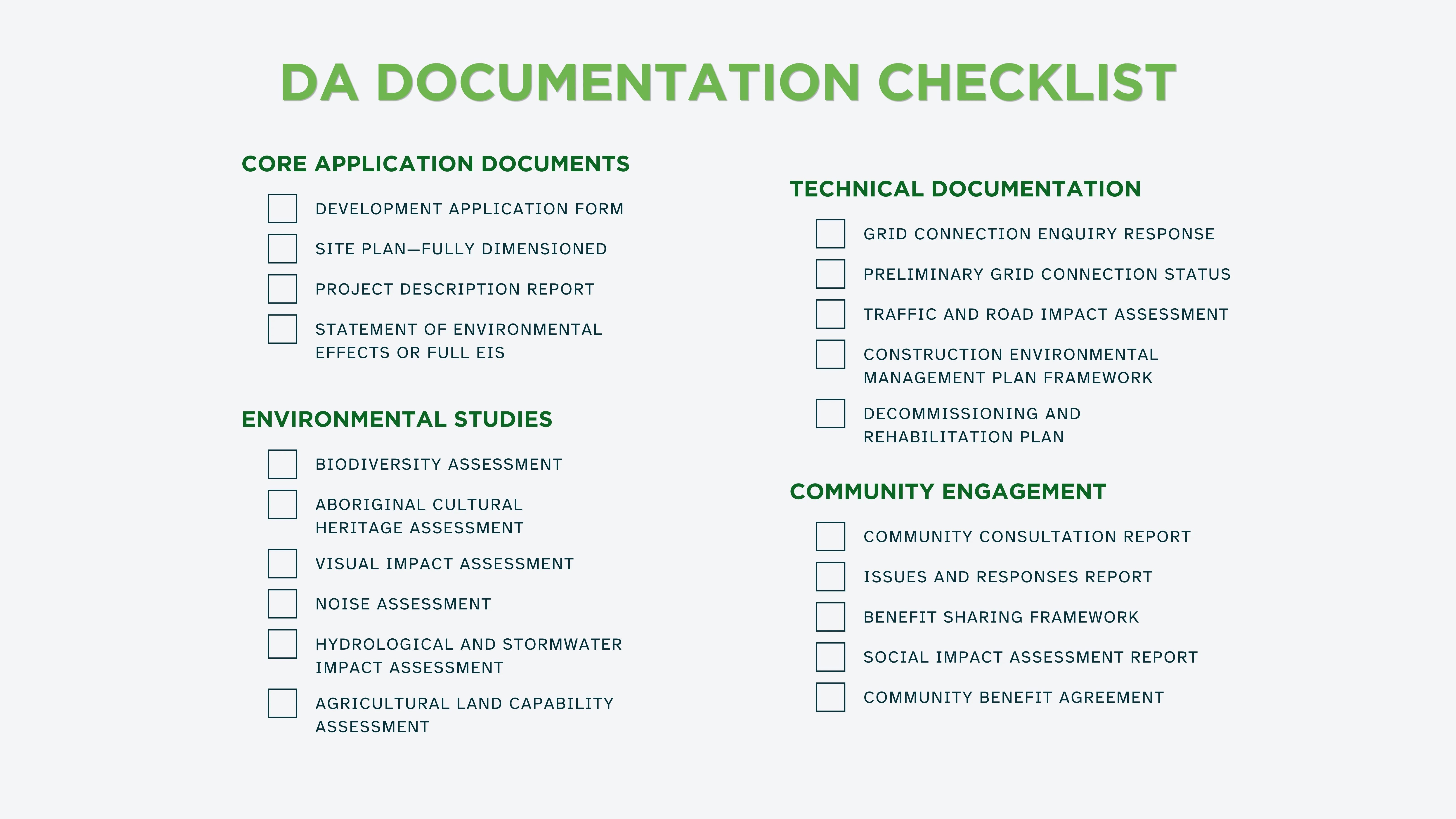
Regardless of jurisdiction, a well-prepared solar farm development application must address the following core elements:
- Site Description and Project Layout. Fully dimensioned site plan showing panel arrays, single-axis tracker configuration, access roads, substation, fencing, exclusion buffers, and proposed screening vegetation.
- Environmental Impact Assessment. Covering biodiversity (flora and fauna surveys, vegetation mapping, threatened species assessments), heritage (Aboriginal cultural heritage and historical), hydrology and drainage, soil and agricultural land capability, noise, and visual impact.
- Grid Connection Documentation. Confirmation of the proposed connection point, connection enquiry response from the NSP, and preliminary indication of the AEMO grid connection process status.
- Community Consultation Record. Documentation of pre-lodgement engagement with landowners, neighbours, local council, and community groups.
- Traffic and Infrastructure Impact Assessment. Assessment of construction traffic routes, road upgrade requirements, and dust and noise management during construction.
- Decommissioning Plan. A conceptual plan for removing solar farm infrastructure and rehabilitating the site at the end of the project's operational life. This is increasingly required as a DA condition in NSW and QLD.
Navigate Solar Farm Approvals with ElectraGlobe
Solar farm development approval in Australia is not a single process. It is a jurisdictional, environmental, community, and technical challenge that differs materially between states. That changed fundamentally in Queensland on 18 July 2025.
ElectraGlobe is Australia's specialist renewable engineering consultancy. Our team brings deep expertise in the technical engineering inputs that planning approval processes require:
- Preliminary grid connection assessments
- Power system study outputs for EIS documentation
- Engineering design layouts for site plans
- Electrical engineering documentation
Engaging experienced engineering consultants early is the most effective way to ensure that the technical components of your solar farm development application are robust, current, and consistent with the grid connection process running in parallel.
Contact ElectraGlobe to discuss the engineering inputs your next solar farm DA needs.
FAQ
How long does solar farm development approval take in Australia?
Timeline varies significantly by state and project complexity. In NSW, the SSD pathway for a straightforward solar farm project takes 18 to 36 months. In Queensland, the impact assessment pathway can take up to 12 months. In Victoria, EES processes are similarly lengthy for projects where significant environmental effects are identified.
Does every solar farm in Australia need an Environmental Impact Statement?
Not every solar farm required an EIS. In NSW, solar farms above 30 MW require an EIS as part of the State Significant Development assessment process. In Queensland, all solar farm development applications are now subject to impact assessment. In Victoria, an Environment Effects Statement is required when the Minister for Planning determines that a project’s effects are likely to be significant.
What did Queensland's July 2025 solar farm planning reforms change?
Queensland's Planning (Social Impact and Community Benefit) and Other Legislation Amendment Act 2025 commenced on 18 July 2025 and introduced three major changes for solar farm developers: (1) All solar farm development applications are now subject to impact assessment, (2) The state government replaces local government as the decision maker for large-scale solar farm applications, and (3) All large-scale solar farm applications must be accompanied by a Social Impact Assessment report and an executed Community Benefit Agreement before they can be properly lodged.