
In utility-scale projects, site selection is the decision that shapes everything else. Choose the right site and a solar project moves efficiently. Choose the wrong site and no amount of good engineering or government support will fix the problems that flow from that initial decision.
Solar farm site selection in Australia has become increasingly competitive and increasingly complex. As of 2024, Australia has over 6.2 GW of operational utility-scale solar and more than 15 GW in the pipeline. With over 53 GW progressing through AEMO’s connection queue as of mid-2025, sites with the best planning viability are being developed faster.
This guide covers every criterion that determines whether a site is genuinely viable for a utility-scale solar project in Australia.
What Site Selection Criteria Determine Project Outcomes?
Selecting the right solar farm site requires careful evaluation of various factors. A poor site selection compounds at every subsequent stage.
Ⓧ A site with inadequate solar resource underperforms its financial model.
Ⓧ A site without available grid capacity faces a connection timeline measured in years.
Ⓧ A site with significant environmental constraints faces an approval process that adds years and millions in cost.
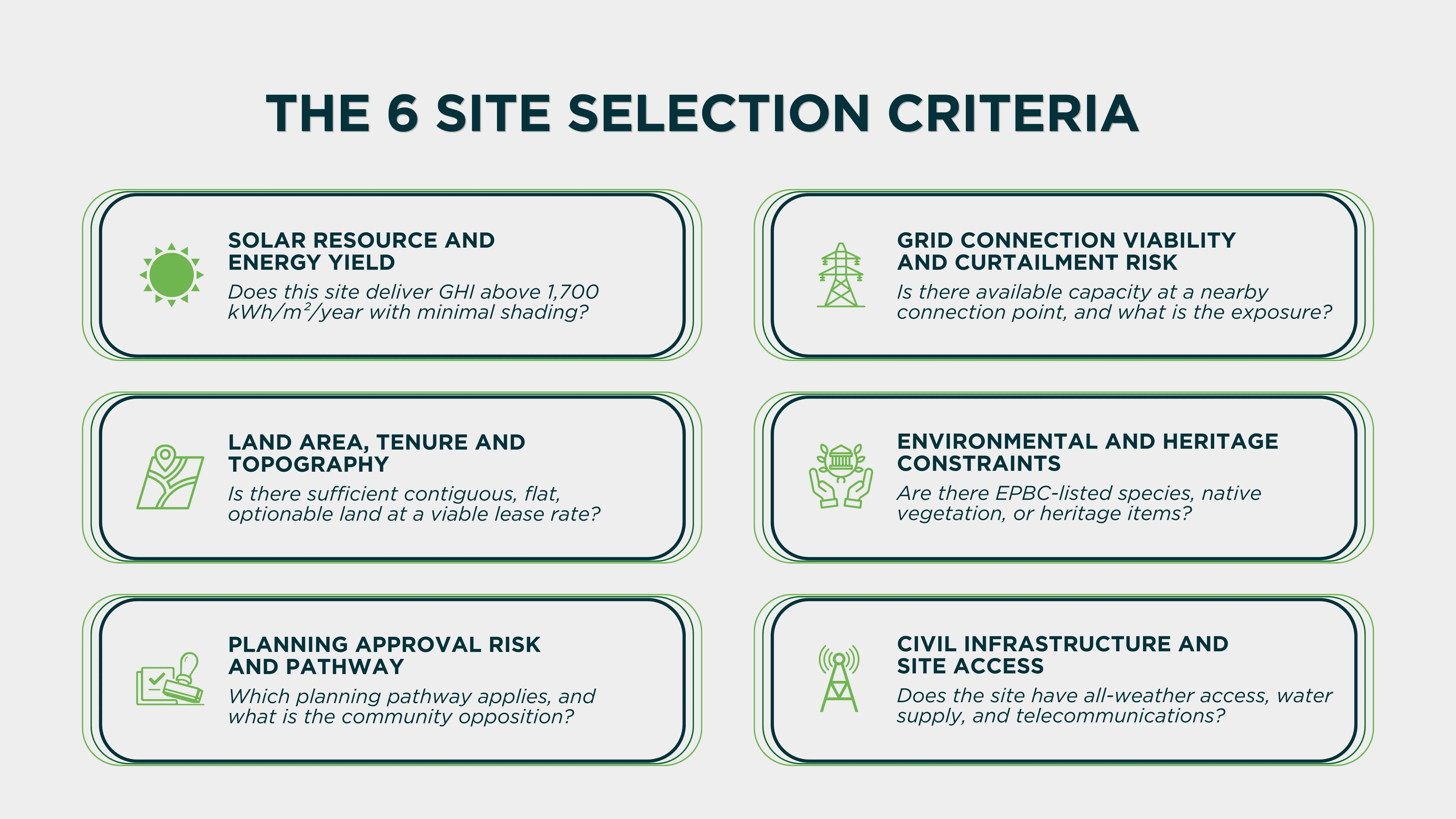
Getting site selection right isn’t about finding a site that scores well on one criterion. It’s about identifying sites where the following align simultaneously:
- Solar resource
- Grid viability
- Land tenure
- Planning risk
Criterion 1: Solar Resource and Energy Yield
The foundation of any solar farm business case is the quality of the solar resource at the site. Australia has among the highest solar irradiance levels in the world, but not all sites are equal.
Key factors include:
- Quality of solar resources available
- Topography
- Environmental impact considerations
- Proximity to existing electricity distribution network infrastructure
The primary irradiance metric for solar farm site assessment is Global Horizontal Irradiance (GHI). This is the total solar radiation received on a horizontal surface per unit area.
For single-axis tracking systems (which now dominate utility-scale solar in Australia), Direct Normal Irradiance (DNI) is also relevant because tracker systems can capture more direct beam radiation than fixed-tilt arrays.
A site with 5–10% higher irradiance than an adjacent site can meaningfully change project returns over a 25-year operational life.
Energy yield modelling must be performed at each candidate site before land is secured. Shading analysis is equally important. Developers must also evaluate how terrain features may cast shadows across rows of solar panels, which can reduce panel efficiency.
Even a site with excellent GHI data can underperform if localised terrain shadows are not identified and addressed in the layout design.
Criterion 2: Grid Connection Viability and Curtailment Risk
Grid connection is the make-or-break criterion for solar farm site selection in Australia. Even the most promising solar farm site may not be viable without reliable grid connection.
In Australia's current market, connection viability is the criterion that eliminates the most candidate sites. The key grid connection questions at the site selection stage are:
- Is there available capacity at nearby connection points? AEMO’s Connection Scorecard, the Integrated System Plan (ISP), and NSP network development plans identify connection points with available capacity and those that are already constrained.
- What is the realistic curtailment exposure? Curtailment is the forced reduction in a generator’s output when the network reaches its capacity. A high-curtailment site with great irradiance can still underperform a lower-irradiance site with minimal curtailment.
- Does the site fall within a Renewable Energy Zone? REZs are areas identified as the best places to host wind, solar and battery projects.
Criterion 3: Land Area, Tenure, and Topography
Land Area Requirements
Utility-scale solar farms typically require five to seven acres per megawatt (MW) of capacity. Developers must find large, contiguous parcels that support these criteria.
Irregular shaped parcels, fragmented ownership, or land with significant exclusion zones reduce the developable area and can make a nominally large parcel effectively too small for the intended project capacity.
Land Tenure
Securing a Lease Option Agreement on the preferred site is the first critical land action, and it must happen before significant development expenditure is committed.
Key lease considerations include:
- Term length
- Annual rent
- Landholders’ right to choose whether to host a project
- Financial payments
Topography
Flat or gently sloping land is ideal, as it minimises the cost of land preparation and installation. Hilly or rocky areas may require additional site preparation and could impact the overall space.
For single-axis tracker systems, a maximum grade of approximately 10–15% in the tracker row direction and 5–8% cross-slope is generally workable. Slopes exceeding these thresholds require either fixed-tilt design, significant earthworks, or terrain-following tracker configurations.
Criterion 4: Environmental and Heritage Constraints
Environmental and heritage constraints are the most common cause of planning approval delays and rejections on Australian solar farm projects.
A site with threatened ecological communities, significant native vegetation, nationally protected habitat, or cultural heritage significance will trigger additional assessment requirements.
The key environmental screening questions at the site selection stage are:
- Are there threatened species or ecological communities present? The EPBC Act protects listed threatened species, migratory birds, and ecological communities.
- Is there significant native vegetation? Clearing of native vegetation on solar farm sites is regulated under state legislation in all jurisdictions. Sites with intact native vegetation face higher clearing offset costs and longer approval timelines.
- Are there Aboriginal or post-contact heritage items present? Aboriginal cultural heritage assessments are mandatory in all states for projects disturbing ground. Sites with high heritage sensitivity face additional requirements to avoid heritage items.
- Are there water management constraints? Environmental concerns such as water drainage, local diversity, and land conservation policies will influence the suitability of land for solar farming.
Conducting a preliminary environmental desktop assessment before committing to a site option allows developers to screen for constraints before capital is deployed.
Criterion 5: Planning Approval Risk and Regulatory Pathway
Understanding the planning approval pathway and the regulatory risk it carries is a non-negotiable part of solar farm site selection in Australia. The planning approval pathway differs significantly by state and project scale.
Key planning risk factors at the site selection stage include:
- Community Sensitivity. Projects in areas with active opposition groups, a history of contested developments, or high-profile agricultural land use conflicts carry higher planning approval risks.
- Visual Impact. Solar farms in areas with high landscape sensitivity face more complex visual impact assessments and are more likely to attract community objection.
- Agricultural Land Classification. Developing on prime agricultural land is subject to increasing scrutiny in NSW and other states.
- Proximity to Existing Infrastructure. Sites within or adjacent to existing industrial, mining, or infrastructure corridors benefit from lower planning sensitivity and often have existing road access that reduces civil construction costs.
Criterion 6: Civil Infrastructure and Site Access
Civil infrastructure constraints have a direct and measurable impact on project capital cost and on project viability. The key infrastructure factors to assess at site selection are:
- Road Access. Solar farm construction requires the delivery of heavy equipment to the site. Sites requiring significant road upgrades or lacking all-weather access roads face higher construction costs and logistical complexity.
- Water Supply. Construction activities require water for dust suppression, concrete, and camp facilities. Sites without accessible water supply require either bore development or water carting.
- Telecommunications. SCADA systems, AEMO market management connectivity, and site monitoring all require reliable telecommunications. Remote sites in areas with poor mobile coverage may require satellite communications.
- Proximity to Existing Electrical Infrastructure. The proximity of the site to existing substations and transmission lines affects the cost of the connection works.
The assessment of these criteria simultaneously is what separates experienced solar developers like ElectraGlobe.
Partner with Experts Who Know Australia’s Solar Landscape
Site selection for a utility-scale solar project requires:
- Current knowledge of the NEM connection queue
- State planning frameworks
- REZ program status
- Environmental databases
ElectraGlobe is Australia's specialist renewable energy engineering consultancy, with 2.5+ GW designed across utility-scale solar, BESS, and hybrid energy projects. Our team brings deep expertise across every site selection criterion: solar resource assessment, grid connection pre-feasibility, GPS modelling, planning pathway analysis, and the environmental and civil engineering due diligence that determines whether a site can be developed.
Contact ElectraGlobe to discuss site selection support for your next utility-scale solar project.
FAQ
How much land does a utility-scale solar farm need in Australia?
Utility-scale solar farms typically require five to seven acres (approximately 2 to 2.8 hectares) per megawatt of capacity. The actual land area required depends on the panel configuration, the proportion of the site excluded by environmental constraints or heritage items, and the site's topography.
Is it better to develop inside or outside a Renewable Energy Zone in Australia?
Developing inside a REZ offers distinct advantages but is not mandatory for project viability. For projects outside REZs, the critical factor is identifying connection points with sufficient network capacity and manageable curtailment exposure.
What environmental assessments are required for solar farm site selection in Australia?
The environmental assessments required depend on the project size, location, and the specific ecological, heritage, and hydrological characteristics of the site. At the site selection stage, a preliminary environmental desktop assessment is the standard first step.