
Getting a solar farm or battery energy storage system (BESS) connected to Australia's National Electricity Market (NEM) is not a simple process.
At the centre of that complexity sit the AEMO Generator Performance Standards. This is the technical framework that every new generating unit must satisfy before it can connect to the grid, operate commercially, and begin generating revenue.
For developers who are new to the NEM connection process, GPS can feel like a black box. For those who have been through it before, it's a known critical path item that can make or break a project timeline.
This guide cuts through the complexity. It explains what AEMO Generator Performance Standards are, what technical requirements they cover, and what developers need to do to navigate GPS efficiently.
What Are AEMO Generator Performance Standards?
The Generator Performance Standards, or GPS, refers to the agreed technical performance standards for a generator. They define the technical behaviour a generating system must demonstrate to connect safely and operate reliably within the NEM power system.
The AEMC established Technical Requirements in the National Electricity Rules to ensure:
- The adequate performance of generating systems
- Efficient design principles by utilising standards where possible
AEMO requires proponents to show compliance with these requirements, specifically NER S5.2.5, establishing access standards collectively referred to as GPS.
GPS applies to all generating systems connecting to the NEM. For inverter-based resources, GPS compliance is particularly demanding because these interact with the grid differently from the synchronous generators that historically provided stability.
GPS is not a single test. It is a framework of multiple technical access standards, each governing a different aspect of how the generating system must perform.
What Are the Three Levels of Access Standards?
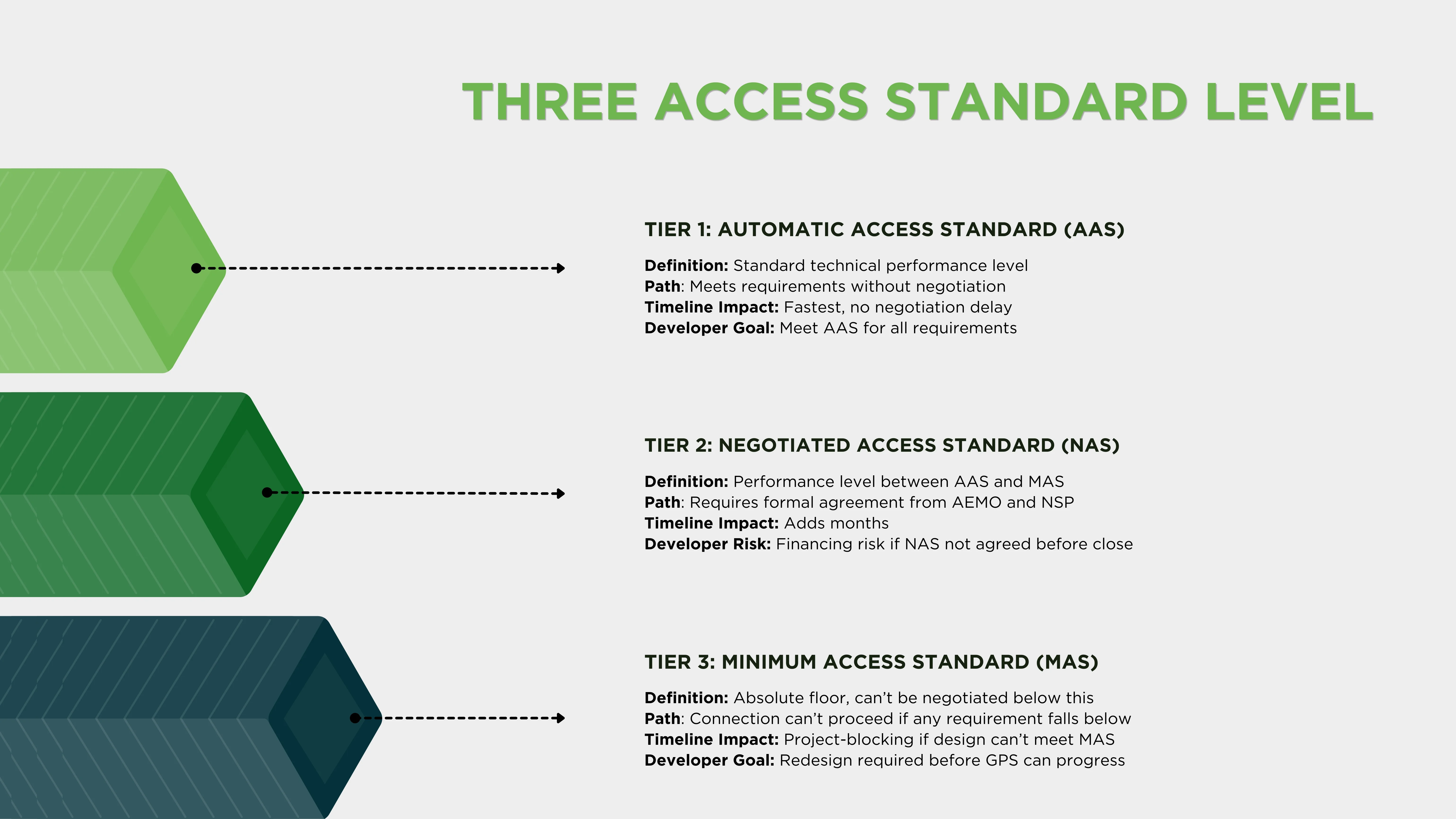
Within the GPS framework, every technical requirement has three possible levels of compliance. Understanding them is essential for developers and their engineering teams.
Automatic Access Standard (AA)
The standard level of technical performance. A generator that meets the AAS for all requirements connects under standard terms without negotiation. This is the fastest and least complex path to GPS approval.
Negotiated Access Standard (NAS)
A negotiated access standard is a level of performance in between the automatic access standard and the minimum access standard applicable to a technical requirement.
Where a generator cannot meet the AAS for a particular requirement, a NAS can be proposed. Both AEMO and the connecting NSP must agree. Negotiation takes time and adds risk.
Minimum Access Standard (MAS)
The absolute floor below which no connection can be approved. If a proposed standard falls below the MAS for any requirement, the connection cannot proceed.
The practical implication for developers is clear: design your system to meet the AAS wherever possible. Proposing negotiated standards for multiple requirements extends the connection timeline significantly and introduces regulatory uncertainty that can affect project financing.
What Are the Key Technical Requirements Under NER S5.2.5?
The GPS technical requirements under NER Schedule 5.2.5 cover the full range of a generating system's interaction with the power system.
Here are the most critical areas developers need to understand:
Active Power Control (S5.2.5.4)
Active power control requires the generating system to regulate its output smoothly and avoid uncontrolled power swings. Reactive power capability must be maintained and active power not reduced other than for transient response, losses, energy source availability and any other factors the NSP and AEMO consider reasonable, for voltages in the range 90 to 110% of nominal voltage.
From early 2017, AEMO and NSPs identified an emerging trend. Plant was being specified in a manner that resulted in issues with reactive control and active power regulation, resulting in non-compliance with the minimum technical requirements in clauses S5.2.5.1 and S5.2.5.4. This remains one of the most common sources of GPS submission issues.
Fault Ride-Through (S5.2.5.5)
The generating system must remain connected and operational through defined voltage disturbances, rather than tripping offline when the grid experiences a fault.
The achievement of 95% of the pre-fault active power output within 100ms of fault clearance is a key AAS requirement. The August 2025 reforms introduced a new term "Adequately Controlled," replacing the previous "Adequately Damped" requirement.
This new definition is considered more subjective than its predecessor, and its practical interpretation is still evolving in AEMO's assessment practice.
Frequency Control (S5.2.5.11)
Frequency control capability is mandatory from 5 October 2018, and applicants must provide evidence of frequency control capabilities for assessment.
These technical requirements consider the performance of the frequency control system and the ability of the generating system to increase or decrease its active power output in response to a power system frequency event.
For solar farms, this means the inverter control system must support Primary Frequency Response, responding automatically to deviations from the 50 Hz nominal frequency. For BESS, frequency response capability is a primary commercial asset, directly linked to FCAS market participation.
Voltage Control (S5.2.5.13)
The generating system must maintain stable voltage at the connection point across its operating range. The voltage control strategy, provided in support of the proposed access standard, must include reactive power capability curves. It should also describe any switching and control logic steps required to achieve the required capabilities.
Settling time for voltage control responses must be under 7.5 seconds.
Protection (S5.2.5.8)
Clause S5.2.5.10 does not circumvent the requirement to ride through disturbances. Protection systems must be designed to disconnect the generating system only when required for safety, not as a workaround for insufficient fault ride-through capability.
Proposals to trip the plant as a result of power system weakness and inadequate plant design to offset its dependence on the provision of system strength from external sources may not be approved by AEMO.
What Is the R0/R1/R2 Compliance Process?
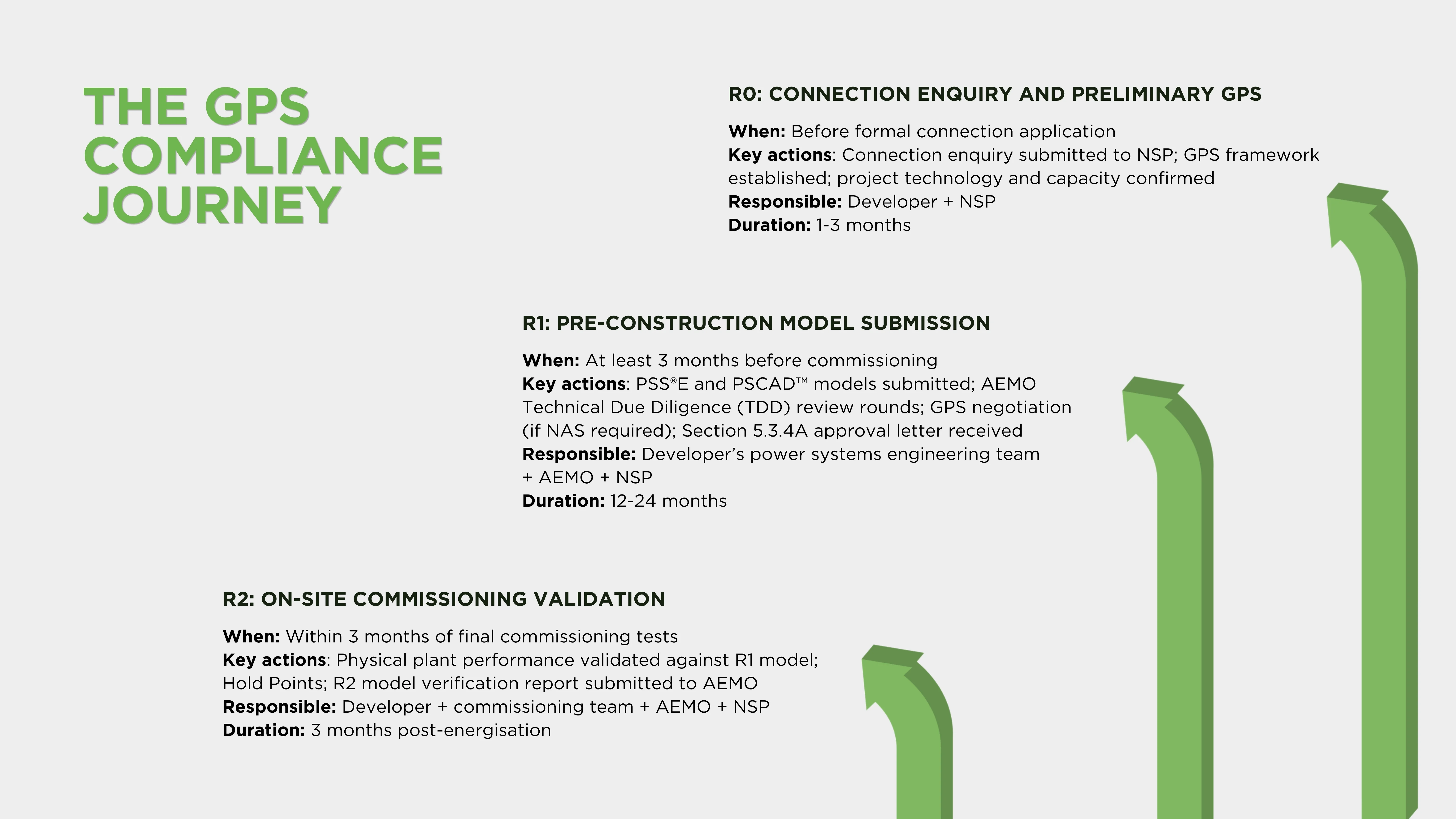
GPS compliance is not a one-time submission. It follows a staged process that begins before construction and continues through commissioning.
R0: Connection Enquiry and Preliminary GPS
The R0 stage covers the connection enquiry and preliminary GPS proposal. The developer submits high-level information about the generating system and receives indicative connection conditions from the NSP. The GPS framework that will apply to the project is established here.
R1: Pre-Construction Model Submission and GPS Approval
R1 is the core GPS approval stage and the most technically intensive. The R1 model package must be submitted at least three months before commissioning as specified under NER S5.2.4.
Connection Applicants are required to submit a model package that represents the structure and performance of their generating plant to AEMO and the connecting NSP. The model package and documentation must conform to:
- Power System Model Guidelines v3.0
- Power System Design and Setting Data Sheets 2025
These are required by NER S5.2.4, S5.2.5, and S5.5.6. This means submitting validated power system models in both PSS®E (for steady-state and dynamic studies) and PSCAD™ (for electromagnetic transient studies).
The models must accurately represent the inverters, transformers, power plant controller, protection systems, and any BESS charging and discharging behaviour.
The R0/R1/R2 compliance process covers GPS proposal through validation and confirmation during commissioning. Projects that submit incomplete or inaccurate models face multiple rounds of AEMO Technical Due Diligence (TDD) revision, each adding months to the timeline.
A new R1 Capability Assessment process introduced by the Enhancing Investment Certainty in the R1 Process Rule 2024 provides applicants with a formal capability assessment at the R1 stage. This gives earlier certainty about whether the proposed GPS will be accepted before full modelling is invested.
AEMO is required to expand the Registration Information Resource and Guidelines (RIRG) to cover the new requirements for the capability assessment set out in NER 5.3.7A.
R2: On-Site Validation and Commissioning
The R2 model package is the validated data that must be submitted along with an R2 model verification report. This should be done within three months of the final commissioning tests being completed as specified under NER S5.2.4.
R2 validation requires demonstrating that the physical plant's actual on-site performance matches the approved R1 simulation model—within ±10% tolerance across all GPS parameters.
The generator progresses through Hold Points at 0%, 10%, 50%, and 100% of capacity. Each Hold Point requires sign-off from AEMO and the NSP. Failure to match the R1 model at R2 means the project is restricted to operating at a lower Hold Point, with direct revenue consequences for every day it remains below full commercial capacity.
Work With Experts Who Know GPS Inside Out
AEMO GPS isn’t a compliance checkbox. It’s a technical discipline that requires:
- Specialist power systems engineering expertise
- Deep familiarity with AEMO's assessment processes
- A proven track record of getting R1 approvals
The difference between a GPS application that sails through Technical Due Diligence and one that spends eighteen months in revision cycles often comes down to the quality and experience of the engineering team behind it.
ElectraGlobe is an Australian specialist renewable energy engineering consultancy, with 2.5+ GW designed across utility-scale solar, BESS, and hybrid energy projects.
GPS applications and power system modelling sit at the centre of what ElectraGlobe does:
- PSS®E and PSCAD™ modelling
- AEMO Technical Due Diligence management
- R1/R2 registration and compliance testing
- End-to-end grid connection support
If your project is approaching the GPS application stage, ElectraGlobe's team has the expertise to move your application forward. Contact our team to get started.
FAQ
What is the difference between AEMO GPS and the NER access standards?
The National Electricity Rules (NER) set out the access standard technical requirements that all new generating systems must meet to connect to the NEM. AEMO GPS is the project-specific agreed performance standards established for each individual generating system through the application and negotiation process.
How long does the AEMO GPS R1 approval process take?
AEMO’s official guidance is that the R1 process can range from a few months to over two years depending on project complexity, the quality of the initial submission, and the number of Technical Due Diligence (TDD) revision rounds required.
Do the August 2025 AEMC access standard reforms apply to my project?
The new grid connection requirements are mandatory for all projects that had received a connection enquiry response by 21 August 2025. Projects that have received a connection enquiry response but have not yet received an offer to connect may choose to apply some or all of the new access standards for their connection.