
Getting a renewable energy project connected to Australia's grid is a technically demanding process. Among the most consequential steps is the AEMO GPS application; the formal process through which generators demonstrate they can meet the Generator Performance Standards required to operate in the National Electricity Market (NEM).
For solar farms, battery energy storage systems (BESS), and hybrid projects, how well this application is prepared determines whether approval is granted, how quickly, and at what cost.
A strong first submission can move a project efficiently from design to connection. A weak one can trigger multiple rounds of review, add months to the timeline, and erode project returns before a single kilowatt-hour is generated.
This guide covers what AEMO GPS Applications involve, what makes them fail, and what experienced engineering teams do differently to get them right.
What Are AEMO GPS Applications?
The Generator Performance Standards (GPS) are technical requirements set under the National Electricity Rules (NER) that define how a generator must perform when connected to the NEM.
They govern the technical behaviour of generating units under a wide range of network conditions. This includes normal operation, network disturbances, and fault events.
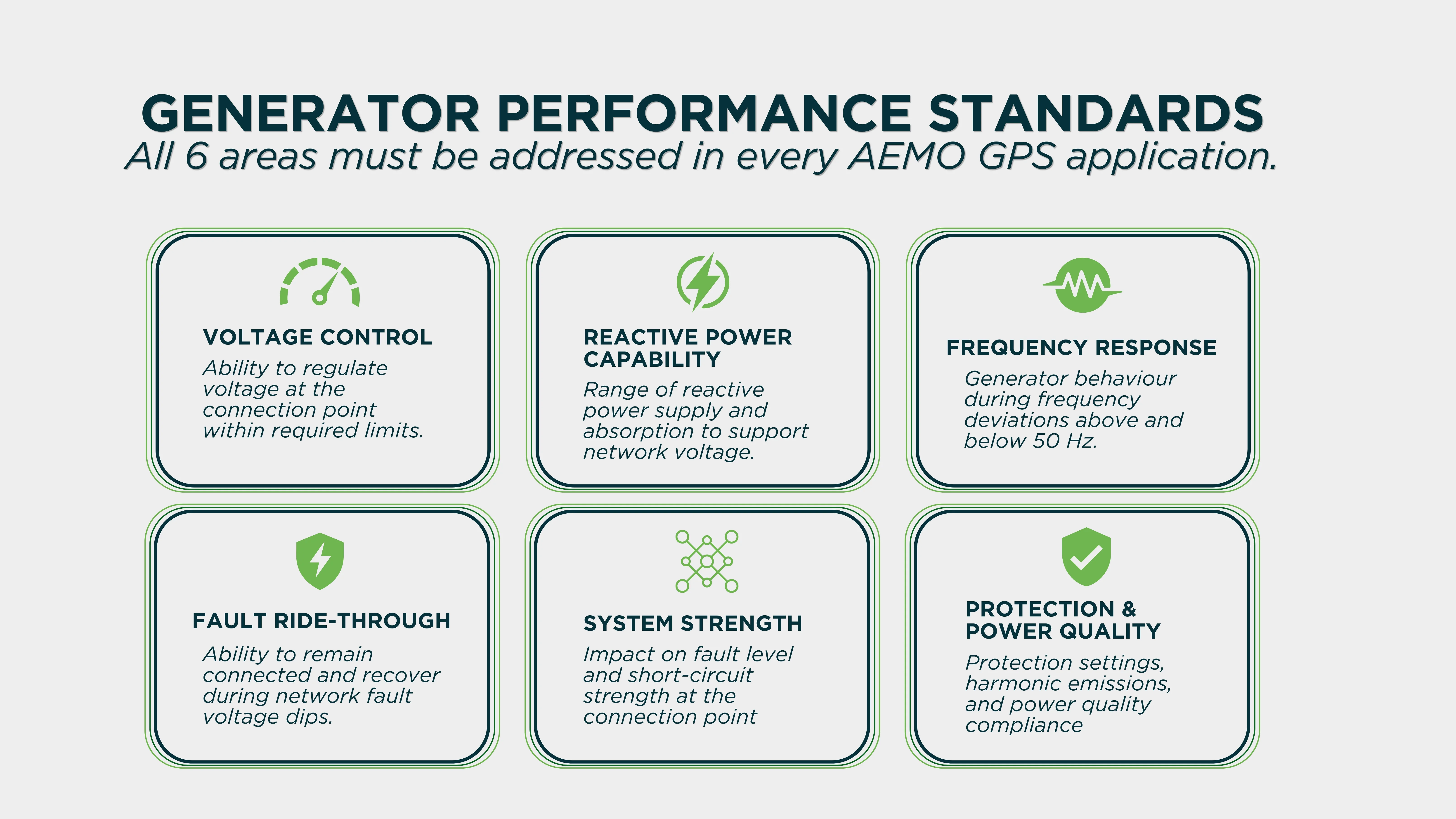
GPS cover six key performance areas:
- Voltage Control. The generator’s ability to regulate voltage at the connection point within required limits.
- Reactive Power Capability. The range of reactive power the generator can supply or absorb to support voltage.
- Frequency Response. How the generator responds to frequency deviations above and below 50 Hz.
- Fault Ride-Through. The ability to remain connected and recover during voltage dips caused by network faults.
- System Strength. The generator’s impact on the fault level and short-circuit strength at its connection point.
- Protection and Quality of Supply. Protection settings, harmonic emissions, and power quality compliance.
Each performance area has a set of standard levels defined in the NER. Generators that cannot meet AAS in any category require a negotiated standard with AEMO's approval.
Who Needs to Lodge an AEMO GPS Application?
Any new generator or significant modification to an existing generator connecting to the NEM must lodge an AEMO GPS Application. This includes:
- Utility-scale solar farms
- Standalone battery energy storage systems (BESS)
- Hybrid solar-plus-battery projects
- Wind farms
- Any generating unit undergoing a material modification that affects its GPS compliance
The application is lodged with AEMO and the relevant Transmission Network Service Provider (TNSP). Both parties assess the application independently as part of the Technical Due Diligence (TDD) process.
What Is the Difference Between GPS and R0/R1/R2 Compliance?
GPS and R0/R1/R2 are related but distinct concepts that are frequently confused.
GPS refers to the agreed technical performance standards that a generator must meet. They describe what the generator must be capable of doing. R0/R1/R2 refers to the staged grid connection process through which GPS compliance is proposed, validated, and confirmed:
- R0: Initial connection enquiry and preliminary assessment
- R1: Detailed connection proposal, including the GPS application and supporting technical studies
- R2: Post-commissioning confirmation that the generator meets the agreed GPS in actual operation
The GPS application itself sits primarily within the R1 stage. However, the engineering and modelling work that supports it must account for what will need to be demonstrated at R2 because GPS agreed at R1 must be verifiable during commissioning.
What Is the AEMO GPS Application Process?
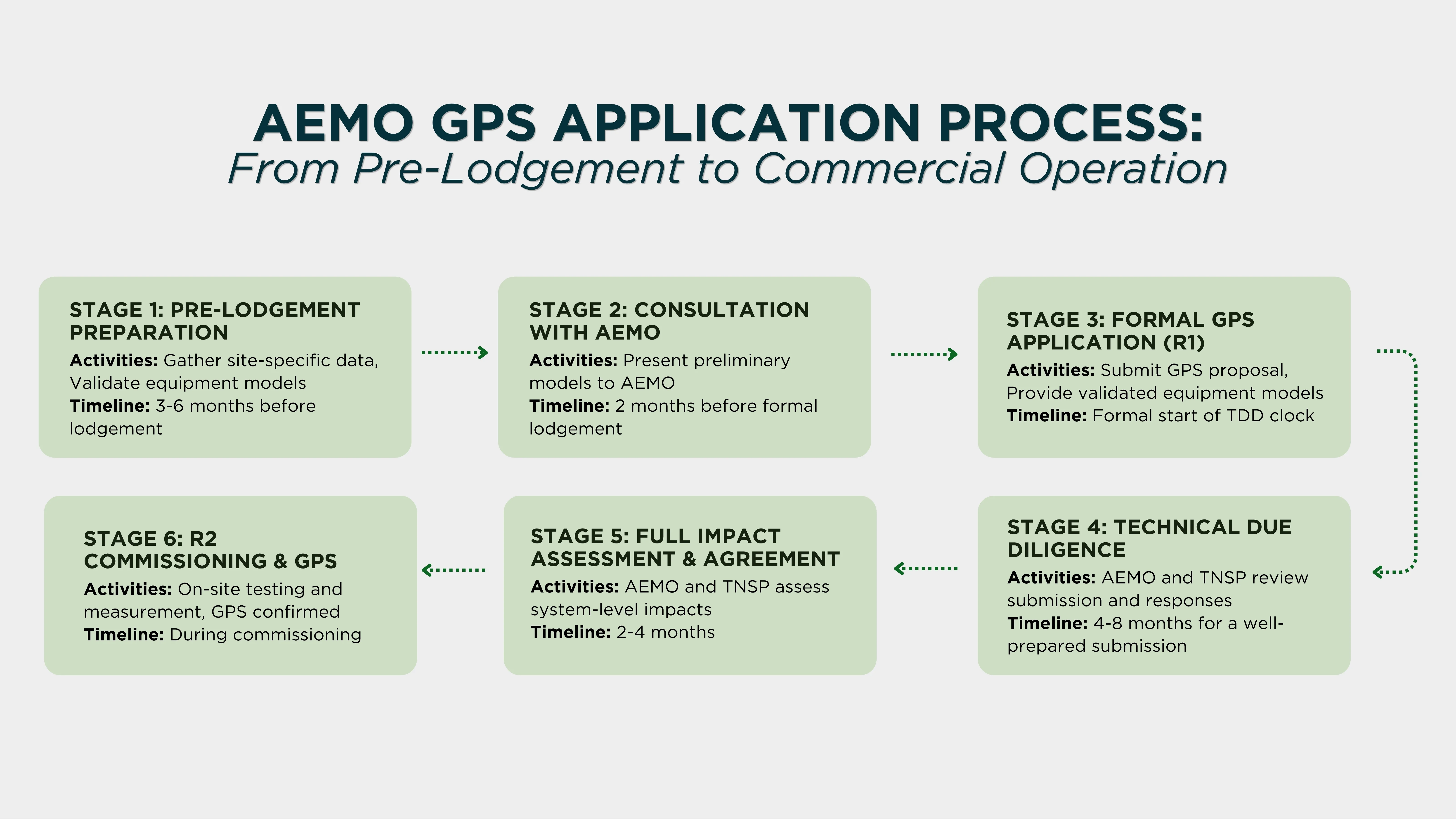
Here’s a step-by-step breakdown of AEMO GPS applications.
Stage 1: Pre-Lodgement Preparation
Before a formal GPS application is submitted, significant preparation is required. This stage involves:
- Gathering Site-Specific Data: Connection point parameters, network topology, fault levels, and voltage profiles from the TNSP
- Preparing Equipment Models: Validated dynamic models of inverters, transformers, protection systems, and battery management systems
- Conducting Preliminary Power System Studies: Load flow, fault level, and initial dynamic analysis to understand the generator’s likely performance
- Identifying Proposed GPS Levels: Determining which performance standard levels the project will propose to meet in each category
The depth of preparation at this stage directly determines the quality of the formal submission. Projects that rush into lodgement without completing robust pre-lodgement analysis routinely face the most TDD rounds.
Stage 2: Pre-Lodgement Consultation with AEMO
AEMO offers pre-lodgement consultation meetings for prospective GPS applicants. These meetings allow engineering teams to:
- Present preliminary models and technical assumptions
- Discuss proposed GPS levels with AEMO’s technical reviewers
- Identify potential issues before formal lodgement
- Understand AEMO’s current expectations and documentation requirements
Pre-lodgement consultation is not mandatory, but it is strongly recommended, particularly for projects with complex technology configurations.
Holding pre-lodgement consultation at least two months before formal lodgement gives engineering teams time to address identified gaps without affecting the connection timeline.
Stage 3: Formal GPS Application Lodgement
The formal GPS application package typically includes:
- The GPS proposal document
- Supporting power system study reports
- Validated equipment models
- Electrical design documentation
- BESS-specific documentation
The completeness and quality of this package determines whether the TDD process moves efficiently or becomes protracted.
Stage 4: Technical Due Diligence (TDD)
Technical Due Diligence is the formal review process conducted by both AEMO and the TNSP after the GPS application is lodged. The standard TDD process involves two rounds:
- Round 1: AEMO and the TNSP review the submitted application and issue a tracker containing comments, questions, and requests for additional information.
- Round 2: The applicant’s engineering team addresses all comments from Round 1 and resubmits. If Round 2 responses are complete and technically sound, the GPS application progresses to the Full Impact Assessment (FIA) stage and then to the Connection Agreement (CA).
A well-prepared application that addresses AEMO's requirements comprehensively can complete TDD in two rounds. A weak or incomplete submission may require four, five, or more rounds, each adding cost, time, and risk to the project's connection timeline.
Stage 5: Full Impact Assessment and Connection Agreement
Once TDD is successfully completed, AEMO and the TNSP conduct the Full Impact Assessment. This is a network-level analysis of how the new generator affects the broader power system. If no material adverse impacts are identified, the Connection Agreement is offered and the project can proceed to commissioning.
Stage 6: R2 Commissioning and GPS Confirmation
During commissioning, the generator must demonstrate that its actual performance meets the GPS agreed in the connection agreement.
This involves on-site testing, measurement, and validation against the simulation models used in the R1 application. Any discrepancy between modelled and actual performance must be investigated and resolved before the generator can move to full commercial operation.
What Are the Common Reasons AEMO GPS Applications Fail?
Understanding what causes GPS applications to fail is the most practical starting point for any project team preparing a submission.
Incomplete or Inaccurate Site Data
The most common cause of GPS application rejection and delay is incomplete or inaccurate technical data in the submission package. Common data gaps include:
- Outdated or missing single line diagrams that don’t reflect the current design
- Protection settings that haven’t been finalised at the time of lodgement
- Inverter models that don’t match the equipment actually being procured
- Transformer impedance data based on estimates rather than confirmed manufacturer specifications
- Missing reactive power capability curves for inverters
These gaps are often not the result of engineering error. They reflect the reality that GPS applications are sometimes lodged before the detailed design is sufficiently complete. Submitting too early, with placeholder data, guarantees multiple TDD rounds.
The solution is to treat GPS application lodgement as a design milestone. The application should not be lodged until the underlying design and equipment selection are sufficiently advanced to provide accurate, confirmed data.
Poor Coordination Across Project Stakeholders
GPS applications draw on information from multiple parties:
- The developer
- The EPC contractor
- Inverter manufacturers
- Transformer suppliers
- The protection engineer
- The network operator
When these parties do not communicate effectively, critical information gets missed or misrepresented in the submission. Common coordination failures include:
- Equipment specifications from manufacturers that are not passed through to the power system modelling team
- Protection settings developed by one engineer that are inconsistent with the GPS levels proposed by another
- Control system logic finalised late in the project that contradicts the behaviour described in the GPS application
- Changes in equipment selection after lodgement that invalidate previously submitted models
Inadequate Dynamic Modelling
Dynamic simulations are at the technical heart of every GPS application. AEMO uses these models to assess how the generator will behave during network disturbances.
Common modelling deficiencies that trigger TDD comments include:
- Inverter models that have not been validated against manufacturer test data
- PSCAD or PSSE models that use generic parameters rather than site-specific values
- Missing or incomplete modelling of the plant-level controller and its interaction with individual inverter controllers
- Fault ride-through studies that do not cover the full range of voltage dip profiles required by the GPS
- Harmonic impedance studies that use simplified network representations
Dynamic modelling for GPS applications is not a task that can be compressed or delegated to a team without specific experience in NEM-connected renewable projects. Errors in dynamic models are detected during TDD and require full reanalysis.
Underestimating BESS-Specific Complexity
Battery energy storage systems introduce modelling and compliance requirements that go beyond the established frameworks for solar PV. Projects that treat BESS as a straightforward addition to a solar application routinely encounter GPS submission problems.
BESS-specific areas that require additional depth in GPS applications include:
- Charging and Discharging Behavior. BESS operates in both generation and load mode.
- Grid-Forming Capability. Some BESS projects propose grid-forming inverter operation, which allows the battery to provide synthetic inertia and voltage support.
- Harmonic Interactions. BESS inverters can produce harmonic emissions that interact with network impedance characteristics.
- System Strength Impact. Large BESS projects in areas with low system strength may need to demonstrate that their connection doesn’t adversely affect other generators.
What Are Strategies to Improve AEMO GPS Application Outcomes?
Start Power System Studies Early
Power system studies should begin as soon as the conceptual design is sufficiently defined. Starting studies early identifies potential GPS compliance gaps while there is still time to address them through design changes, rather than through expensive post-lodgement rework.
Early studies also provide the technical basis for pre-lodgement consultation with AEMO. This allows engineering teams to get AEMO's feedback on potential issues before they are embedded in a formal submission.
Build a GPS Documentation Checklist
GPS applications involve dozens of individual documents, data inputs, and study requirements. A structured GPS documentation checklist ensures that nothing is missed and that each input is at the required level of completeness before lodgement.
The checklist should include:
- Inverter test reports and validated models
- Protection scheme documentation and settings
- Reactive power capability curves
- Single line diagrams at design-complete status
- Transformer specifications
- All power system study reports reviewed for internal consistency
Validate Equipment Models Before Submission
Inverter models submitted as part of a GPS application must accurately represent the inverter's actual behaviour. Generic or unvalidated models are a frequent source of TDD comments.
Validation requires comparing model outputs against manufacturer factory acceptance test data or field test results. This step takes time and requires cooperation from the inverter manufacturer. It should be planned into the project schedule well ahead of the lodgement date.
Engage AEMO in Pre-Lodgement Consultation
Pre-lodgement consultation is one of the highest-return activities available to a GPS applicant. It costs relatively little in engineering time and provides direct access to AEMO's technical reviewers before the formal TDD clock starts.
The most effective pre-lodgement consultations present specific technical questions. Engineering teams that come with preliminary models, specific GPS level proposals, and identified technical risks get the most useful feedback.
Partner with ElectraGlobe for AEMO GPS Applications
AEMO GPS Applications require engineering depth, project coordination, and specific NEM experience. The difference between a two-round TDD process and a five-round process is rarely the complexity of the project.
ElectraGlobe provides end-to-end AEMO GPS Application support for utility-scale solar farms, BESS projects, and hybrid systems across Australia. Our services include:
- Pre-lodgement power system studies (load flow, fault level, dynamic, harmonic)
- GPS documentation preparation and coordination
- PSSE and PSCAD dynamic modelling and validation
- Pre-lodgement consultation support with AEMO and TNSPs
- TDD round management and issue tracker responses
- R2 commissioning support and GPS confirmation
We work with developers, EPCs, and asset owners who need GPS applications that move efficiently, with engineering that holds up under AEMO's scrutiny from the first round.
Start your AEMO GPS Application with the ElectraGlobe team. Let’s discuss your project's connection requirements.
FAQ
How long does the AEMO GPS Application process take?
The timeline for an AEMO GPS Application depends on submission quality, project complexity, and AEMO's current workload. A well-prepared application for a standard solar farm or BESS project can complete the TDD process in approximately four to six months.
What is the difference between an Automatic Access Standard and a Negotiated Access Standard in the GPS framework?
The Automatic Access Standard (AAS) is the minimum level of performance a generator must meet in each GPS category to obtain connection. The AAS values are set in the National Electricity Rules. Negotiated standards require additional AEMO assessment and often involve more detailed technical analysis than AAS compliance.
Can BESS projects be registered as both a generator and a load for AEMO GPS purposes?
Yes. Battery energy storage systems can be registered in the NEM as both a scheduled generator (during discharge) and a scheduled load (during charge). This dual registration reflects the bidirectional nature of BESS operation.