
In utility-scale solar PV construction, few milestones carry as much weight as the golden table review. It's the point where the first completed module row is inspected, challenged, and formally approved as the benchmark for the rest of the plant.
Get it right at table one. Replicate it across every table that follows.
It sounds simple. In practice, it's one of the most consequential quality control decisions made on any solar site.
What Is the Golden Table in Solar PV?
The golden table refers to the first module row and substructure assembly constructed on a photovoltaic plant. Once it passes a formal review and receives sign-off from the relevant project stakeholders, it becomes the physical reference standard for the entire site.
Every subsequent table in the park must replicate it exactly, which means:
- Consistent clamp positions
- Correct torque values
- Uniform module gaps
- Grounding continuity
- Accurate string labelling
- Compliant cable routing
The term "golden" reflects its status as the approved model, the one that all others are measured against.
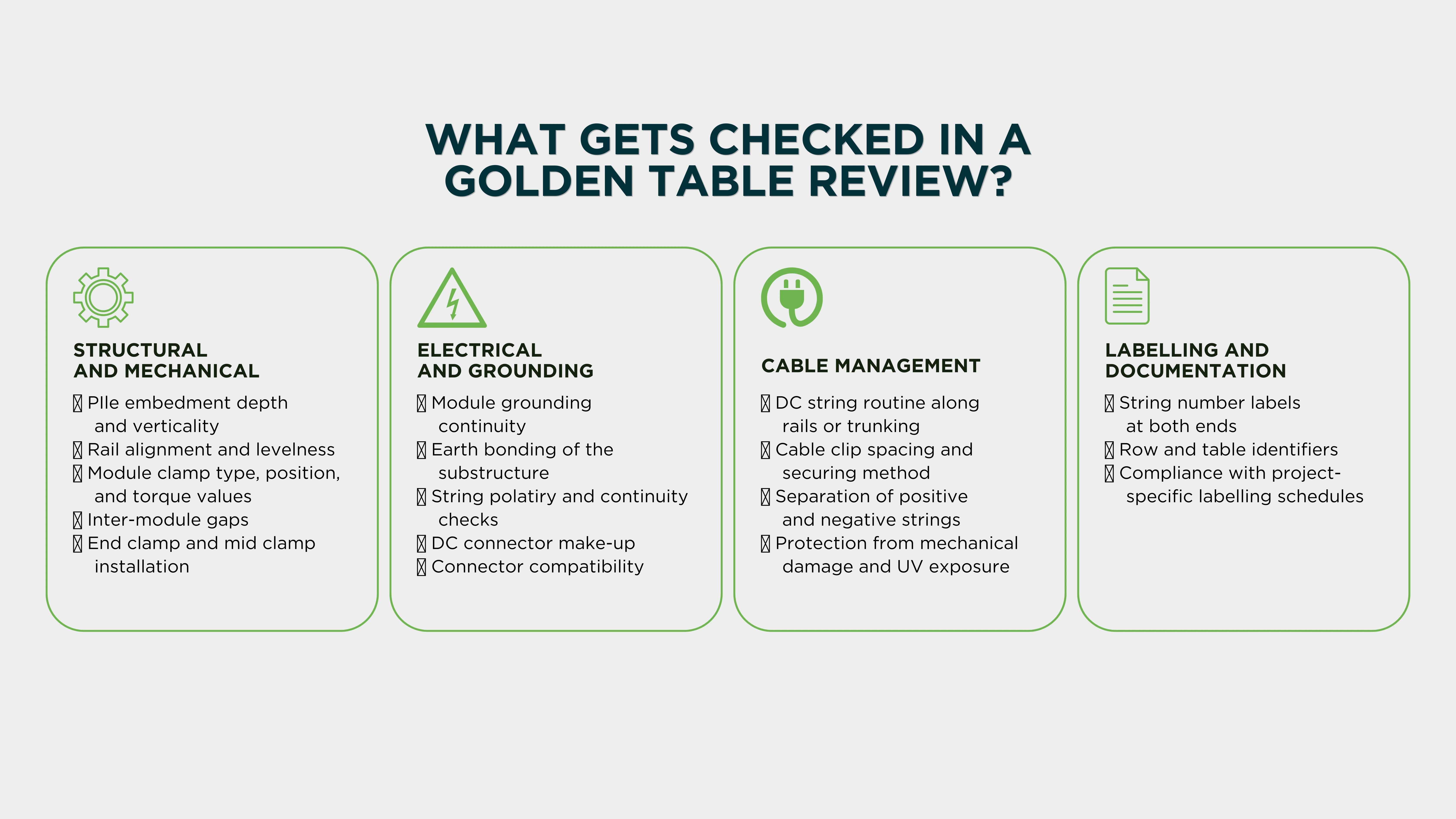
What Gets Checked in a Golden Table Review?
A thorough golden table review typically covers the following:
Structural and Mechanical
- Pile embedment depth and verticality
- Rail alignment and levelness
- Module clamp type, position, and torque values
- Inter-module gaps (thermal expansion compliance)
- End clamp and mid clamp installation
Electrical and Grounding
- Module grounding continuity (bonding clips or lugs)
- Earth bonding of the substructure
- String polarity and continuity checks
- DC connector make-up and strain relief
- Connector compatibility (matching brands and series)
Cable Management
- DC string routine along rails or trunking
- Cable clip spacing and securing method
- Cable loop sizing at module junction boxes
- Separation of positive and negative strings
- Protection from mechanical damage and UV exposure
Labelling and Documentation
- String number labels at both ends
- Row and table identifiers
- Compliance with project-specific labelling schedules
Each of these items must be verified, documented, and signed off before the golden table is approved.
Who Should Be Present at the Review?
The golden table review is a collaborative hold point, not a unilateral contractor sign-off. Attendees typically include:
- EPC Site Manager or Construction Lead
- Quality Manager or QA/QC Inspector
- Owner’s Engineer or Client Representative
- Design or Engineering Representative
The review should be formally documented. A signed inspection test record (ITR) or quality hold point form creates a traceable record that the golden table was approved before bulk construction commenced.
Why Is the Golden Table Review Essential?
It Establishes Site-Wide Conformity
A utility-scale solar plant can contain hundreds or thousands of module tables. Without a single approved reference point, each installation crew will inevitably interpret drawings and specifications slightly differently. Small variations compound quickly.
The golden table eliminates that ambiguity. Once signed off, it answers the question "how should this table look?" for every tradesperson on site, from day one to mechanical completion.
It Prevents Errors at Scale
Finding a torque error or a misrouted string cable on table #1 is a five-minute fix. Finding the same error replicated across 800 tables is a rework campaign that threatens programme, budget, and warranty compliance.
The golden table review is designed to catch those errors before they can multiply. It is structured defect prevention, not reactive inspection.
It Finalises DC Cable Management
The golden table review is the right time to resolve DC string routing, connector strain relief, and trunking or clip solutions before those details get locked in across the site. Improvising cable management on table #200 means you've already built the problem in everywhere else. Decisions made at this stage become the cable management standard for the entire plant.
It Creates a Platform for Continuous Improvement
The golden table review is also an opportunity to challenge the design and ask:
- Can this be installed more safely?
- Can the sequence be made faster?
- Is there a cleaner way to route these cables that reduces wear and improves long-term performance?
Quality is not something you inspect into a finished product. It is something you build into the process from the very first table.
What Are the Common Issues Identified During Golden Table Reviews?
Even on well-managed projects, golden table reviews regularly surface issues that need resolution before sign-off. The most common include:
- Clamp positions deviating from manufacturer requirements (often too close to module edges)
- Torque values not being verified with a calibrated torque wrench
- DC connectors made up without proper strain relief, creating long-term fatigue risk
- Cable routing running across sharp rail edges without adequate protection
- Grounding bonds missing or incorrectly installed
- String labels missing, facing the wrong direction, or using non-compliant formats
- Module gaps outside the tolerance range specified by the module manufacturer
These are exactly the type of details that are easy to miss during bulk installation, but straightforward to correct when identified at table one.
The Golden Table Review and AS/NZS Compliance
For projects in Australia, the golden table review provides a structured checkpoint to verify compliance with relevant standards before they are locked in across the site.
Key references include:
- AS/NZS 5033. Installation and safety requirements for photovoltaic (PV) arrays, covering DC wiring, string protection, and earthing
- AS/NZS 3000. Wiring rules applicable to the broader electrical installation
- AS/NZS 4777.1:2024. Grid connection requirements, particularly relevant for inverter-interfaced systems and protection settings
- IEC 62548. Design requirements for PV arrays, often referenced in project specifications
The golden table review is the appropriate checkpoint to verify that the physical installation matches what was designed to meet these standards.
Build Quality In From Table One
A golden table review is not a formality. It is one of the highest-leverage quality interventions available on a solar PV construction project.
One approved table, rigorously reviewed, becomes the standard for thousands. One unresolved issue at that stage becomes a site-wide problem. The investment of time and attention at this single hold point pays dividends across every row that follows.
Developing a utility-scale solar or BESS project and want a quality partner that builds into every stage? The team at ElectraGlobe brings the technical depth and field experience to get it right from table one.
FAQ
When in the construction programme does the golden table review take place?
The golden table review is conducted after the first complete module row has been fully installed. It occurs before bulk module installation begins, typically within the first few days of the civil and mechanical works phase on any given tracker or fixed-tilt block.
Can the golden table review be waived if the EPC has prior experience with the same racking system?
No. Even if the contractor and substructure system are familiar, the golden table review serves a project-specific function. It verifies that the design drawings, project specifications, and any site-specific deviations have been correctly interpreted and implemented for this particular plant.
Who is responsible for approving the golden table—the EPC or the client?
Formal sign-off typically requires both the EPC's quality representative and the client or owner's engineer. The EPC is responsible for constructing to specification, while the owner's engineer provides independent verification that the installation meets the project's technical and contractual requirements. Joint sign-off creates shared accountability and a clear paper trail.