
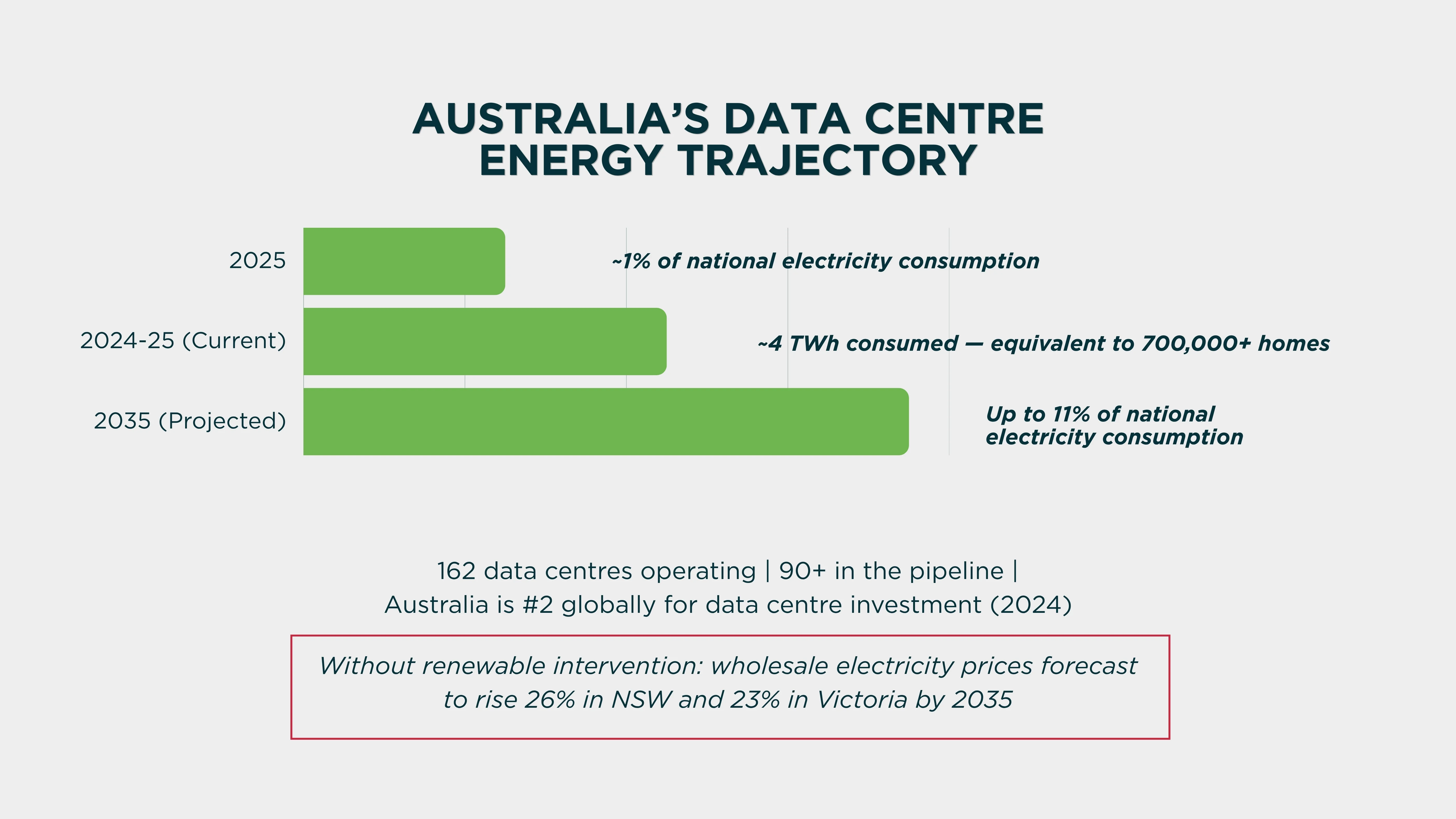
Australian data centres are expected to grow fourfold within a decade and could represent up to 11% of the nation's total electricity consumption by 2035, up from about one per cent in 2025.
Australia is already a global investment hotspot with 162 data centres in operation and more than 90 projects in the pipeline. The scale of this growth creates a direct conflict.
A 26% wholesale electricity price rise in NSW and 23% rise in Victoria by 2035 is forecast if data centre demand is met with gas rather than renewables. For data centre operators, this is not just an environmental problem. It is a cost, reputational, and regulatory problem.
Solar power is the most commercially viable path through this challenge. This article explains how solar power reduces data centre energy costs and carbon emissions in Australia, what procurement models are available, and what operators need to understand about co-located storage, Power Purchase Agreements, and the government's new expectations for the sector.
Why Can’t Data Centres Ignore Energy?
In 2024–25, data centres used around four terawatt-hours (TWh), or 2%, of the electricity in Australia's main grid, equivalent to the electricity use of more than 700,000 homes.
The industry's energy demand is already growing rapidly, reportedly almost doubling in Victoria and increasing by 18% in NSW over the past 12 months. AEMO figures showed data centres could account for 13% of total national electricity demand in 2040 under a high-growth scenario.
That figure increased more than fivefold between AEMO's 2024 and 2025 reports, reflecting how rapidly AI workloads are accelerating data centre energy demand. For Australian operators, the business case for clean energy procurement is not primarily ideological. It is financial:
- Rising Grid Electricity Prices: Data centre demand met with gas could push wholesale electricity prices up 26% in NSW and 23% in Victoria by 2035.
- Carbon Liability: Data centres growing to 11% of national electricity demand will increasingly face direct carbon accounting obligations, and the grid's emissions intensity means that grid-powered data centres carry a significant Scope 2 emissions footprint.
- Investor and Customer Pressure: Corporate customers increasingly require their co-location providers to source verifiable clean electricity.
- Government Expectations: The Australian government has released its expectations about how data centres should contribute to Australia's national interest, the energy transition, water security, workforce and innovation capabilities.
How Does Solar Power Reduce Data Centre Energy Costs?
Power Purchase Agreements
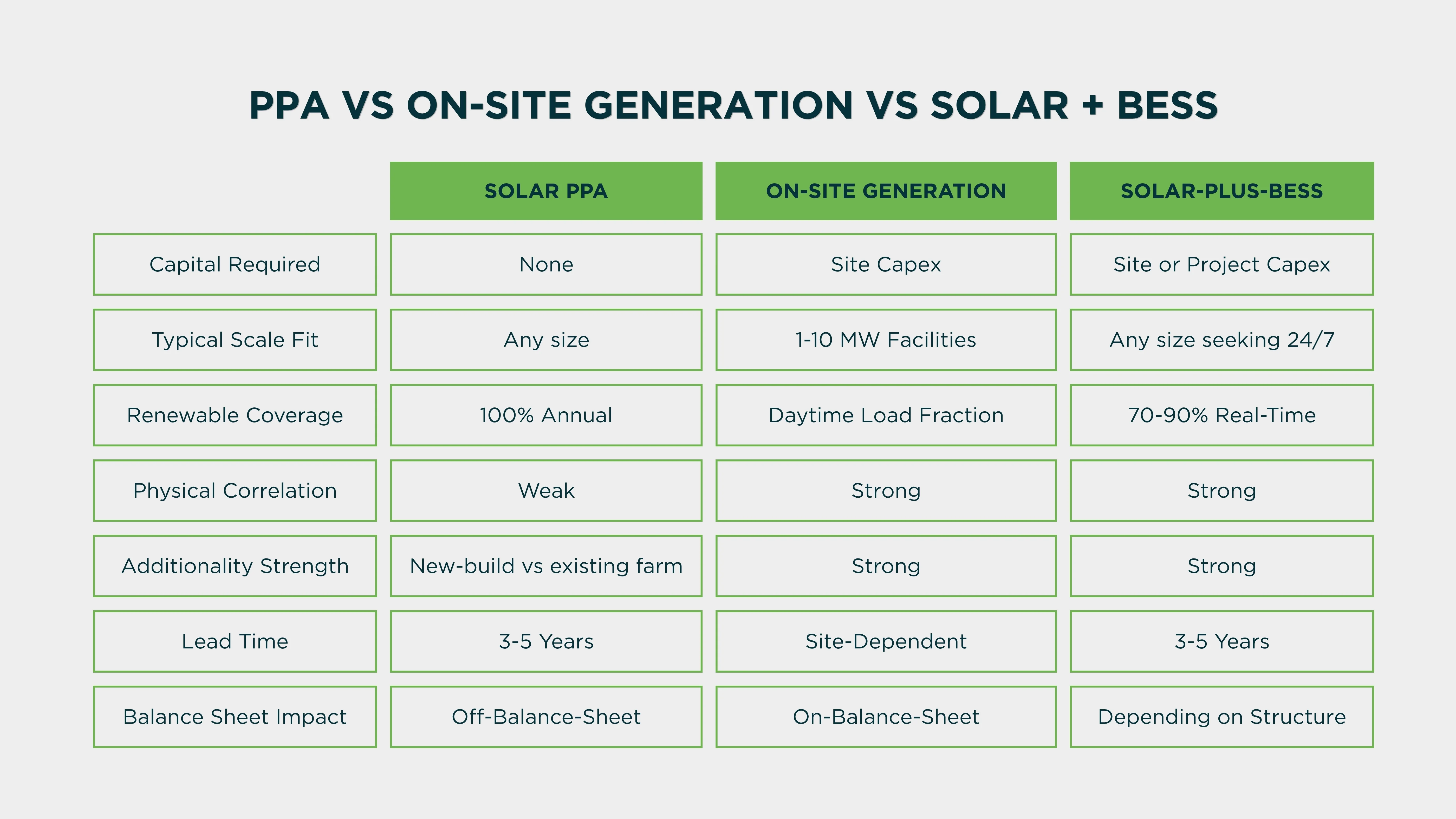
The most widely used mechanism for data centres to access solar power without building or operating generation assets is the Power Purchase Agreement (PPA).
Last year, Microsoft penned a 15-year Power Purchase Agreement with developer Fotowatio Renewable Ventures Australia for a 353 MW solar PV power plant in New South Wales. The FRV Australia New South Wales PV plant with Microsoft data centre PPA was set to power Microsoft-owned data centres in the state.
A solar PPA delivers several commercial advantages for data centre operators:
- Price Certainty Over a Long Term: A 15-year fixed-price PPA eliminates exposure to wholesale electricity price volatility for the contracted volume. At current utility-scale solar costs, long-term solar PPAs can lock in electricity at significantly below projected future grid prices.
- Scope 2 Emissions Reduction: A PPA linked to a specific solar farm, in the same region as the data centre, allows the operator to retire Large-scale Generation Certificates (LGCs) against grid electricity consumption.
- Bankability and Cost of Capital: A long-term PPA with a creditworthy solar counterparty provides lenders with electricity cost certainty, reducing the perceived risk of the project and potentially improving financing terms.
On-Site Solar Generation
Larger data centre campuses can install on-site solar PV systems that provide direct renewable electricity to the facility.
The scale of on-site generation depends on available roof and land area relative to the data centre's load. A hyperscale data centre consuming 100 MW continuously cannot be powered entirely by on-site solar. For smaller commercial data centres consuming 1–10 MW, on-site solar can supply a meaningful fraction of daytime load.
The key advantage of on-site generation is the direct, physical relationship between generation and consumption. This reduces reliance on the grid mix and potentially qualifying for more stringent "additionality" claims under corporate renewable energy commitments.
Battery Energy Storage
Solar power is intermittent. Data centres are not.
The gap between solar generation and data centre load is bridged by battery energy storage systems (BESS). A solar-plus-BESS configuration allows a data centre to:
- Absorb solar generation during daylight, storing surplus in the battery
- Draw from the battery during evening and overnight periods when solar is unavailable
- Reduce grid electricity consumption and associated grid emissions during peak periods
- Participate in NEM ancillary services markets (FCAS) with the battery, potentially generating additional revenue that offsets the battery's capital cost
For a data centre operator considering a direct investment in solar generation assets, hybrid solar-plus-BESS co-location provides the closest available approximation to 24/7 renewable power from a single asset.
What Are the Australian Government’s 2026 Expectations?
The Australian Government's Expectations of data centres and AI infrastructure developers, released on 23 March 2026, outlines explicit expectations about how data centres should contribute to Australia's national interest and the energy transition.
The key energy-related expectations include:
- Clean Energy Procurement Commitments: Data centres are expected to demonstrate credible commitments to procuring clean electricity.
- Grid Support: The coalition's second principle requires data centres to "strengthen grid stability" through demand response, storage deployment, and grid-support services.
- Transparency: Data centres are expected to publish energy consumption, emissions, and water use data.
- Location and Timing Alignment: New data centre development is increasingly expected to be located where clean energy is available or being developed.
These expectations reflect a broader shift: from recognising data centres as critical infrastructure to actively shaping how they are developed and integrated into Australia's national interest. For data centre operators without a solar energy strategy, these expectations create a near-term imperative.
Power Your Data Centre with Renewable Energy—Partner with ElectraGlobe
Data centres that move first on clean energy procurement benefit from better PPA pricing, stronger developer relationships, and first access to constrained grid capacity in key locations.
ElectraGlobe is Australia's specialist renewable energy engineering consultancy. Our team has worked directly with data centre operators, developers, and energy investors to structure and deliver the solar and storage assets that underpin credible clean energy commitments.
From grid connection feasibility and generator performance standards compliance through to detailed electrical design, Owner's Engineering oversight, and commissioning, ElectraGlobe provides the engineering expertise needed to bring a solar or solar-plus-BESS project from concept to commercial operation on the timeline that data centre decarbonisation requires.
Talk with ElectraGlobe about your data centre’s renewable energy strategy.
FAQ
How much of a data centre's energy can solar power realistically supply?
Through a solar-plus-BESS hybrid project, a data centre can achieve much higher real-time renewable coverage, typically 70–90% of annual energy from the solar-BESS system depending on battery duration and design. True 24/7 clean electricity matching requires a portfolio of renewable sources with different generation profiles, rather than solar alone.
What is a Power Purchase Agreement (PPA) for a data centre and how does it reduce costs?
A Power Purchase Agreement is a long-term bilateral contract under which a data centre purchases electricity directly from a renewable energy generator at a fixed price per MWh. The PPA reduces data centre electricity costs by providing price certainty over the contract period, typically at a level below forecast future grid electricity prices for the equivalent volume.
Does the Australian Government require data centres to use renewable energy?
As of mid-2026, the Australian Government has not legislated mandatory renewable energy requirements for data centres. However, it has released its Expectations of data centres and AI infrastructure developers, which included credible clean energy procurement commitments, grid support services, and transparency reporting on energy consumption and emissions.