
Abundant sunshine. A mature policy environment. A national electricity market hungry for new clean capacity. These factors make Australia one of the most attractive markets for large-scale solar panels installation.
As of mid-2025, 260 projects totaling 53 GW were progressing through AEMO’s grid connection process. This is nearly 40% more than the same period the previous year. The conditions for developing a utility-scale solar farm in Australia have never been more favourable.
However, the process of building one is complex. From site selection to grid connection, each stage carries distinct risks, costs, and regulatory requirements.
This complete guide walks you through every phase of development. So, you can move from concept to commissioning with clarity and confidence.
What Qualifies as a Utility-Scale Solar Farm in Australia?
A utility-scale solar farm is generally defined as a ground-mounted solar photovoltaic (PV) installation of 5 MW or greater that feeds electricity directly into the National Electricity Market.
Projects range from small regional farms in the tens of megawatts to major installations exceeding 500 MW. Understanding the scale of your project upfront determines which regulatory pathways, approvals, and grid connection processes apply.
What Processes Are Involved in Building Utility-Scale Solar Farms?
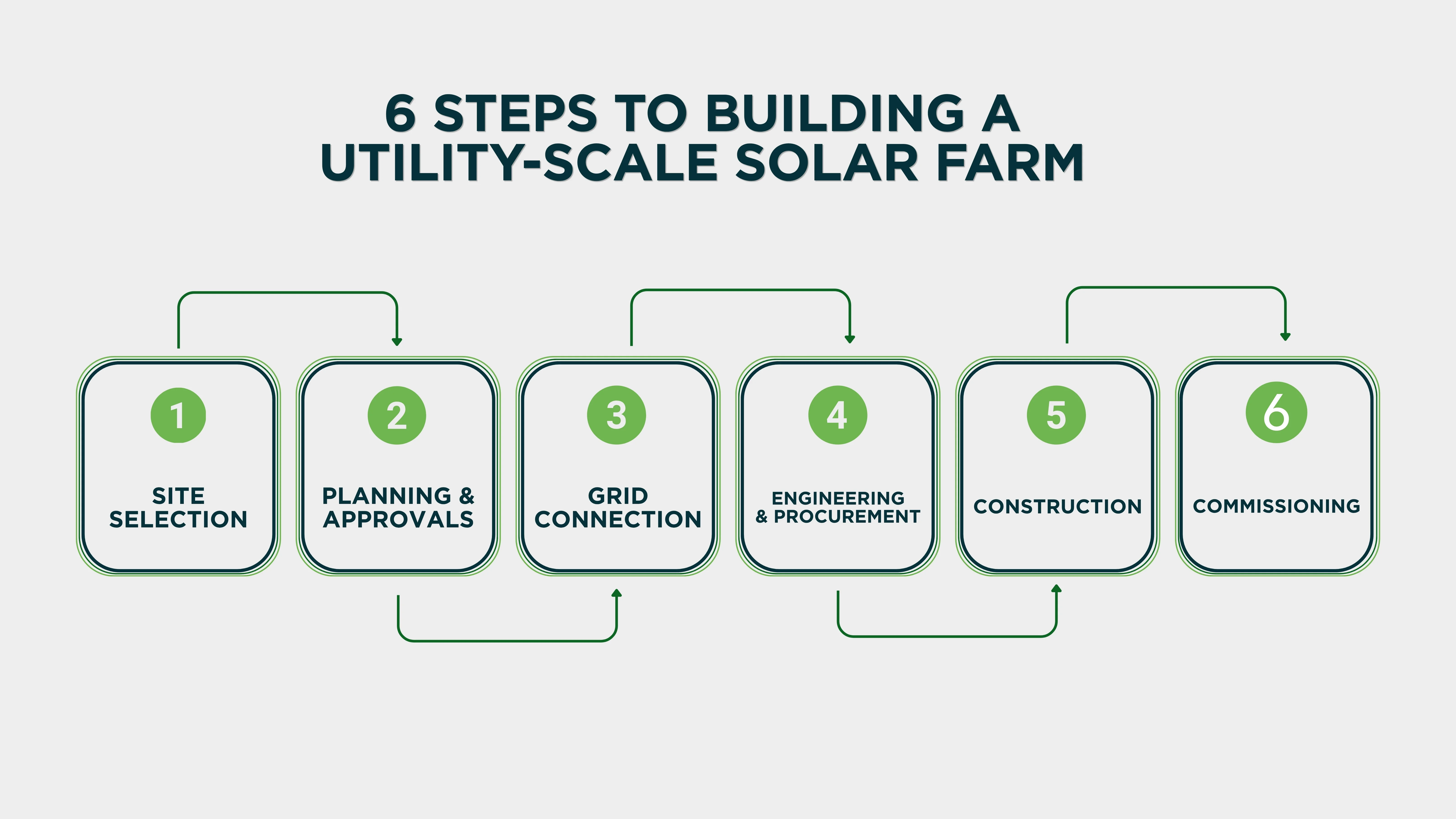
Step 1: Site Selection and Feasibility Assessment
The foundation of every successful utility-scale solar farm in Australia is choosing the right site. A poor site selection can add years to your timeline and millions to your costs.
Step 2: Planning and Development Approvals
Navigating Australia’s approval landscape is one of the most complex aspects of developing a utility-scale solar farm. Requirements differ significantly between states and involve both local and federal frameworks.
Federal Approval: EPBC Act
If your project is likely to have a significant impact on the national environment, it must be referred to the federal government under the Environment Protection and Biodiversity Conservation Act 1999 (EPBC Act). This referral process determines whether a formal environmental impact assessment is required.
State Planning Approvals
Each state has its own planning framework for utility-scale solar:
- New South Wales. Utility-scale solar farms above 30 MW are classified as State Significant Development (SSD). These are assessed by the NSW Department of Planning under the Large-Scale Solar Energy Guideline.
- Queensland. Projects are assessed under the State Development and Public Works Organisation Act, through the Coordinator-General for projects above 50 MW.
- Victoria. Large solar projects are assessed under the Environment Effects Act. Projects with major impacts may need an Environment Effect Statement (EES).
- South Australia, Western Australia, and other states each have equivalent development approval (DA) pathways with differing thresholds and requirements.
Development Application (DA) Requirements
A typical DA for a utility-scale solar farm in Australia must include:
- Fully-dimensioned site plans
- Environmental and biodiversity assessments
- Visual impact analysis
- Soil and water management plans
- Community consultation records
Councils and planning authorities routinely request revisions when documentation lacks sufficient technical detail. This means engaging experienced planning, environmental, and electrical engineering consultants early is essential to avoid costly delays.
Step 3: Grid Connection and AEMO Registration
Connecting to the grid is often the hardest technical part of building a utility-scale solar farm in Australia.
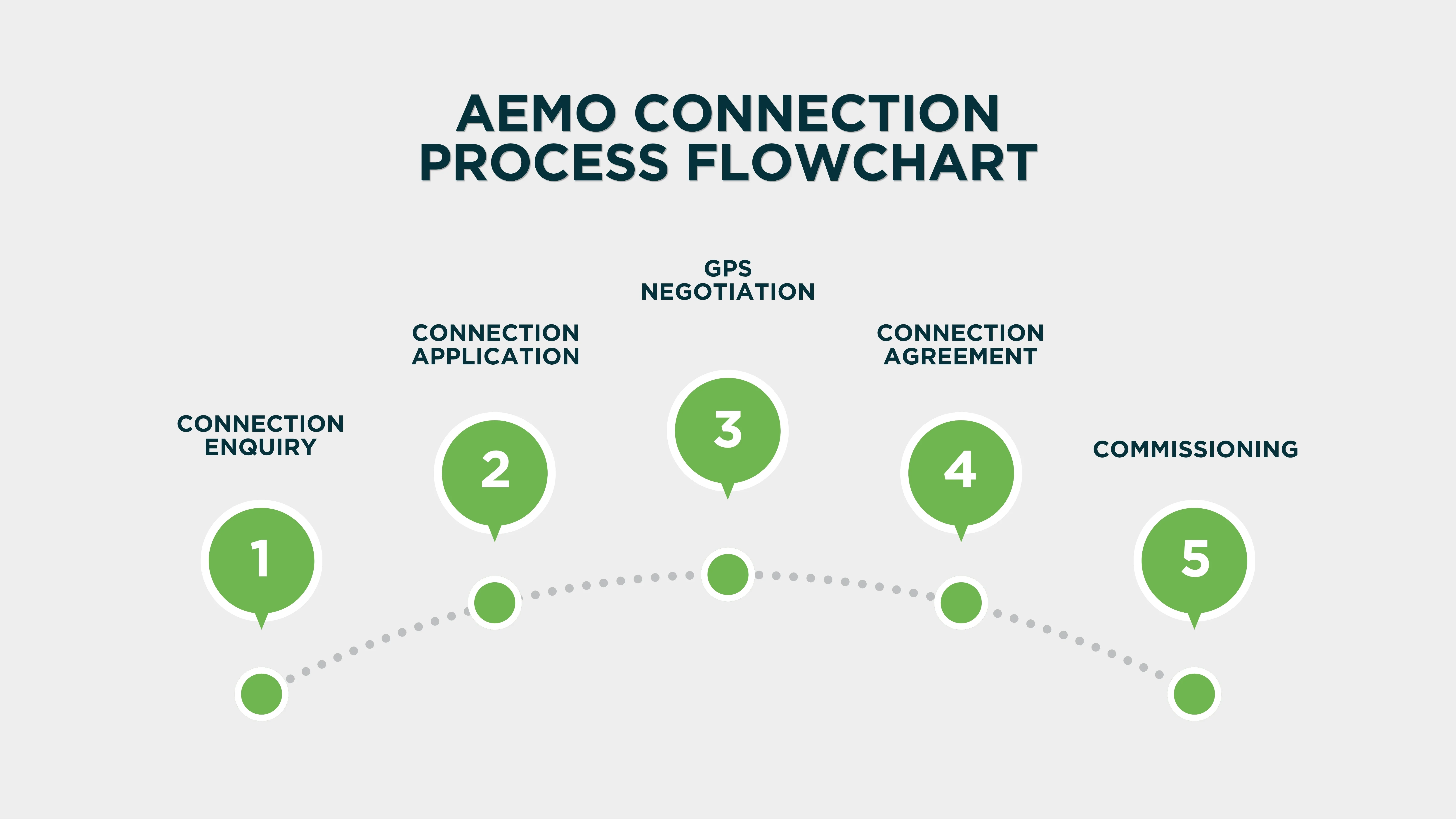
The Connection Process
Grid connection in the NEM is managed by the Australian Energy Market Operator (AEMO). It is also managed by the relevant Network Service Provider (NSP).
The process involves five key stages:
- Connection enquiry
- Connection application
- Access standards negotiation
- Connection agreement
- Construction and commissioning
Generator Performance Standards (GPS)
Before construction begins, your project must receive Generator Performance Standards (GPS) and approval from AEMO and the connecting NSP. GPS defines the technical performance requirements your facility must meet to connect safely to the grid. The process involves detailed grid modelling and simulation studies.
AEMO Market Management System (MMS) Registration
To participate in NEM dispatch and settlement, your solar farm must be registered in AEMO’s Market Management System (MMS). Registration requires completed connection agreements, compliance testing, and technical validation.
Step 4: Engineering Design and Procurement
With approvals secured, the project moves into detailed engineering design and equipment procurement.
Engineering Design
Your engineering team will produce an Issued for Construction (IFC) design package—the official reference for procurement and physical construction.
Module and Equipment Procurement
PV modules, inverters, transformers, and balance-of-system components must be procured in compliance with Australian Standards. Module procurement should account for supply chain lead times, tariff exposure, and warranty terms.
Step 5: Construction
Solar farm construction typically takes between 12 and 24 months. This depends on project size, site conditions, and supply chain logistics.
The physical build involves several workstreams:
- Civil Works. Land clearing, grading, access road construction, stormwater drainage, and erosion controls. All civil works must align with environmental approval conditions and the IFC documentation.
- Mechanical Installation. Pile driving or ground screw installation, mounting structure assembly, and solar module installation. Single-axis tracker systems require precise calibration and commissioning.
- Electrical Works. DC cabling, combiner boxes, inverter skid installation, AC cabling, substation construction, protection relay testing, and SCADA system integration.
- Safety and Environmental Management. Construction must comply with Work Health and Safety (WHS) legislation and approved environmental management plans. Waste streams, including electrical materials, must be managed responsibly to avoid landfill pressure and compliance breaches.
Step 6: Commissioning and Commercial Operation
Commissioning must be agreed with the connecting NSP and AEMO at least three months before commencement for transmission-connected projects.
This phase includes:
- Energisation and protection relay testing
- Performance testing against GPS requirements
- Demonstration of SCADA and National Metering Identifier (NMI) functionality
- Final compliance verification
Once commissioning is complete and AEMO MMS registration is confirmed, the facility can start commercial operation. It can then generate Large-scale Generation Certificates (LGCs) under the Large-scale Renewable Energy Target (LRET).
What Are the Revenue and Commercial Structures for Utility-Scale Solar in Australia?
Long-term revenue certainty is critical for attracting project finance. The main commercial structures for a utility-scale solar farm in Australia include:
- Power Purchase Agreements (PPAs). Long-term agreements with energy retailers, corporations, or government entities to purchase electricity at a fixed price.
- Capacity Investment Scheme (CIS). The federal government’s main program offers revenue support contracts. These contracts cover up to 40 GW of new renewable and dispatchable capacity. The goal is to reach this by 2030. It gives developers a floor price to support project viability.
- Wholesale Market Exposure. Projects without full PPA coverage participate in the NEM spot market, where LGC revenues supplement wholesale electricity receipts.
What Are the Common Challenges in Building Utility-Scale Solar in Australia?
Developing a utility-scale solar farm in Australia carries specific risks that experienced developers plan for from day one.
Grid Connection Delays
Delays remain the single biggest cause of project timeline blowouts. Fortunately, this can easily be avoided by:
- Engaging NSPs and AEMO early
- Conducting connection feasibility studies before committing to land
- Allowing buffer in your programme for technical negotiations
Approval Complexity
Complexity across federal, state, and local frameworks demands a multidisciplinary team. To address this, ensure to adequately document matters and avoid resubmissions.
Community Opposition
Opposition around visual impact, glare, agricultural land use, and property values can delay or derail projects. This can be avoided by proactive and transparent community engagement, starting before the DA is lodged.
ElectraGlobe Simplifies Building a Utility-Scale Solar Farm in Australia
Developing a utility-scale solar farm in Australia is a rewarding but demanding undertaking. The market has never offered more opportunity. 53 GW is already progressing through AEMO’s connection pipeline. Over 150 operational solar farms are already in production. The government policy is also firmly aligned with large-scale renewable expansion.
However, success requires disciplined site selection, expert navigation of approvals, rigorous engineering, and a clear commercial strategy from the outset.
This is where ElectraGlobe comes in.
ElectraGlobe is an engineering consultancy in Australia that assists end-to-end engineering for utility-scale solar, BESS, and hybrid energy systems. From concept design through commissioning, we’ll be supporting your projects across Australia.
Planning a renewable project? Contact our team for expert guidance on site selection, development approvals, grid connection, and project delivery.
FAQ
How long does it take to develop a utility-scale solar farm in Australia from concept to commercial operation?
The typical development timeline for a utility-scale solar farm in Australia ranges from three to six years. This depends on project size, location, and grid connection complexity.
Can a utility-scale solar farm in Australia operate without a Power Purchase Agreement (PPA)?
Yes, but it is uncommon for large projects to proceed to construction without at least partial revenue certainty. Most utility-scale solar farms secure a PPA covering a portion of their output before reaching financial close. The Federal Government’s Capacity Investment Scheme (CIS) also provides an alternative revenue support mechanism.
How much does it cost to build a utility-scale solar farm in Australia?
Capital costs for utility-scale solar farms currently range from approximately AU$800,000 to AU$1.2M per MW of AC capacity. Grid connection costs vary significantly. BESS adds approximately AU$400,000 to AU$600,000 per MWh of storage capacity at current market rates.