
Getting a solar farm, wind farm, or battery energy storage system (BESS) connected to Australia's National Electricity Market requires models.
Specifically, it requires validated power system simulation models that AEMO and the connecting Network Service Provider (NSP) use to assess Generator Performance Standards (GPS) compliance before a single kilowatt-hour is exported.
AEMO uses PSS®E and PSCAD™/EMTDC™ software for connection studies. Both platforms are mandatory. Neither substitutes for the other.
This guide explains what PSS/E and PSCAD each do, why AEMO requires both for renewable energy projects, how models are validated and accepted, and what the 2025 regulatory updates mean for developers and their engineering teams.
What Is PSS/E and What Does It Model?
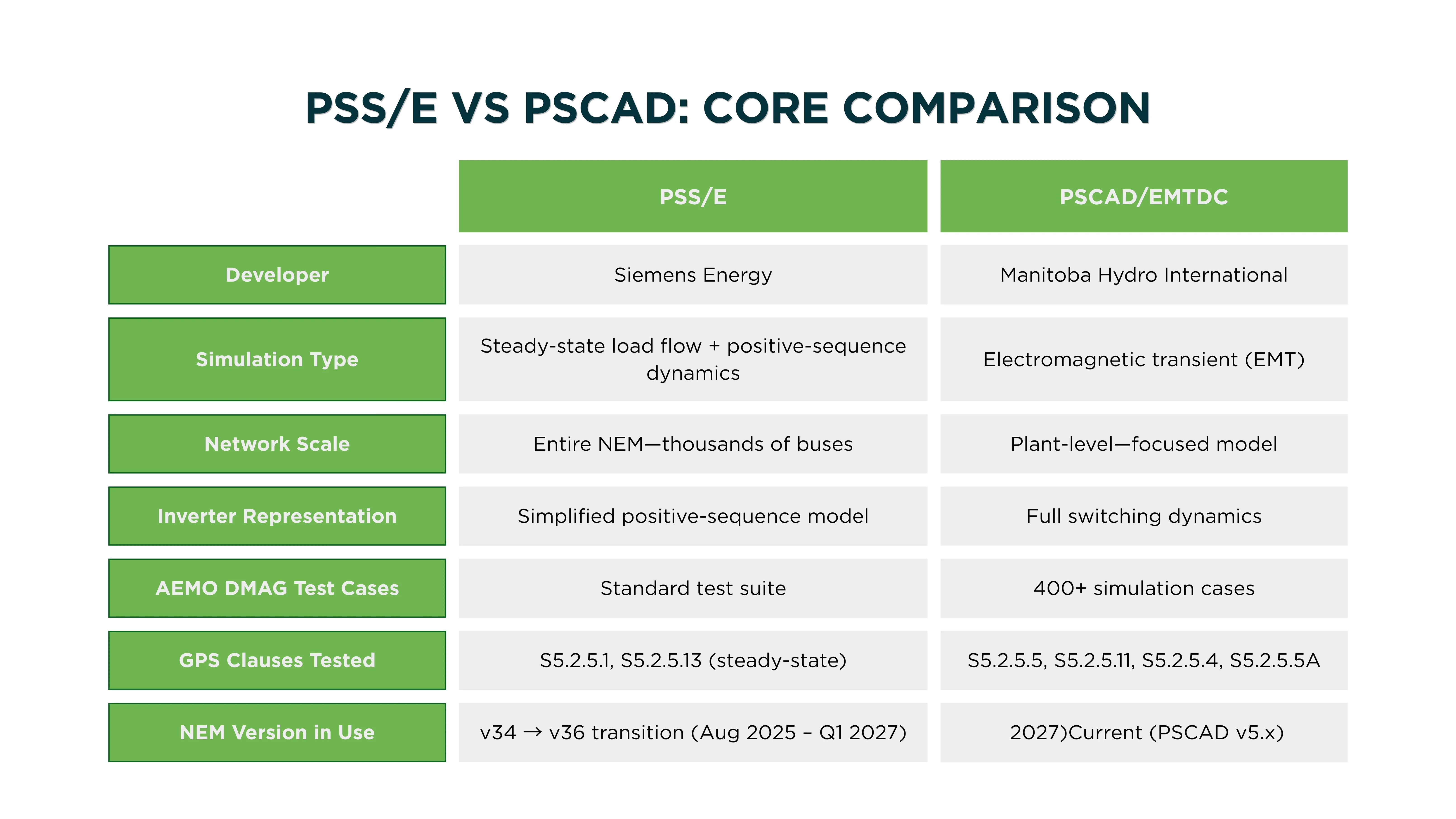
PSS/E (Power System Simulator for Engineering) is software developed by Siemens Energy, used globally for steady-state load flow analysis and positive-sequence dynamic simulations of large power systems.
In the context of Australian grid connection, PSS/E is used for two distinct study types:
- Steady-State Studies: Load flow analysis calculating voltage magnitudes and angles at every bus in the network, power flows through every transmission line and transformer, and fault levels at the connection point. These studies confirm that the project does not overload network equipment, maintains voltage within statutory limits, and produces the fault current data needed for protection relay coordination.
- Positive-Sequence Dynamic Studies: Transient stability simulations that model how the generator and the wider NEM network respond following a major disturbance. PSS/E's dynamic models use simplified positive-sequence representations of generator and inverter controllers. This simplification makes PSS/E computationally fast enough to simulate a multi-thousand-bus NEM network but means it cannot capture the high-frequency switching behaviour of power electronic inverters.
AEMO requires the provision of PSS®E and PSCAD™ models of your generating system which meet the requirements of the AEMO Power System Model Guidelines Version 2, July 2023.
What Is PSCAD and What Does It Model?
PSCAD (Power Systems Computer Aided Design) is used for electromagnetic transient (EMT) simulations that capture the sub-millisecond electrical behaviour of power electronic converters.
Where PSS/E operates on a timescale of tens of milliseconds to tens of seconds and uses simplified positive-sequence models, PSCAD simulates events at microsecond resolution. It captures the switching dynamics of individual IGBT transistors in an inverter, the interaction of cable capacitance and inductance with inverter control loops, and the sub-cycle transients that occur during and immediately after a fault event.
For Australian renewable energy projects, PSCAD is specifically required to model:
- Detailed Inverter Control Systems: The PSCAD model must accurately represent the current control loop, phase-locked loop (PLL), DC bus voltage regulation, reactive power regulation, and all protection functions within the inverter.
- Fault Ride-Through Dynamics: The sub-cycle behaviour of inverter current during and immediately after a voltage dip can only be accurately captured in PSCAD.
- Harmonic Performance: PSCAD is used to assess harmonic impedance and voltage distortion at the connection point, ensuring the project does not inject excessive harmonics into the network.
- Control System Interactions: In systems with multiple inverters, the PSCAD model can reveal control loop interactions that do not appear in positive-sequence simulation. It includes resonances between inverter control loops and network impedances that can cause oscillatory instability.
For BESS and hybrid solar-plus-BESS projects, PSCAD must model the bidirectional inverter in both charging and discharging modes, the interaction between the battery management system (BMS) state of charge and available inverter current, and the energy management system (EMS) dispatch logic.
Why Does AEMO Require Both PSS/E and PSCAD?
The use of both tools is not redundancy. They answer fundamentally different questions about system behaviour.
PSS/E Answers:
- How does the generator interact with the wider NEM network under normal operating conditions and following a large system disturbance?
- Can the network remain stable with this generator connected?
- Does the generator maintain the required reactive power capability across its full operating range?
PSCAD Answers:
- How does the inverter itself behave during and immediately after a disturbance?
- Does the inverter control system respond correctly under all fault conditions?
- Are there harmonic or control system interaction issues that only appear at sub-cycle resolution?
The Dynamic Model Acceptance Test Guideline specifies that new test requirements are to be satisfied for pre-qualification of electrical plant models in PSCAD as well as PSS/E before connection studies are undertaken. The acceptance tests required by the DMAG will involve over 400 simulation cases in PSCAD for a single generator.
The Interdependence Between the Two Platforms
Every PSCAD dynamic simulation must be initialised from a validated steady-state operating point derived from a PSS/E load flow solution. An inaccurate PSS/E base case produces inaccurate PSCAD results.
Additionally, benchmarking between PSS/E and PSCAD models is required as part of model validation. Key dynamic responses must be consistent between the two platforms within defined tolerances. Where the two models produce materially different results, the source of the discrepancy must be identified and resolved before the models can be accepted by AEMO.
What Is the AEMO Model Acceptance Process?
AEMO uses modelling data and simulation models to assess technical performance standards, to determine power system operational limits, as well as to assess the connection requirements for future Generators.
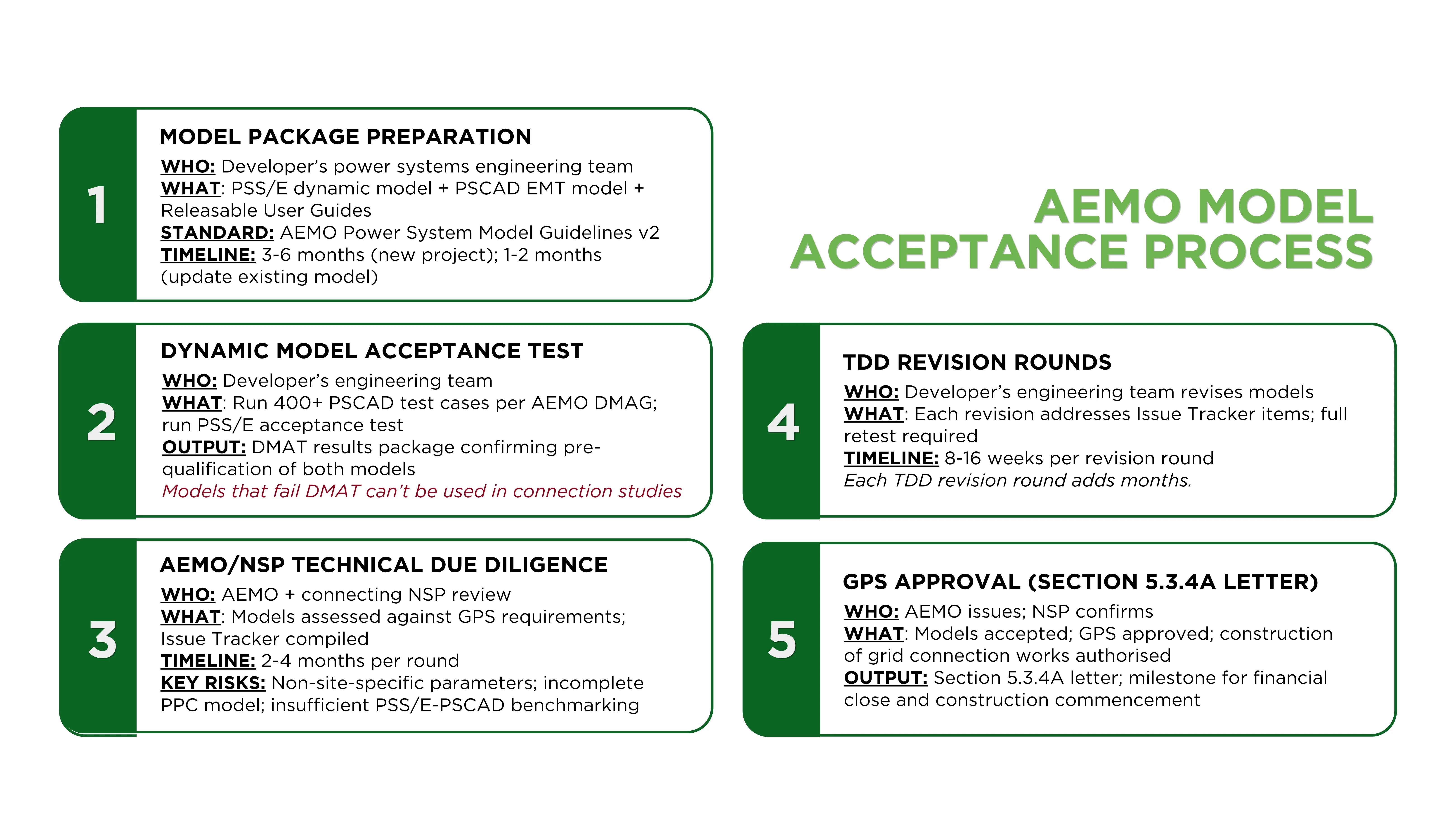
Model acceptance follows a structured process tied to the R1 GPS submission:
- Model Package Preparation: The developer's engineering team prepares the PSS/E and PSCAD model packages in accordance with AEMO's Power System Model Guidelines v2. This includes the model files, releasable user guides explaining the model structure, and the documentation required under NER S5.2.4.
- Dynamic Model Acceptance Test (DMAT): Both PSS/E and PSCAD models must pass the Dynamic Model Acceptance Test before they can be used in connection studies. The acceptance tests required by the DMAG will involve over 400 simulation cases in the PSCAD software for a single generator.These cases are defined in AEMO's DMAG and cover fault ride-through, voltage step response, frequency step response, and reactive power regulation across the full range of operating conditions defined in the GPS.
- Technical Due Diligence (TDD): AEMO and the NSP review the submitted models and DMAT results. Issues identified during TDD are recorded in an Issue Tracker and returned to the applicant for resolution. Multiple TDD rounds are the primary reason GPS approvals take 18 months or more on complex projects.
- R1 GPS Approval: Once the models are accepted and GPS compliance is demonstrated, AEMO issues a Section 5.3.4A letter confirming GPS approval and authorising construction of the grid connection works.
What Changed in 2025 for PSS/E?
AEMO is transitioning from PSS®E version 34 to version 36 for all NEM connection studies. This is to address critical software support and cyber security issues.
AEMO will begin requiring dynamic model source code in both PSS®E versions 34 and 36 from 4 August 2025 with the full transition to be completed by Q1 2027. This version transition has significant practical implications for developers and engineering teams:
- Dual-Version Submission: From August 4, 2025, AEMO requires model source code in both PSS/E v34 and v36 for all new submissions. Models that were previously qualified in v34 alone are no longer sufficient for new connection studies.
- Model Conversion Requirement: Dynamic models coded for PSS/E v34 must be converted and validated in v36.
- OEM Coordinated Required: The transition will require a coordinated effort from industry including NSPs, applicants/developers and OEMs. Equipment vendors who supply PSS/E dynamic models for their inverters and transformers must also provide v36 compatible models, and the timeline for OEM model updates is not always aligned with developer connection application timelines.
For developers with active GPS applications that commenced under v34, or projects approaching the R1 submission stage, the v34/v36 transition adds a specific new workstream that must be planned and resourced.
Build Models That Pass. Partner with ElectraGlobe
PSS/E and PSCAD modelling for Australian renewable energy GPS applications is a specialist discipline. It requires deep familiarity with AEMO's Power System Model Guidelines, the DMAG test requirements, the NER Schedule 5.2 GPS framework, and the specific control system architectures of the inverter and BESS equipment being connected.
ElectraGlobe’s power systems engineering team builds and validates PSS/E and PSCAD models to AEMO's current requirements:
- Dual v34/v36 PSS/E model packages required from August 2025
- DMAG pre-qualification testing
- GPS TDD management
- R2 on-site validation support.
Whether you are preparing a new R1 GPS submission, updating existing models for the PSS/E v36 transition, or navigating the additional IRS modelling requirements of a hybrid solar-plus-BESS project, our team has the depth and current regulatory knowledge to get your models accepted.
Contact ElectraGlobe to discuss PSS/E and PSCAD modelling support for your project.
FAQ
What is the difference between PSS/E and PSCAD in the context of AEMO grid connection?
PSS/E performs steady-state load flow analysis and positive-sequence dynamic simulations using simplified, computationally efficient models of generators and inverters. PSCAD performs electromagnetic transient (EMT) simulations at microsecond resolution, capturing the detailed switching dynamics of power electronic inverters, sub-cycle fault ride-through behaviour, harmonic performance, and control system interactions that PSS/E's simplified models cannot represent.
Why does AEMO require over 400 PSCAD simulation cases for a renewable energy GPS application?
These cases cover the full range of operating conditions, fault types, and voltage profiles that the GPS framework requires the generator to demonstrate ride-through capability for. This includes partial voltage dips, remote faults, sequential faults, frequency step events, and reactive power step events, at multiple active power output levels and connection point voltage levels.
What does the PSS/E version 34 to version 36 transition mean for renewable energy developers in Australia?
AEMO will begin requiring dynamic model source code in both PSS®E versions 34 and 36 from 4 August 2025 with the full transition to be completed by Q1 2027. The transition will require a coordinated effort from industry including NSPs, applicants/developers and OEMs.