
Data centres are becoming one of the most important energy consumers in the digital economy. At the same time, data centre operators are under growing pressure to reduce emissions, improve energy efficiency and secure reliable electricity supplies.
This is creating a significant opportunity for renewable energy for data centres.
Solar PV, battery energy storage systems (BESS), grid-connected renewable power and hybrid energy systems can help data centres address some of their biggest energy challenges. However, integrating these technologies into mission-critical infrastructure requires careful electrical engineering, power system studies and grid planning.
Why Does Renewable Energy Matter for Data Centres?
The International Energy Agency (IEA) projects that global data centre electricity consumption could roughly double from around 485 TWh in 2025 to approximately 950 TWh by 2030.
AI-focused data centres are expected to grow even faster as high-performance computing increases. This creates two connected challenges:
- How to supply enough electricity
- How to supply it reliably and sustainably
The IEA expects renewables to meet nearly half of the additional electricity demand from data centres through 2030, driven largely by the growth of solar PV and wind generation.
For data centre developers and operators, renewable energy is therefore becoming more than a sustainability initiative. It can form part of a broader energy strategy focused on:
- Reducing reliance on carbon-intensive electricity
- Increasing access to clean electricity
- Managing long-term energy costs
- Improving energy resilience
- Supporting corporate emissions targets
How Can Solar Power Support Data Centres?
Solar PV is one of the most accessible renewable energy technologies for data centre developments. Depending on site conditions and available land or roof space, solar can be deployed directly on or near a data centre or through larger off-site renewable energy projects.
On-Site Solar PV
On-site solar can generate electricity close to where it is consumed. This can reduce the amount of power that needs to be imported from the grid during periods of solar generation.
However, data centres operate around the clock, while solar generation varies throughout the day. This means solar PV alone cannot generally provide continuous power for a mission-critical facility, which is a limitation where energy storage becomes important.
Off-Site Renewable Energy
Data centre operators can also procure renewable electricity from external solar and wind projects through mechanisms such as power purchase agreements (PPAs). This approach can provide access to substantially more renewable generation than a facility could accommodate.
However, renewable procurement should not be confused with physical energy independence. A data centre still needs robust grid infrastructure and appropriate backup systems to maintain continuous operations.
Uptime Institute has also highlighted the increasing use of PPAs and large-scale battery deployments as part of data centre sustainability strategies, while cautioning that renewable energy procurement needs to be considered carefully alongside grid reliability and broader energy-system impacts.
What Is the Role of BESS in Renewable Energy for Data Centres?
Battery energy storage systems can help bridge the gap between renewable generation and data centre demand. They store electricity when energy is available and release it when required. When paired with solar PV, this can make renewable generation more flexible.
During periods of strong solar production, excess electricity can be directed into the battery. The stored energy can then be discharged when solar output falls or when grid conditions and electricity prices make it beneficial.
Several potential BESS applications in data centres have been identified, including:
- UPS support
- Peak shaving
- Renewable energy shifting
- Power balancing
However, it should also be noted that large-scale BESS deployment in data centres remains an emerging area, and batteries should currently be viewed as complementary to conventional generation and grid infrastructure rather than a universal replacement.
BESS Can Provide More than Energy Storage
For data centre applications, the value of BESS extends beyond simply storing renewable electricity. Depending on the operating strategy, BESS can potentially support:
- Peak demand management
- Renewable energy shifting
- Power quality
- Short-duration backup
- Energy arbitrage
- Demand response
- Microgrid operation
The exact application depends on the facility's electrical architecture, grid connection, battery technology, duration requirements and operational objectives.
Solar and BESS: Building a More Flexible Energy System
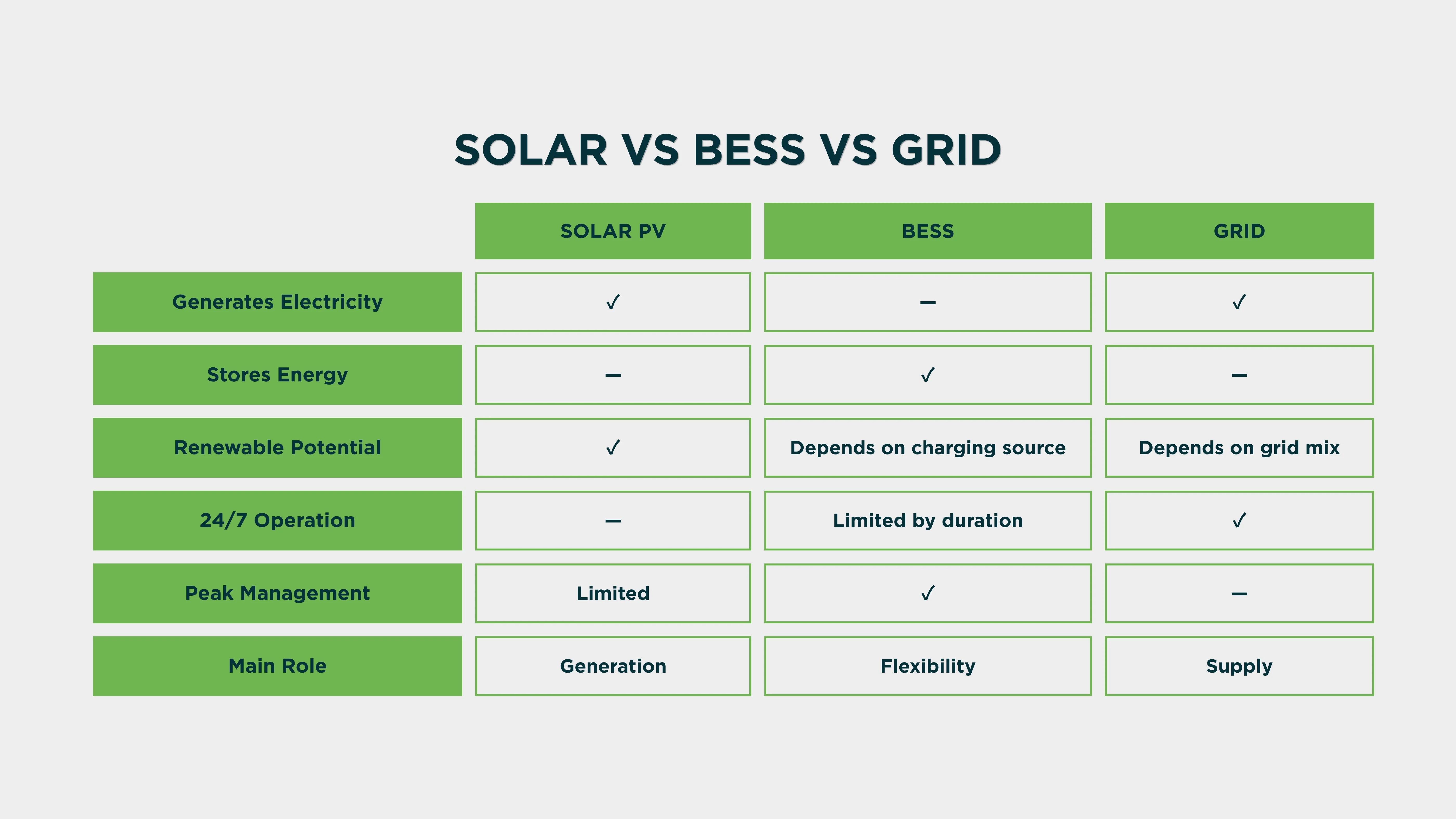
The strongest opportunity may not be solar or BESS individually, but the integration of both technologies. A solar and BESS system for a data centre can be designed as part of a wider hybrid energy architecture, with each component performing a different role.
- Solar provides renewable generation.
- BESS provides flexibility and fast response.
The grid provides large-scale electricity supply. Backup generation can provide additional resilience where required. An energy management system coordinates these assets based on operating conditions. This integrated approach is particularly relevant as data centre loads become larger and more complex.
Designing Renewable Energy Systems Around Data Centre Loads
The first step in designing renewable energy for a data centre should be understanding the facility's electrical demand. Important questions include:
- What is the peak load? AI and high-performance computing can significantly increase power density. Understanding peak demand is essential when sizing electrical infrastructure, renewable generation and storage.
- How consistent is the load? Rapid changes in computing demand can introduce additional requirements for power management.
- When is electricity consumed? Understanding hourly load profiles helps engineers determine how much solar generation can be consumed directly and how much may need to be stored or exported.
- How much energy storage is required? A high-power, short-duration battery may be suitable for fast-response applications, while a longer-duration system may be better suited to renewable energy shifting.
Grid Connection Is a Critical Part of the Strategy
Renewable energy does not eliminate the need for a robust grid connection. In fact, as data centre loads increase, grid capacity can become one of the most significant constraints.
The IEA notes that data centres can often be built faster than the broader energy infrastructure needed to supply them, creating potential bottlenecks around grid connections and energy equipment. Early electrical engineering can therefore help developers understand:
- Available network capacity
- Connection requirements
- Import and export limits
- System strength
- Protection requirements
- Power quality impacts
- Renewable generation constraints
- BESS operating limits
This is particularly important when solar and BESS are intended to operate alongside a large grid-connected load.
Renewable Energy for Data Centres Requires an Engineering-Led Approach
Solar and BESS can play an important role in building cleaner, more resilient data centre infrastructure. But the technologies themselves are only part of the solution.
The real value comes from designing the electrical system around the facility's operational requirements. That means considering renewable generation, battery storage, grid connection, power quality, protection, and system performance as one integrated engineering problem.
For data centre developers, this approach can help create an energy strategy that is not only more sustainable but also technically robust and scalable.
Power the Next Generation of Data Centre Infrastructure with ElectraGlobe
The transition toward renewable-powered digital infrastructure requires engineering expertise across solar, BESS, hybrid systems and grid integration.
ElectraGlobe provides end-to-end renewable energy engineering for utility-scale solar, BESS and hybrid energy projects across Australia, with capabilities spanning:
- Concept Design
- Detailed Engineering
- Grid Connection Studies
- AEMO GPS Applications
- Power system studies, owner's engineering and construction management.
For organisations exploring renewable energy for data centres, solar PV, BESS or hybrid energy systems, the right engineering strategy can help turn energy goals into a technically viable project. Talk to ElectraGlobe about your renewable energy project.
FAQ
What is renewable energy for data centres?
Renewable energy for data centres refers to using renewable electricity sources such as solar and wind to meet some or all of a data centre's electricity requirements. This can involve on-site solar, off-site renewable projects, PPAs, BESS and hybrid energy systems.
Can solar power alone run a data centre?
Solar power alone generally cannot guarantee continuous data centre operation because solar generation varies with daylight and weather conditions. Solar can instead be combined with BESS, grid electricity and appropriate backup systems to create a more flexible and resilient energy strategy.
Why is BESS important for renewable-powered data centres?
BESS can store renewable electricity and discharge it when needed. Depending on the system design, it can also support peak demand management, renewable energy shifting, power quality, grid services and short-duration backup applications. Its role should be determined by the data centre's load profile, reliability requirements and grid conditions.