
Hyperscalers, colocation providers, and AI infrastructure investors are racing to secure sites, power, and connection approvals across New South Wales, Victoria, and Queensland.
However, the rules for getting connected have changed significantly.
New federal expectations now push data centres toward majority renewable power. At the same time, transmission network service providers like Transgrid have tightened the technical and commercial requirements developers must satisfy before a project gets anywhere near the grid.
For anyone planning a facility in this market, understanding both layers of regulation helps projects get built on schedule and one that stalls at the connection queue. This guide breaks down what's changed, why it matters, and how developers can plan ahead.
Why Is Australia Tightening the Rules on Data Centres?
Data centres are no longer a minor line item on the National Electricity Market (NEM). Australian data centres consumed roughly 4 terawatt-hours of electricity in the 2024–25 financial year, about 2% of total grid-supplied electricity. The Australian Energy Market Operator expects that share to climb to as much as 6% by 2030 as AI workloads scale up.
That growth is arriving at a delicate moment for the grid. Coal plants are retiring, new transmission is under construction, and network operators are trying to keep prices stable while integrating record volumes of renewables and storage.
A handful of large, power-hungry data centre campuses landing in the wrong place, at the wrong time, could strain local networks and push costs onto everyday households and businesses. That's the problem the new rules are designed to solve.
The Federal Push: Majority Renewable-Powered Data Centres
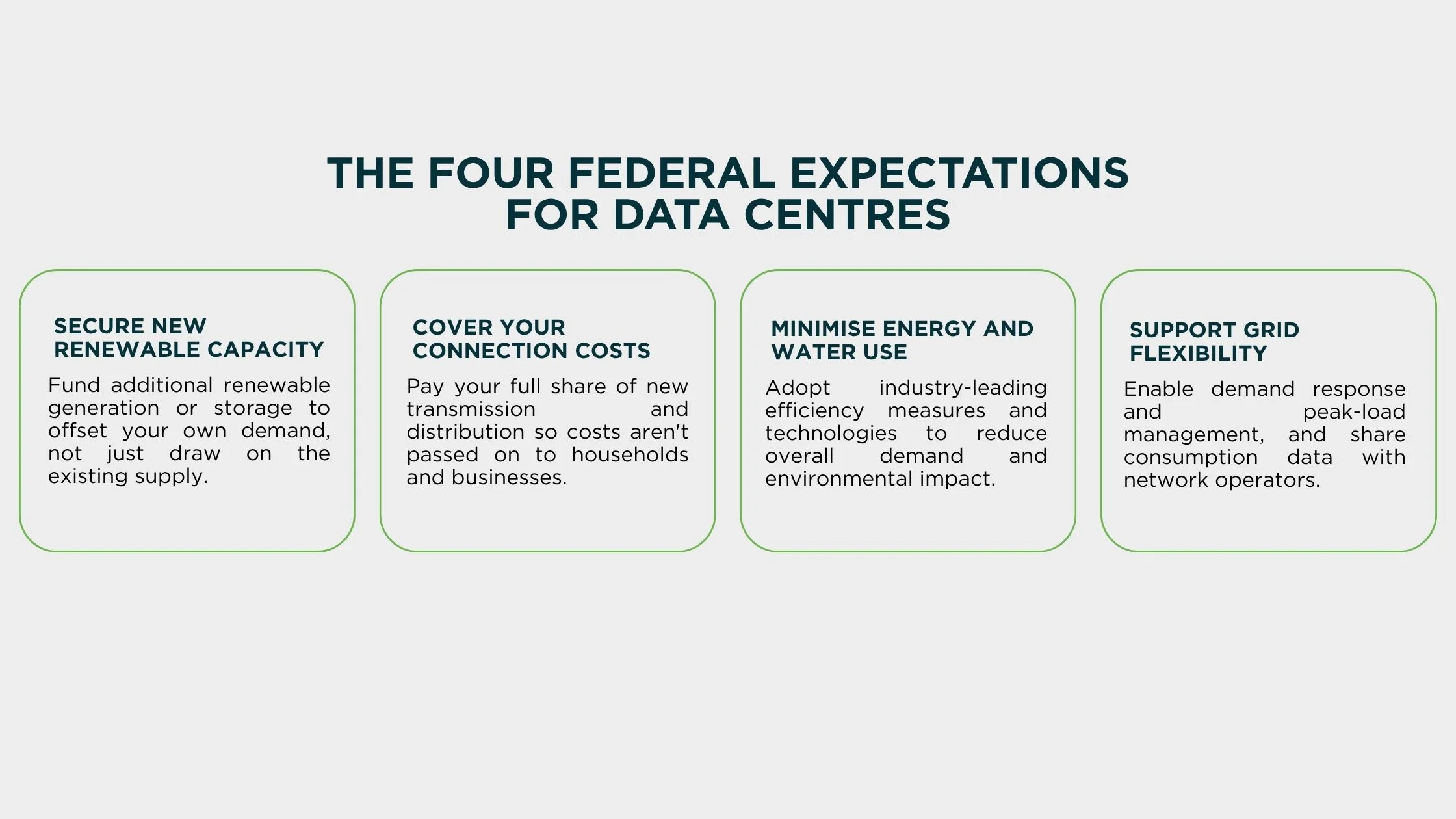
The federal government confirmed that new data centres will be expected to be majority renewable-powered, formalising an approach first flagged under the National AI Plan.
The policy sits inside a broader document called Expectations of Data Centres and AI Infrastructure Developers, released jointly by the Minister for Energy and Climate Change and the Assistant Minister for Science, Technology and the Digital Economy.
The expectations set out that data centre and AI infrastructure operators should:
- Secure new, additional renewable generation or storage capacity to offset their demand.
- Cover their full share of transmission and distribution connection costs, so the bill doesn't land on households and other businesses.
- Minimise energy and water demand through best-practice efficiency technologies.
- Support grid stability through demand flexibility, including peak-load management and, where appropriate, sharing consumption data with network operators.
Crucially, the government has linked compliance to project prioritisation. Proposals that align closely with the expectations will be fast-tracked through Commonwealth regulatory assessment. Those that don't align risk being pushed to the back of the queue.
State-level bodies are reinforcing the same direction. In New South Wales, the state's Net Zero Commission has proposed that data centres should:
- Fund new renewable generation commensurate with their own demand
- Contribute to grid reliability by limiting consumption during peak periods
- Meet world-leading energy and water efficiency standards with public reporting
Transgrid's Rules: What Developers Actually Have to Navigate
Policy expectations are one layer. The practical, day-to-day compliance burden sits with the transmission network service providers who actually connect projects to the grid, and in NSW and the ACT, that's Transgrid.
Transgrid operates the high-voltage backbone of the NSW network: more than 13,000 kilometres of transmission lines and over 100 substations, all feeding into the NEM.
Any data centre load large enough to connect directly to transmission, rather than through a local distributor, has to work through Transgrid's framework under the National Electricity Rules.
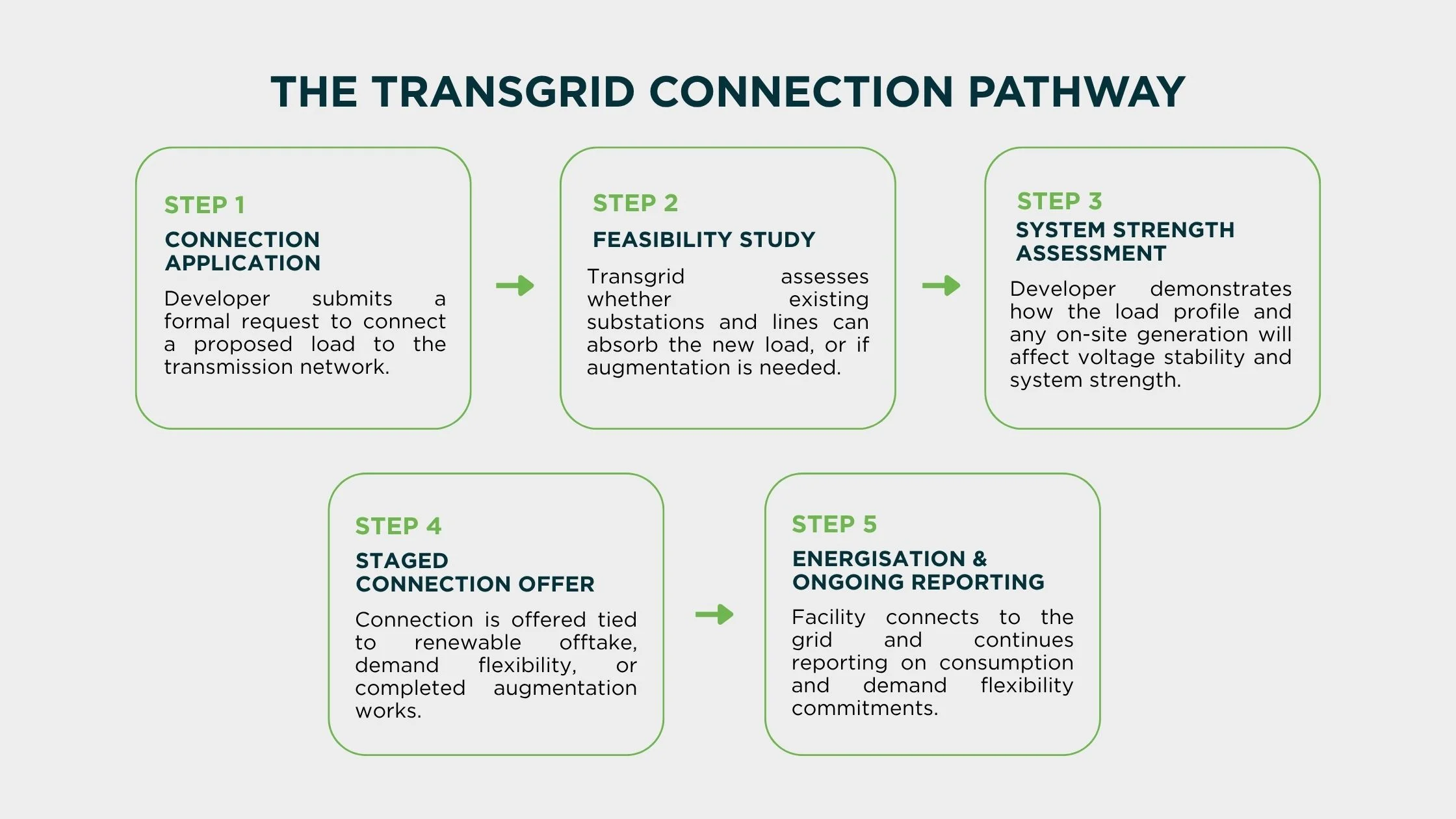
For developers, that framework typically involves:
- Formal Connection Applications and Feasibility Studies: Before a data centre can secure a connection offer, Transgrid needs to assess how the proposed load will interact with the existing network, including whether local substations and lines have the headroom to absorb it, or whether augmentation is required first.
- System Strength and Stability Obligations: Large, continuous loads can affect voltage stability and system strength in ways that intermittent renewable generation doesn't. Developers may need to demonstrate how their load profile, power factor correction, and any on-site generation or storage will interact with the network under both normal and stressed conditions.
- Cost-Reflective Connection Charges: In line with the federal expectations, developers are expected to fund the augmentation their project actually triggers, rather than having those costs socialised across all network users.
- Staged and Conditional Connection Offers: Transgrid may issue connection agreements in stages, tied to milestones such as confirmed renewable offtake, demand flexibility commitments, or network augmentation being completed.
- Demand Flexibility and Reporting Commitments: Consistent with the national expectations, some connection agreements now build in requirements around load shedding capability, peak-period demand response, and ongoing consumption reporting.
The practical effect is that a data centre developer in NSW isn't just negotiating a connection point and a megawatt allocation. They're also negotiating a technical, commercial, and reporting relationship that has to satisfy both Transgrid's engineering standards and the federal government's renewable and cost-sharing expectations at the same time.
What Does This Mean for Data Centre Developers Right Now?
Pulling the federal expectations and Transgrid's connection requirements together, a few practical takeaways stand out for anyone planning a facility in Australia:
- Bring your renewable strategy to the table early. Waiting until after a connection agreement is signed to think about renewable offtake or on-site storage is now a competitive disadvantage.
- Budget for your full share of network costs. Cost-reflective connection charging is now the expectation. Early feasibility and cost studies matter more than ever.
- Design for demand flexibility. Facilities that can demonstrably shift or shed load during peak periods will have an easier path through both federal prioritisation and network connection negotiations.
- Treat compliance as a technical engineering problem. System strength, power quality, and grid stability studies are where renewable ambition meets network reality.
The Grid Is Ready If Developers Plan Around It
The good news for developers is that Australia's renewable and storage pipeline is expanding fast enough to support this shift.
Renewable energy sources, including storage, supplied 51% of the NEM's quarterly electricity demand for the first time in the December 2025 quarter, up from 46% a year earlier.
At the same time, storage now makes up more than a quarter of AEMO's record project pipeline, with battery systems dominating new connection applications as developers race to firm up variable wind and solar output. That combination of rising renewable supply and rapidly scaling storage is exactly what majority renewable-powered data centres will need to draw on.
The opportunity for developers is to treat renewable and storage procurement as part of the data centre project itself.
How ElectraGlobe Helps Data Centres Meet Australia’s Renewable and Grid Requirements
Meeting these requirements takes engineering that can withstand scrutiny from AEMO, transmission network service providers, and regulators. This is where ElectraGlobe comes in.
ElectraGlobe is a renewable energy engineering consultancy, covering utility-scale solar, battery energy storage systems (BESS), and hybrid energy projects. For data centre developers navigating the current regulatory environment, ElectraGlobe's team can support:
- Grid connection studies, including full DNSP and transmission application packages, feasibility assessments, and connection agreement negotiation support.
- AEMO Generator Performance Standard (GPS) applications, under NER Chapter 5 and 5A, for any co-located or offsetting generation and storage assets.
- Power system studies, including PSS/E and PSCAD modelling, to demonstrate how a data centre's load will behave under real network conditions.
- Power quality analysis, covering harmonics, flicker, and voltage stability, which matter enormously for continuous, high-density data centre loads.
Get in touch with ElectraGlobe for your data centre project. Our engineering team can help design and de-risk that pathway from concept through commissioning.
FAQ
Does every new data centre in Australia have to be majority renewable-powered?
The federal government's expectations apply to new data centre and AI infrastructure proposals seeking Commonwealth support or prioritisation. Projects that align closely with the renewable and grid-cost expectations will be prioritised in regulatory assessment.
What makes Transgrid's data centre connection process different from a standard grid connection?
Data centres present a large, continuous, highly predictable load rather than the variable generation profile Transgrid is more used to managing from wind and solar projects. That means connection assessments focus heavily on system strength, voltage stability, and cost-reflective charging, and large loads may face staged or conditional connection offers tied to renewable offtake and demand flexibility commitments.
How can a data centre developer demonstrate compliance with the renewable energy expectations?
In practice, this means securing new, additional renewable generation or storage capacity, rather than relying solely on existing grid-supplied renewable energy. Supporting technical studies, such as AEMO GPS applications and grid connection feasibility assessments, help demonstrate that the renewable strategy is genuine and technically sound.