
Detail engineering is the engineering phase where an approved basic engineering package is converted into fully detailed, construction-ready documents, including engineering calculations, final layouts, equipment schedules, and Issued for Construction (IFC) packages.
The IFC design package for a solar farm is not a single document. It is a controlled set of drawings, calculations, schedules, and specifications that have progressed through IFR (internal review) and IFA (client approval) stages and have been formally authorised as the definitive technical reference for construction.
Every cable size in the field, pile depth, protection relay setting, conduit route, and earthing point trace back to the IFC package.
This guide explains what a complete solar farm IFC design package contains, why each discipline's deliverables exist, and what separates a package that enables smooth construction from one that generates costly field queries and rework.
What Does the IFC Status Actually Mean on a Solar Farm Project?
IFC isn’t simply the final version of a drawing. It’s a formal status designation that carries specific legal and contractual meaning.
IFC drawings are the legal, operational, and coordination foundation of a project. Among construction drawings, IFC drawings are the most critical. They represent the approved, authorised version that the contractor is entitled and required to build from.
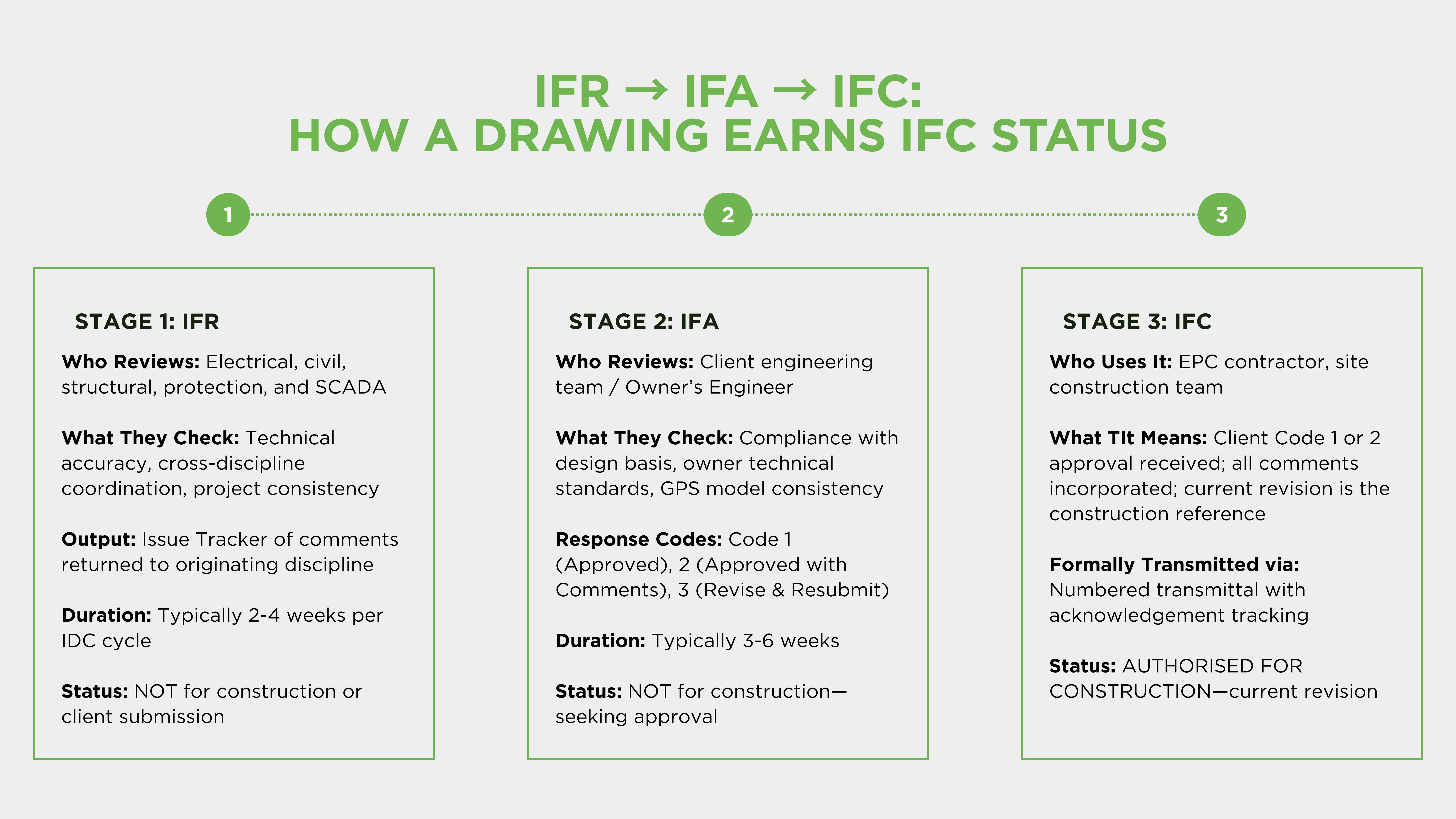
For a drawing to carry IFC status on a solar farm project, it must have:
- Completed internal inter-owner's engineer discipline review (IDC)
- Received client or engineer approval (Code 1 or Code 2 response to the IFA)
- Had all IFA comments formally incorporated into the drawing
- Been assigned the next revision designation in the project's numbering convention
Every drawing should have a revision indicator in its title block along with a revision date and a brief description of what changed. For projects involving multiple revision cycles, a revision cloud on the drawing should highlight the specific areas that changed in each revision, so field supervisors can quickly identify what differs from the version they previously worked with.
A drawing that has not passed through this complete review and approval cycle is not IFC. Confusing IFA with IFC, or issuing drawings marked IFC before client approval, is one of the most common and consequential document control failures on solar farm projects.
What Disciplines Contribute to a Solar Farm IFC Package?
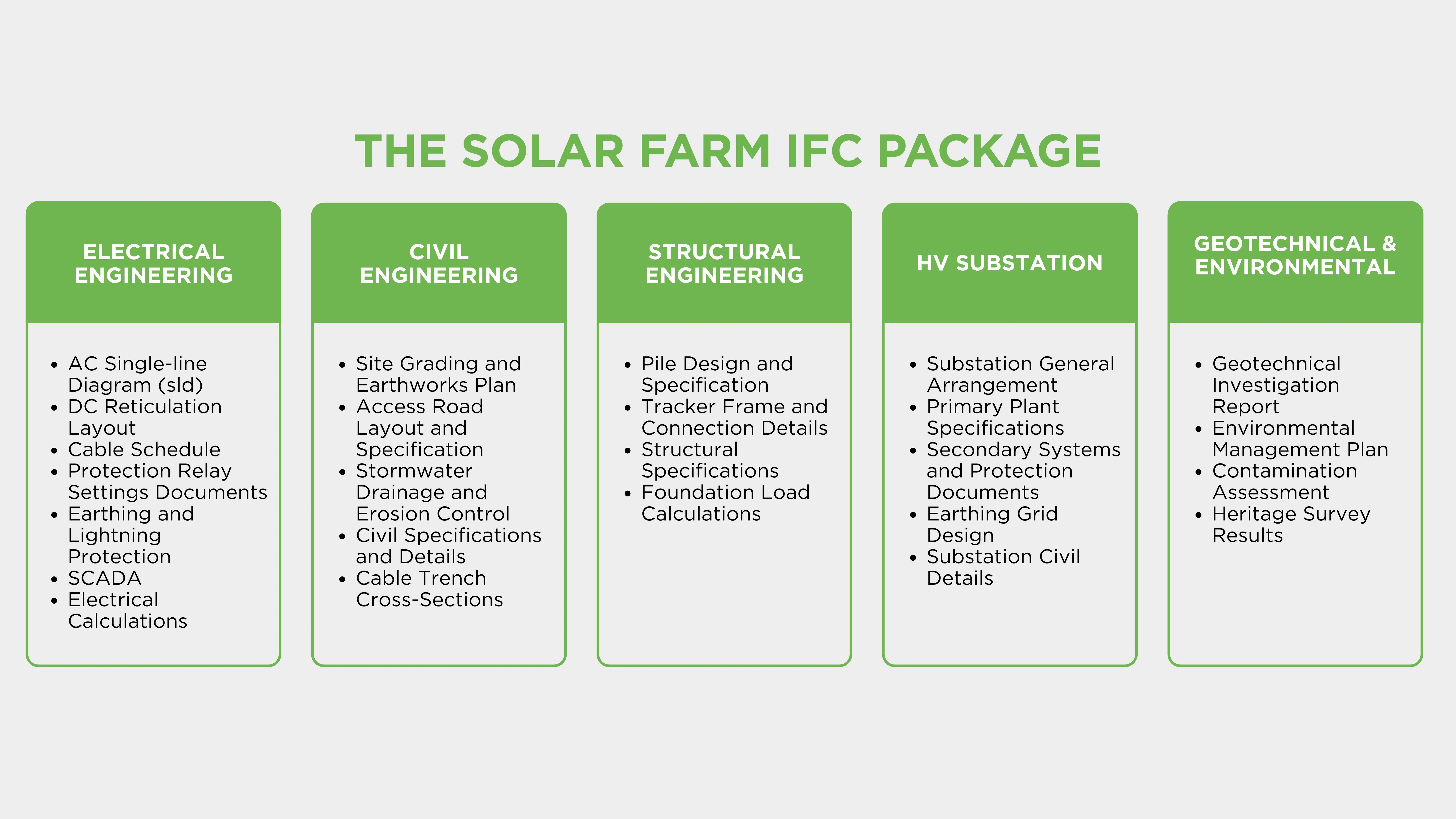
A utility-scale solar farm IFC design package spans five engineering disciplines. Each produces its own set of controlled deliverables. All five must be coordinated because a change in one discipline's drawings frequently affects all the others.
Electrical Engineering IFC Deliverables
The electrical IFC package is typically the most complex and most referenced set of documents on a solar farm project. It establishes the electrical architecture from the PV module strings through to the grid connection point.
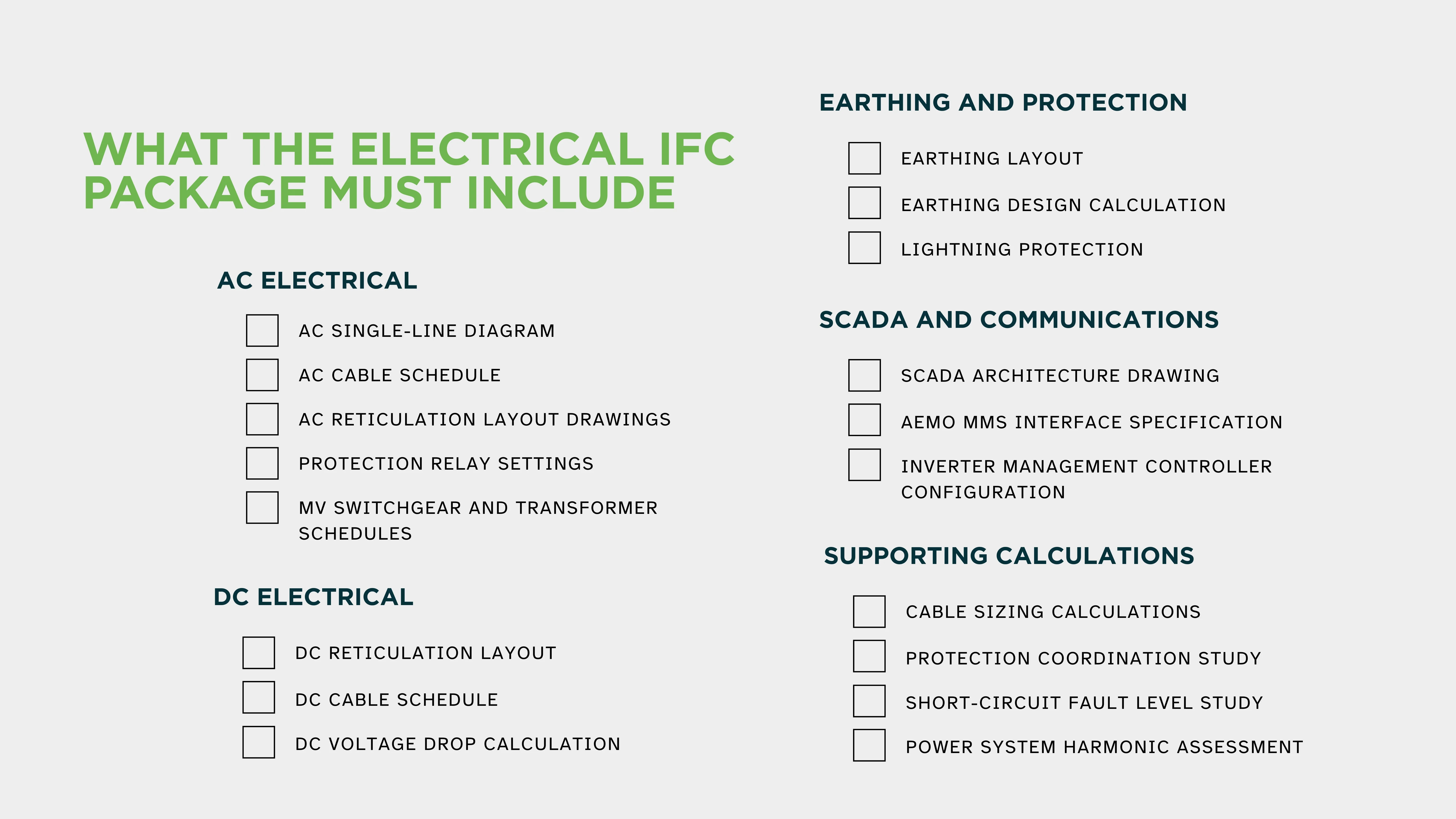
- AC Single-Line Diagram (SLD): The Single Line Diagram is the master electrical schema for a solar farm. The IFC SLD must show every inverter block, every medium-voltage (MV) feeder, every transformer designation, protection relay type and location, metering arrangement, and grid connection point configuration.
- DC Reticulation Layout: This shows string groupings, combiner box locations, DC cable routing from module strings to string combiner boxes to inverter DC inputs. At IFC stage, cable sizes must be confirmed against AS/NZS 3008.1.1:2025 calculations.
- AC Cable Schedule: The IFC cable schedule lists every cable on the project with its unique identifier, specification, from/to routing, estimated length, and voltage drop calculation reference. This document drives procurement and is the primary reference for the construction team during cable installation.
- Protection Relay Settings: Protection relay settings documents specify the relay type, firmware version, and complete parameter set for every protection relay in the collection system and substation. These settings are derived from the protection coordination study and must be formally approved by the owner's engineer before IFC issue.
- Earthing and Lightning Protection Layout: Shows the earthing grid design, earthing conductor sizes and burial depth, earthing electrodes, and lightning protection air termination network. The IFC earthing drawing must be consistent with the earthing design calculation confirming the touch and step voltage limits are met.
- SCADA and Communications Architecture: The SCADA IFC package shows the communications network topology and defines the interface between the site SCADA system, the inverter management controllers, and AEMO's Market Management System.
Civil Engineering IFC Deliverables
The civil IFC package defines every earthworks and infrastructure element of the solar farm site.
- Site Grading and Earthworks Plan: Shows existing and finished levels across the site, earthworks cut and fill volumes, slope stabilisation measures, and the grading required for tracker row installation. The grading plan must accommodate tracker installation tolerances (typically ≤10–15% slope in the tracker direction) while minimising earthworks volume and preserving the site's drainage characteristics.
- Access Road Layout and Specification: Defines access road routes, widths, construction materials (gravel, crushed rock, sealed pavement), and design loading. Access roads must accommodate the heaviest construction vehicles and must be maintained throughout the project's operational life for O&M access.
- Stormwater Drainage and Erosion Control: Shows the drainage network design designed to manage stormwater from the developed site without increasing peak flows or erosion risk at downstream watercourses. The stormwater design must be consistent with the planning consent conditions and the environmental management plan.
- Civil Specifications and Details: Standard civil details covering concrete specifications, compaction requirements, erosion control installation, fencing details, and cable trench cross-sections. These details ensure that site-specific conditions translate into consistent construction quality across the full site footprint.
Structural Engineering IFC Deliverables
The structural IFC package covers the foundations and mounting structure for the solar panels.
- Pile Design and Specification: Foundation design with calculated embedment depths based on actual soil investigation data is a non-negotiable component of the IFC structural package. At IFC stage, pile embedment depths are based on the results of the geotechnical investigation, not assumed from regional defaults.
- Tracker Frame and Connection Details: Structural drawings for the tracker rail system, torque tube connections, drive pile connections, and end-of-row frame details. These drawings are produced in conjunction with the tracker manufacturer and must reflect the actual equipment being installed.
- Structural Specifications: Materials, coating systems, fastener specifications, and quality control requirements for all structural steelwork. At IFC stage, specifications are aligned with the equipment bill of materials from the tracker and mounting supplier.
High-Voltage / Substation IFC Deliverables
For projects connecting at transmission voltage, the on-site substation requires its own IFC package.
- Substation General Arrangement: Shows the physical layout of the substation yard. At IFC stage, the GA is based on actual equipment dimensions from the transformer and switchgear manufacturers. Equipment placement must accommodate maintenance access clearances and electrical safety distances.
- Primary Plant Specifications: IFC specifications for the main power transformer, high-voltage switchgear (circuit breaker, disconnectors, instrument transformers), and surge arresters, specifying technical ratings, quality standards, factory acceptance test requirements, and delivery schedule requirements.
- Secondary Systems and Protection: Protection relay configuration, SCADA interface, auxiliary power distribution within the substation, and interlock schemes. These deliverables are closely coordinated with the protection relay settings documents from the electrical discipline and must be consistent with the GPS R1 model assumptions.
Geotechnical and Environmental IFC Deliverables
While not traditional engineering drawings, several geotechnical and environmental deliverables are included in or referenced by the IFC package.
- Geotechnical Investigation Report: The final geotechnical report is referenced by the structural IFC drawings and provides the technical basis for pile specification and earthworks design.
- Environmental Management Plan (EMP): The IFC EMP defines the environmental controls that must be in place during construction. The EMP is a planning consent condition on most Australian solar farm projects and must be formally incorporated into the construction contract.
What Separates a Complete IFC Package from an Incomplete One?
The test for a complete IFC package is simple: can a competent construction team build the solar farm from this package alone, without requiring additional design information?
- If yes, the package is complete.
- If the construction team would need to make any assumptions, it’s not complete
Version control failures are among the most preventable causes of rework on solar projects. EPCs should insist that all approved drawing sets are distributed through a controlled document register rather than email attachments, which are easily forwarded out of context.
The most common IFC package deficiencies on Australian solar farm projects are:
- Protection relay settings not issued with the electrical IFC package. This is the most dangerous omission. A solar farm energised without formally approved protection settings may not have adequate protection against fault conditions.
- Cable schedule sizes based on IFA assumptions. Cable sizes must be verified against AS/NZS 3008.1.1:2025 at IFC stage. A cable schedule issued at IFC with preliminary sizing creates procurement risk if cable sizes change after procurement.
- Pile specification based on assumed rather than tested soil conditions. Where the geotechnical investigation is not completed before the structural IFC package is issued, pile depths are necessarily conservative estimates. If actual soil conditions are worse than assumed, piles may need to be extended.
- SCADA configuration documents not coordinated with AEMO's requirements. The SCADA system must meet AEMO's specific requirements for market management system interface. An IFC SCADA specification prepared without reference to AEMO's SCADA interface specification will require revision.
- Interdiscipline coordination not completed. The electrical cable trench routing conflicts with the civil stormwater drainage. The pile layout conflicts with the earthing grid. These conflicts are discovered by the construction team, who must submit RFIs and wait for engineering responses.
Deliver Your Solar Farm IFC Package with ElectraGlobe
A complete, coordinated, and fully compliant IFC design package is the technical foundation that a solar farm is built on. The quality of the IFC package determines the quality of construction, the speed of commissioning, and the accuracy of the as-built documentation that the asset operator relies on for the next 25 to 35 years.
ElectraGlobe is a renewable energy engineering consultancy, with an engineering team that delivers complete, coordinated IFC design packages across Australia. We work with EPC contractors, asset owners, and developers to produce construction-ready IFC packages:
- Fully coordinated across disciplines
- Verified against AS/NZS 3008.1.1:2025 and AS/NZS 3000
- Consistent with the GPS R1 model
- Supported by a controlled document register
Contact ElectraGlobe to discuss detailed engineering and IFC package delivery for your next solar farm project.
FAQ
What is an IFC design package for a solar farm?
An Issued for Construction (IFC) design package is the engineering phase where an approved basic engineering package is converted into fully detailed, construction-ready documents. For a utility-scale solar farm, the IFC package spans five engineering disciplines: electrical, civil, structural, high-voltage substation, and geotechnical/environmental.
What is the difference between an IFA drawing and an IFC drawing on a solar farm project?
IFA is the formal issue of a drawing to the client or owner's engineer for review and approval. The IFA drawing represents the design team's considered position and is ready for external scrutiny but has not yet received the client's formal approval. IFC is the drawing that has received client approval (typically Code 1 or Code 2 approval with comments incorporated) and is authorised as the construction reference.
How long does it take to produce an IFC design package for a utility-scale solar farm?
The timeline for producing a complete IFC design package depends on the project scale, the complexity of the grid connection and substation configuration, and the extent to which geotechnical and environmental inputs are available at the start of detailed engineering. For a typical 100–200 MW solar farm with a standard string inverter configuration, detailed engineering from preliminary design to a complete IFC package typically takes 6 to 12 months.