
Connecting a solar farm to the transmission network is a regulatory proving ground. Before your plant can operate commercially, you must demonstrate that it performs exactly as modelled.
Current injection testing for solar farms is one of the most critical on-system validation tests standing between your project and energisation. This article explains what current injection testing is, why it matters for solar farm grid connections in Australia, and how to avoid the mistakes that cause delays.
What Is Current Injection Testing?
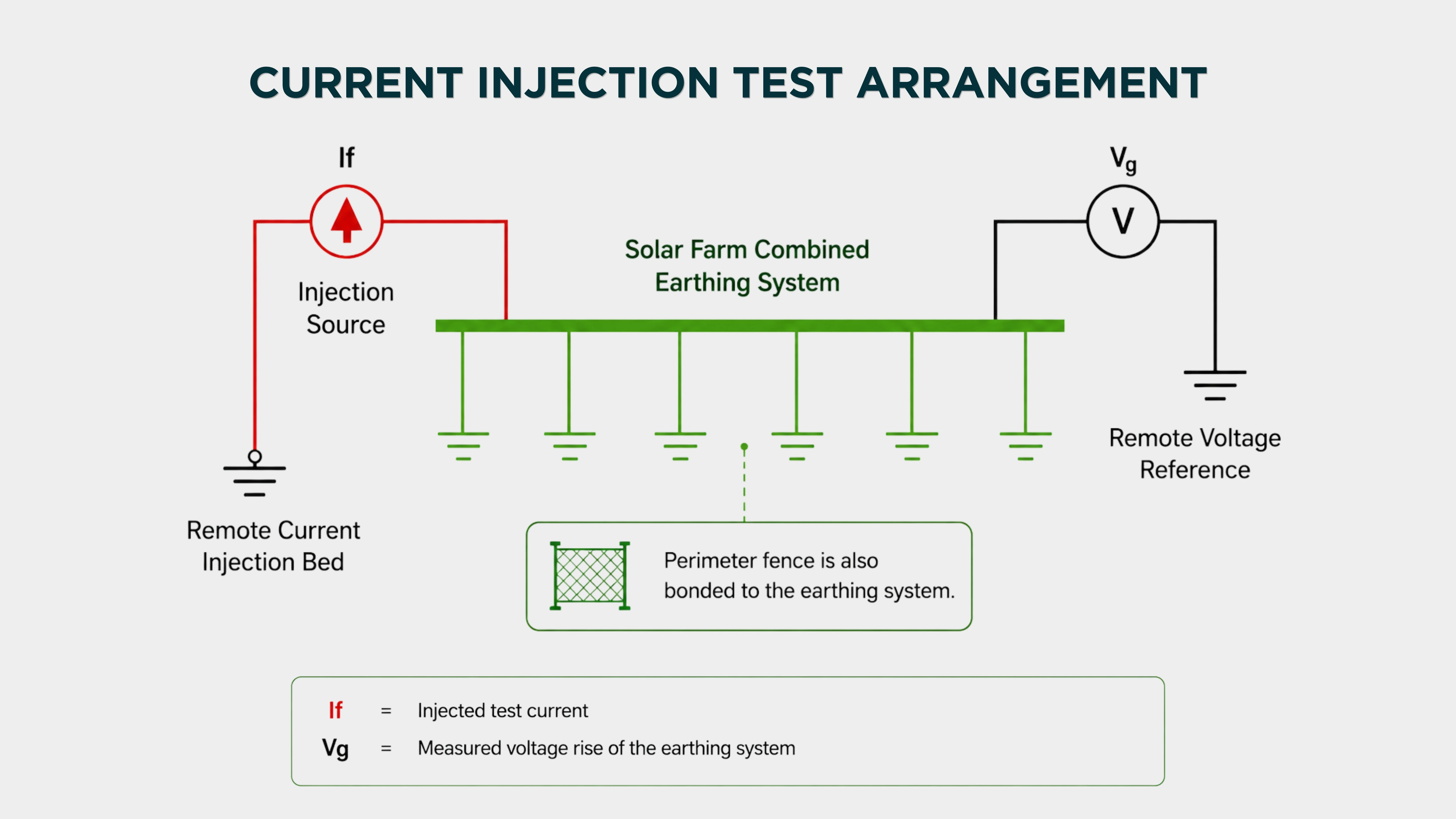
Current injection testing is a commissioning verification method. It’s used to confirm that a generating system's protection and control systems respond correctly to simulated fault conditions. It works by injecting a known current signal into protection relay circuits to verify their operation without exposing the live network to an actual fault.
For solar farms, current injection testing is a mandatory step in validating that protection systems meet the agreed Generator Performance Standards (GPS) before the plant is permitted to operate normally on the transmission network. It includes assessment of:
- Earthing system resistance
- Earth potential rise
- Step voltage
- Touch voltage
- Transfer voltage
- Fence and equipment bonding performance
- Hazardous contact scenarios around HV and LV equipment
Why Is Current Injection Testing Important for Solar Farms?
Solar farms generate power through inverters rather than synchronous machines. This means their fault response characteristics are fundamentally different from conventional generators.
During an earth fault, fault current can flow through the earthing system and create voltage gradients across the ground and bonded metallic structures. If not properly controlled, these voltages can create hazardous conditions for:
- Site personnel
- Maintenance contractors
- Network operators
- Members of the public near the site boundary
Protection systems must be precisely configured to detect, isolate, and respond to faults within defined time windows. The National Electricity Rules (NER) require generators to demonstrate compliance with agreed access standards through commissioning tests, including protection verification. If a protection system does not respond correctly during current injection testing, the plant cannot progress to full R2 on-system model validation.
Errors caught late carry significant cost. Delays at this stage push back commercial operation, impact revenue forecasts, and can trigger penalties under the Transmission Connection Agreement (TCA).
What Is Checked During the Test?
Current injection testing for a solar farm may assess multiple areas, including:
- Inverter stations
- Transformer locations
- HV switchgear
- LV switchboards
- Cable routes
- Earth grid connections
- Equipment earth bars
- Perimeter fencing
The final test report should record measured voltages, scaled voltages, hazard type, applicable safety limits, and pass/fail compliance outcomes.
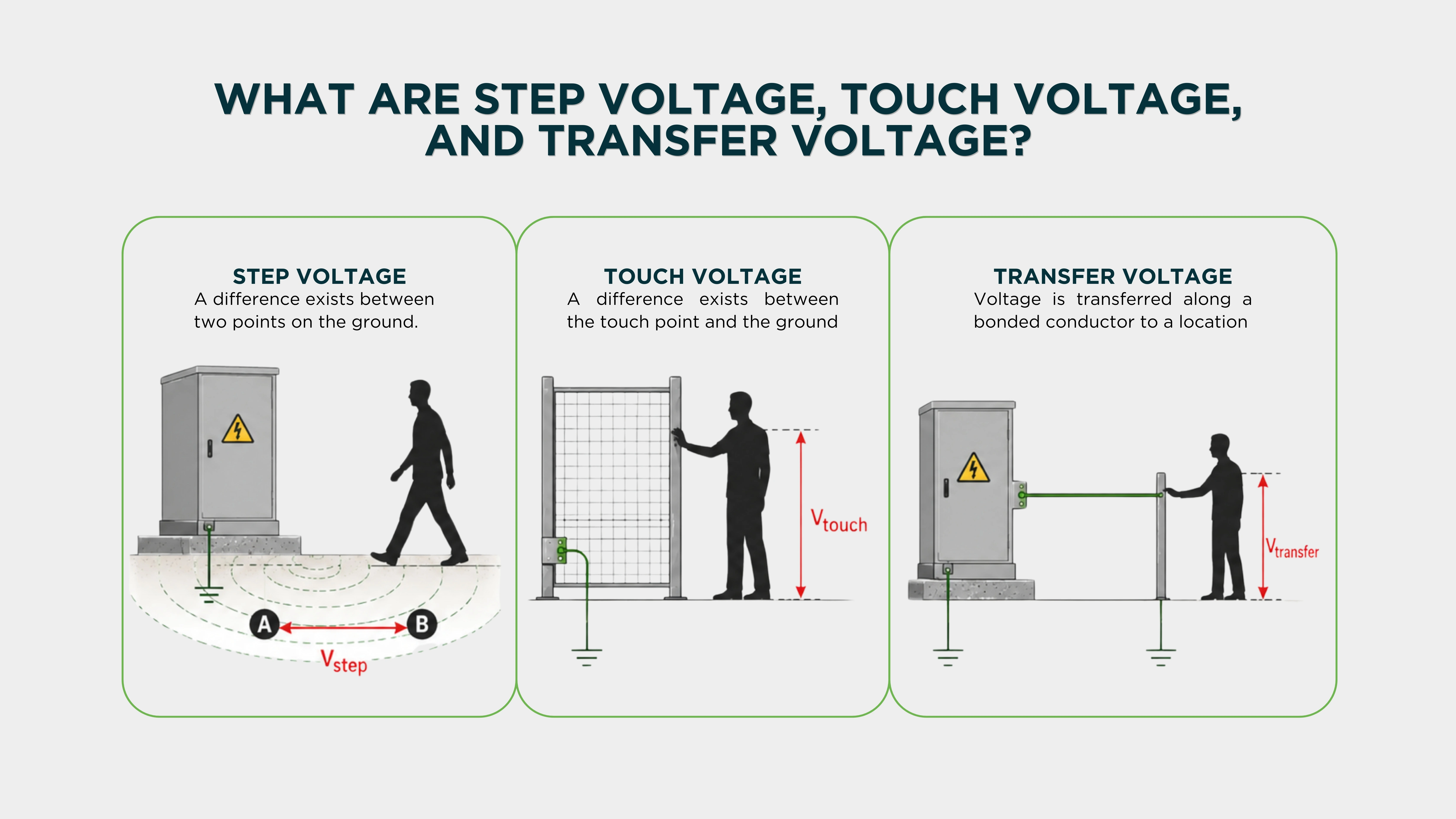
What Are Step Voltage, Touch Voltage, and Transfer Voltage?
- Step Voltage: The voltage difference between two points on the ground that a person or animal may bridge with their feet. This is important around substations, inverter stations, transformer pads, and site boundaries.
- Touch Voltage: This occurs when a person touches a conductive object, while standing on the ground. This is one of the most important contact scenarios assessed during earthing compliance studies and current injection testing.
- Transfer Voltage: This can occur when voltage is transferred from one earthing system or conductive structure to another location.
Where Does the Current Injection Testing Sit in the Connection Process?
Understanding where current injection testing fits within the broader connection process helps developers plan and resource it correctly.
The Connection Process at a Glance
The connection process for generators in South Australia progresses through six structured stages:
- Pre-feasibility and connection enquiry
- Application to connect
- GPS due diligence, stability assessment, and offer to connect
- TCA negotiation and execution
- Capability assessment and R1 model submission
- Compliance and R2 testing
Current injection testing sits within Stage 6—compliance and R2 testing—governed by NER Schedule 5.5.2(b).
Compliance Tests vs R2 Tests
Compliance tests are pre-R2 commissioning tests that demonstrate a generating system meets its agreed GPS under NER Schedule 5.2. They must be completed before normal operation is permitted. Current injection testing is a core component of protection compliance testing.
R2 tests are post-connection, on-system model validation tests. Their purpose is to confirm the installed plant behaves exactly as represented in the R1 model submissions. R2 test plans must be submitted to ElectraNet and AEMO at least three months before first energisation—aligned with the R1 model submission timeline.
Compliance tests are prerequisites to R2 testing. You cannot run R2 tests until compliance tests, including current injection, are complete and accepted.
Key Timelines to Plan Around
Getting current injection testing right requires early, detailed planning.
Missing the test plan deadline is one of the most avoidable causes of commissioning delay. Build backwards from your target energisation date and work this milestone into your project schedule early.
How Does the Current Injection Testing for Solar Farms Work?
Test Planning and Submission
Before any on-site work begins, a Test Plan must be prepared and submitted to both ElectraNet and AEMO for review and endorsement. This is not optional — commissioning cannot proceed without approved test plans.
The test plan should document:
- Test objectives and scope for each protection function
- Injection current values, angles, and timing sequences
- Expected relay responses and trip times
- Pass/fail criteria aligned with GPS access standards
- Witness requirements and safety procedures
On-Site Execution
Current injection tests are witnessed by ElectraNet to confirm compliance. This means your testing team must coordinate directly with the NSP on scheduling, access, and witnessing arrangements.
During testing, a secondary injection test set is used to apply test currents to protection relay inputs. Each element is tested individually, with results recorded against the agreed settings.
Reporting and Acceptance
Following testing, a Test Report must be submitted to ElectraNet for approval. The report must clearly present:
- Test results against expected responses for each protection element
- Any deviations from expected performance and their resolution
- Relay settings as-tested versus design specifications
- Confirmation that all protection elements are operational and correctly configured
What Are Common Issues that Cause Current Injection Testing to Fail?
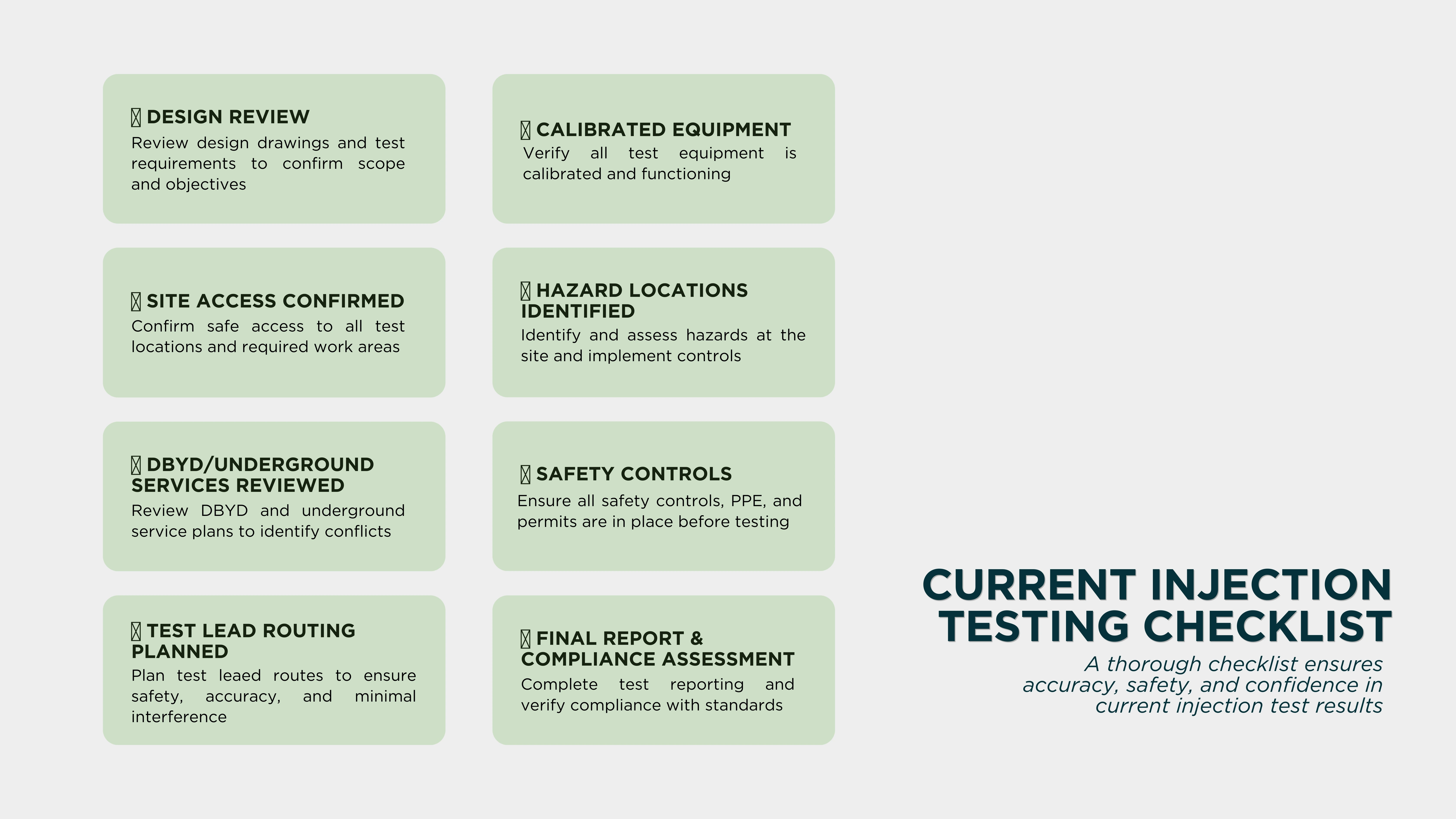
Several recurring problems delay commissioning; some apply directly to protection testing and current injection:
- Incorrect Relay Settings. Relay settings that differ from what was modelled in PSSE or PSCAD submissions create immediate compliance failures. Settings must be consistent across all technical documents.
- Incomplete Test Plans. Test plans that do not cover all required protection elements, or that lack clear pass/fail criteria, are returned for revision.
- Insufficient Technical Commentary. When unexpected behaviour is observed during testing, reports that simply present the data without explanation fail the review.
- OEM Delays. Protection relay parameters depend on OEM-provided configuration data. Late delivery of OEM settings is a common cause of commissioning timeline blowouts.
- Model-to-Hardware Mismatches. If relay behaviour during current injection testing differs from what the model predicts, R2 model validation is compromised.
What Does a Strong Current Injection Test Package Look Like?
A submission-ready current injection test package includes:
- A complete test plan endorsed by ElectraNet and AEMO before testing begins
- Test scope covering every protection function specified in the GPS access standards
- Pass/fail criteria derived directly from the accepted GPS settings
- As-tested relay settings matched to PSSE, PSCAD, and PSDS documentation
- Clear technical commentary on any deviations, anomalies, or retriggering events
- Simulation overlays from R1 models compared against measured responses
- A finalised test report approved by ElectraNet before R2 validation proceeds
What Are the Emergency Control Scheme Considerations?
Solar farms connecting to the South Australian transmission network must also be assessed for their impact on Emergency Control Schemes (ECS). These include:
- Remedial Action Scheme. Mitigates thermal overloading and voltage stability risks
- SSOMPS. Addresses sub-synchronous oscillations, particularly near series capacitor installations
- SAIT RAS. Protects SA from NEM separation events
- Anti-Islanding Scheme. Manages safe operation during network islanding events
ECS assessment begins once the Dynamic Model Acceptance Test (DMAT) is confirmed as acceptable. If your project has an adverse impact on any active ECS, you will be required to modify your plant configuration to integrate with the relevant scheme. This can affect protection system design and, in turn, current injection test scope.
ECS commissioning requirements follow the same test plan, witnessing, and report approval process as GPS compliance testing.
Working with ElectraGlobe on Your Grid Connection
Navigating protection system design, DMAT compliance, current injection test planning, and GPS negotiation requires deep technical knowledge of the NER and practical experience with ElectraNet's connection process.
ElectraGlobe provides specialist power systems engineering services for utility-scale solar and BESS projects. From AEMO GPS studies and PSCAD/PSS/E modelling through to commissioning test plan preparation and R2 validation support.
Is your project approaching the connection application stage or are you already in due diligence and want to reduce the risk of costly commissioning delays?
Contact us to discuss how ElectraGlobe can support your project.
FAQ
When does current injection testing need to be completed relative to R2 testing?
Current injection testing is a compliance test that must be completed and accepted before R2 on-system model validation can begin. Both are governed under NER Schedule 5.5.2(b). Your test plan for both must be submitted to ElectraNet and AEMO at least three months before first energisation.
What happens if current injection test results don’t match the R1 model predictions?
If there is a material discrepancy between relay behaviour observed during current injection testing and what the PSCAD or PSS/E R1 models predict, the models must be reviewed and retuned. This typically requires a resubmission of updated models, retesting, and resubmission of the R2 test report.
Does connecting near the SA interconnector corridor change what protection testing is required?
Yes. Projects connecting to the main interconnector corridor substations via a single circuit cut-in are unlikely to meet minimum access standards for power quality and voltage ride-through. A double circuit cut-in configuration is recommended, which changes the protection system architecture and expands the scope of current injection testing.