
Data centres run on one non-negotiable principle: the power cannot go out.
A few minutes of downtime can mean lost transactions, corrupted data, and reputational damage that follows an operator for years. This is why resilience has always been engineered into every layer of a data centre's power system.
For decades, that resilience has rested on two pillars:
- Uninterruptible power supplies (UPS) for the first few minutes of an outage
- Diesel generators for everything after that
This is a proven model, but it's also an aging one. Diesel has emissions, fuel logistics, and maintenance obligations that sit awkwardly with a data centre sector’s pressure to decarbonise.
Battery energy storage systems (BESS) are changing that equation. Increasingly, data centre operators are looking at BESS not just as a UPS replacement, but as a genuine upgrade to how resilience, reliability, and energy security are engineered from the ground up.
Why Is Data Centre Power Reliability Under Pressure?
Data centre demand is growing faster than almost any other category of electricity load. AI workloads, cloud computing, and always-on digital services are pushing power requirements up at a pace grid infrastructure wasn't originally designed for.
That growth is colliding with two other pressures at the same time.
- Grid stability is changing. As more renewable generation enters the grid, network stability profiles are shifting. Data centres, which need an exceptionally stable, continuous supply, are more exposed to voltage fluctuations and frequency variation than they were on a grid dominated by large, steady thermal generators.
- Connection timelines are stretching. In many parts of Australia, new data centre loads are large enough that connecting to the grid requires significant network augmentation. That can mean years of lead time before a facility gets its full contracted supply, let alone any headroom for future expansion.
Both pressures point toward the same conclusion: data centres need power infrastructure that gives them more control over their own reliability, rather than depending entirely on grid conditions and diesel backup.
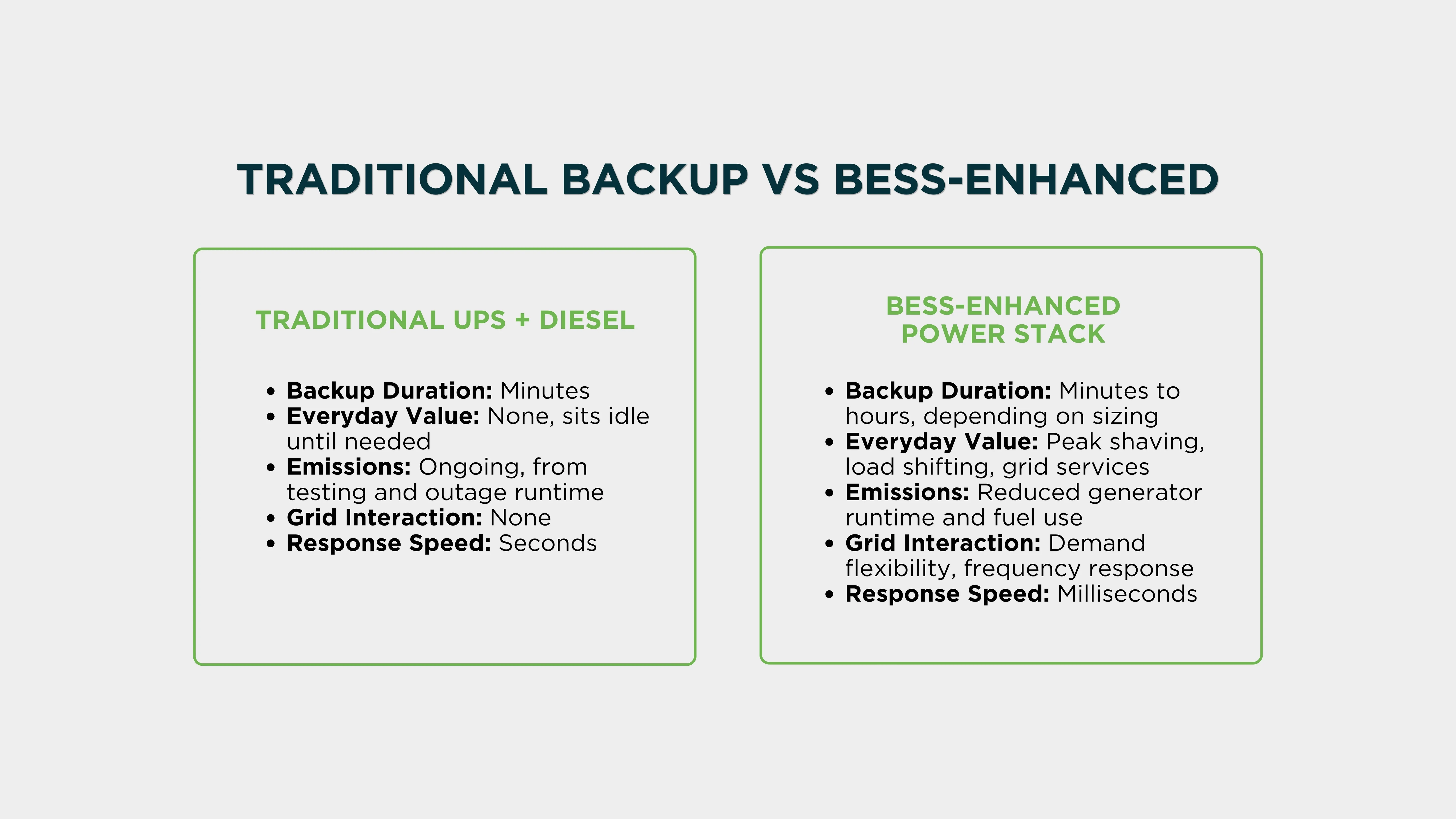
Where Traditional Backup Power Falls Short
The conventional data centre power stack, UPS plus diesel generators, has kept facilities running reliably for decades. But it has real limitations that are becoming harder to ignore.
- Short Duration: Traditional UPS battery systems are designed to bridge a gap of minutes, just long enough for diesel generators to start and take over.
- Diesel Dependency: Generators need fuel storage, regular testing, and ongoing maintenance, and they carry real emissions, both from routine testing and from actual outage events.
- No Everyday Value: A diesel generator sits idle almost all the time, delivering no operational or financial value until the moment it's needed.
- Limited Grid Interaction: Traditional backup systems aren't built to interact with the grid in any meaningful way. They can't help manage demand charges, respond to price signals, or support grid stability.
BESS addresses each of these gaps directly, which is why it's increasingly part of the conversation for new data centre builds and major upgrades alike.
How Does BESS Improve Energy Security and Cost Control?
Resilience isn't the only benefit. A well-designed BESS also gives data centre operators more control over their energy costs and their relationship with the grid.
- Peak Shaving: By discharging stored energy during periods of high demand, a BESS can reduce a facility's peak grid draw, lowering demand charges that are often a significant part of a data centre's electricity bill.
- Load Shifting: Energy can be stored when electricity prices are low and discharged when prices rise, reducing exposure to volatile wholesale pricing.
- Grid Services Participation: Depending on the market and connection agreement, a BESS can participate in frequency response or other grid services, turning what was previously a pure cost centre into an asset that can generate revenue or offset costs.
- Reduced Dependency on Network Augmentation: In some cases, a well-sized BESS can reduce how much new network capacity a data centre needs to draw on, helping ease connection timelines and requirements.
How Does BESS Improve Data Centre Resilience?
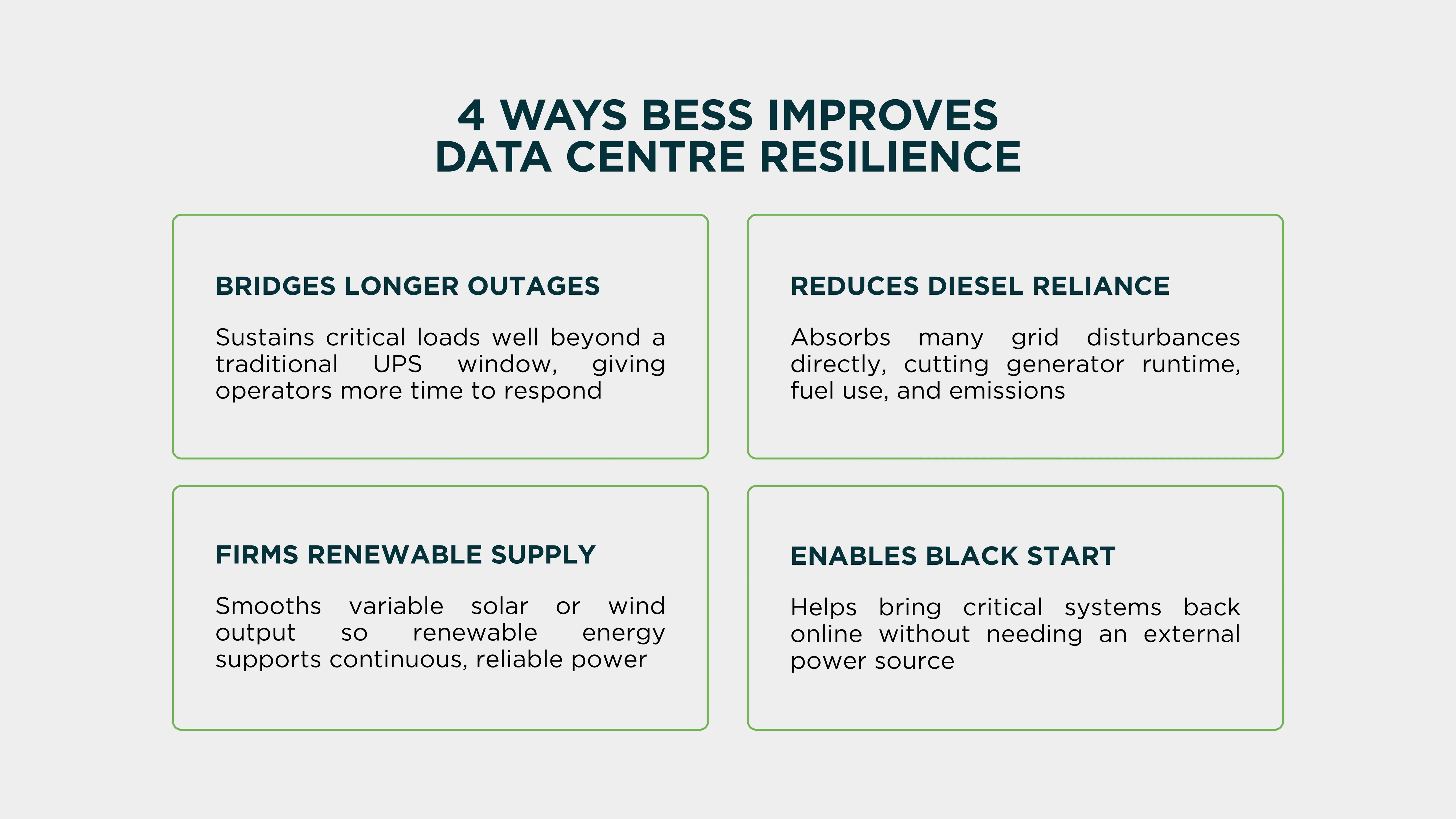
Bridging Longer Outages
Unlike a traditional UPS, a properly sized BESS can sustain critical loads for a meaningfully longer window. This gives operators more time to:
- Manage an extended outage
- Bring backup generation online in a more controlled way
- Ride through shorter grid disturbances without generators starting at all.
Reducing Reliance on Diesel Generators
A BESS can absorb the first line of response to many grid disturbances, reducing how often diesel generators need to start. Less runtime means lower emissions, reduced fuel consumption, and less wear on generator equipment, without compromising backup capability.
Supporting Renewable Integration
Data centres pursuing renewable generation, solar in particular, need storage to firm that supply. A BESS smooths out the variability of renewable generation, storing excess output and discharging it when generation dips. Renewable energy actually contributes to reliable, continuous supply rather than just offsetting demand on paper.
Enabling Black Start Capability
In more advanced configurations, BESS can support black start capability, helping bring critical systems back online without needing an external power source to initiate the restart. That's a meaningful resilience advantage in a severe or extended outage scenario.
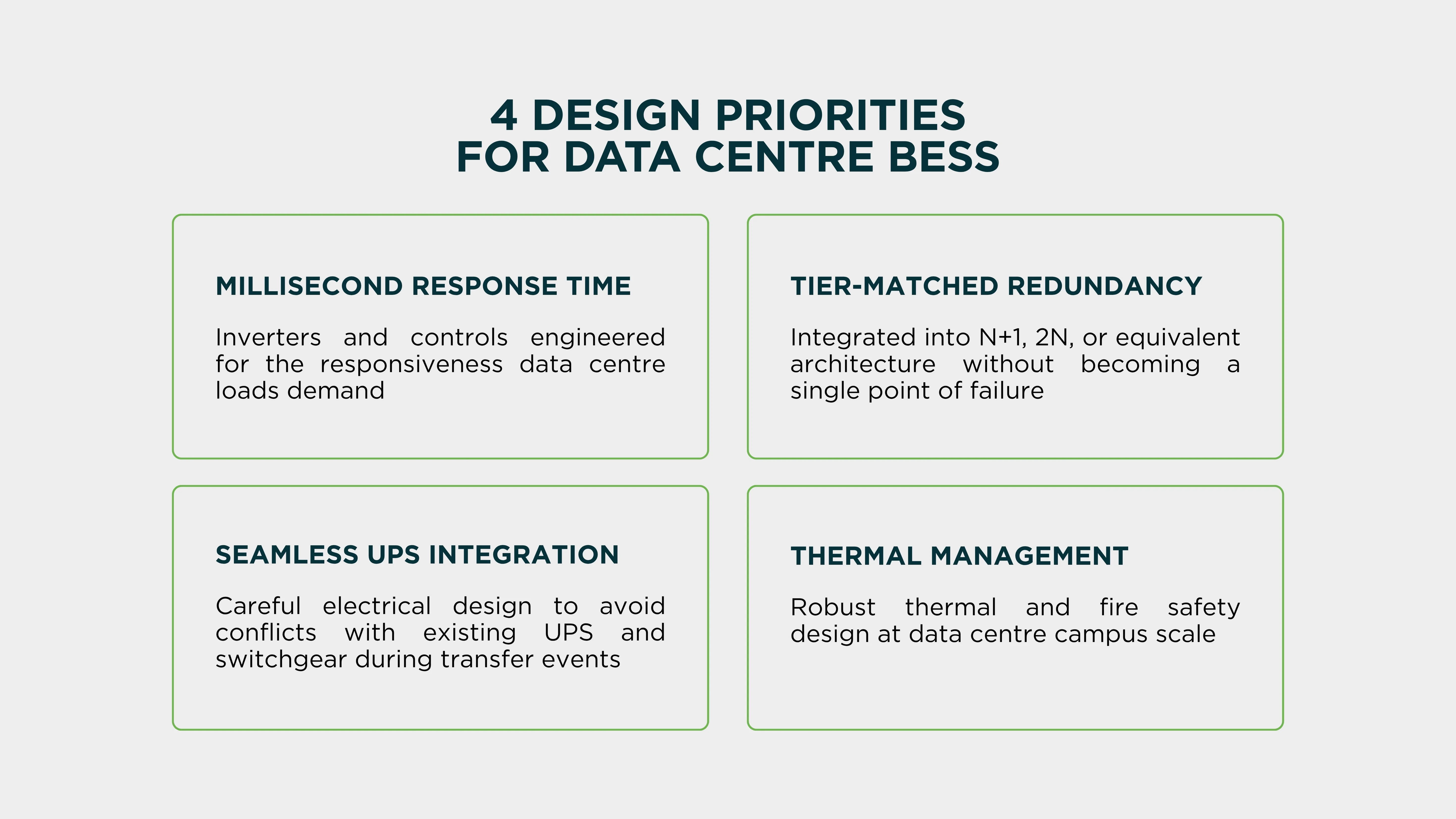
How Is a BESS Designed for Data Centre Applications?
Not every BESS is designed the same way, and a system built for a data centre has different priorities than one built purely for grid-scale renewable firming.
- Response Time Matters Most. Data centre loads need power that responds in milliseconds, not seconds. The BESS's inverter and control systems need to be engineered specifically for this level of responsiveness.
- Redundancy Has to Match the Facility’s Tier Rating. Data centres are typically designed to Uptime Institute or equivalent tier standards, and the BESS needs to be integrated into that redundancy architecture.
- Integration with Existing UPS and Switchgear. In most cases, a BESS is being integrated alongside existing UPS and switchgear infrastructure, which requires careful electrical design to avoid conflicts during transfer events.
- Thermal Management and Safety. Battery systems need robust thermal management and fire safety design, particularly at the scale required for a data centre campus, where system availability requirements leave very little room for compromise.
Getting this right requires detailed power system studies, protection coordination, and grid connection modelling, not just a battery sized to a rough estimate of the facility's load.
Plan a BESS Strategy for Your Data Center with ElectraGlobe
Deploying BESS for data centre resilience is a genuine engineering project, not an off-the-shelf equipment purchase. It requires the same rigour as any grid-connected energy asset: detailed system design, protection studies, and a connection strategy that satisfies both the facility's reliability requirements and the network service provider's technical standards.
ElectraGlobe is a renewable energy engineering consultancy with a 2.5+ GW portfolio designed across Australia, spanning utility-scale solar, BESS, and hybrid energy projects. For data centre operators and developers exploring BESS, ElectraGlobe's team supports:
- Power system studies, including PSS/E and PSCAD modelling, to confirm how a BESS will perform under real operating and fault conditions alongside data centre loads.
- Grid connection studies, covering feasibility assessments and connection agreement negotiation for co-located generation and storage assets.
- AEMO Generator Performance Standard (GPS) applications, for any BESS asset that needs to meet national technical standards.
- Power quality analysis, covering the voltage stability and transient response critical to protecting sensitive data centre equipment.
If your organisation is evaluating BESS as part of a data centre's energy strategy, ElectraGlobe's team can help design a system that holds up under real operating conditions, not just on paper. Get in touch with ElectraGlobe to start planning your BESS strategy.
FAQ
Can BESS fully replace diesel generators in a data centre?
BESS works alongside diesel generators rather than replacing them outright, handling shorter disturbances and reducing how often generators need to start. As battery technology and duration capabilities continue to improve, some facilities are exploring BESS-first architectures with generators as a deeper backup layer, but full replacement is still uncommon at scale today.
How long can a BESS power a data centre during an outage?
This depends entirely on how the system is sized relative to the facility's critical load. A BESS can be designed to bridge anywhere from minutes to several hours, but very few systems are sized to sustain a data centre indefinitely. The right duration depends on the facility's risk tolerance, backup generation strategy, and the typical outage profile of its local grid.
Does adding a BESS help a data centre with grid connection approval?
A well-sized BESS can reduce a facility's peak grid draw and support demand flexibility commitments, both of which are increasingly relevant to how network service providers assess large new connections. It's not a guaranteed shortcut through the approval process, but it strengthens a project's case, particularly under connection frameworks that reward reduced network impact and grid support capability.