
Connecting any embedded generation or storage system to the Australian electricity network starts with a document pack submitted to the local Distribution Network Service Provider.
How complete that pack is largely determines how fast the application moves. A DNSP can only assess what's actually in front of them, and a missing or poorly formatted document doesn't just slow the process down. It often sends the whole application back to the start.
Whether it's a residential solar and battery system, a commercial embedded generation project, or a larger negotiated connection, the documentation requirements follow a similar core structure, even though each DNSP publishes its own forms and portals.
This guide covers exactly what's needed, why each document matters, and where applications most commonly run into trouble.
What Is the DNSP Connection Framework in Australia?
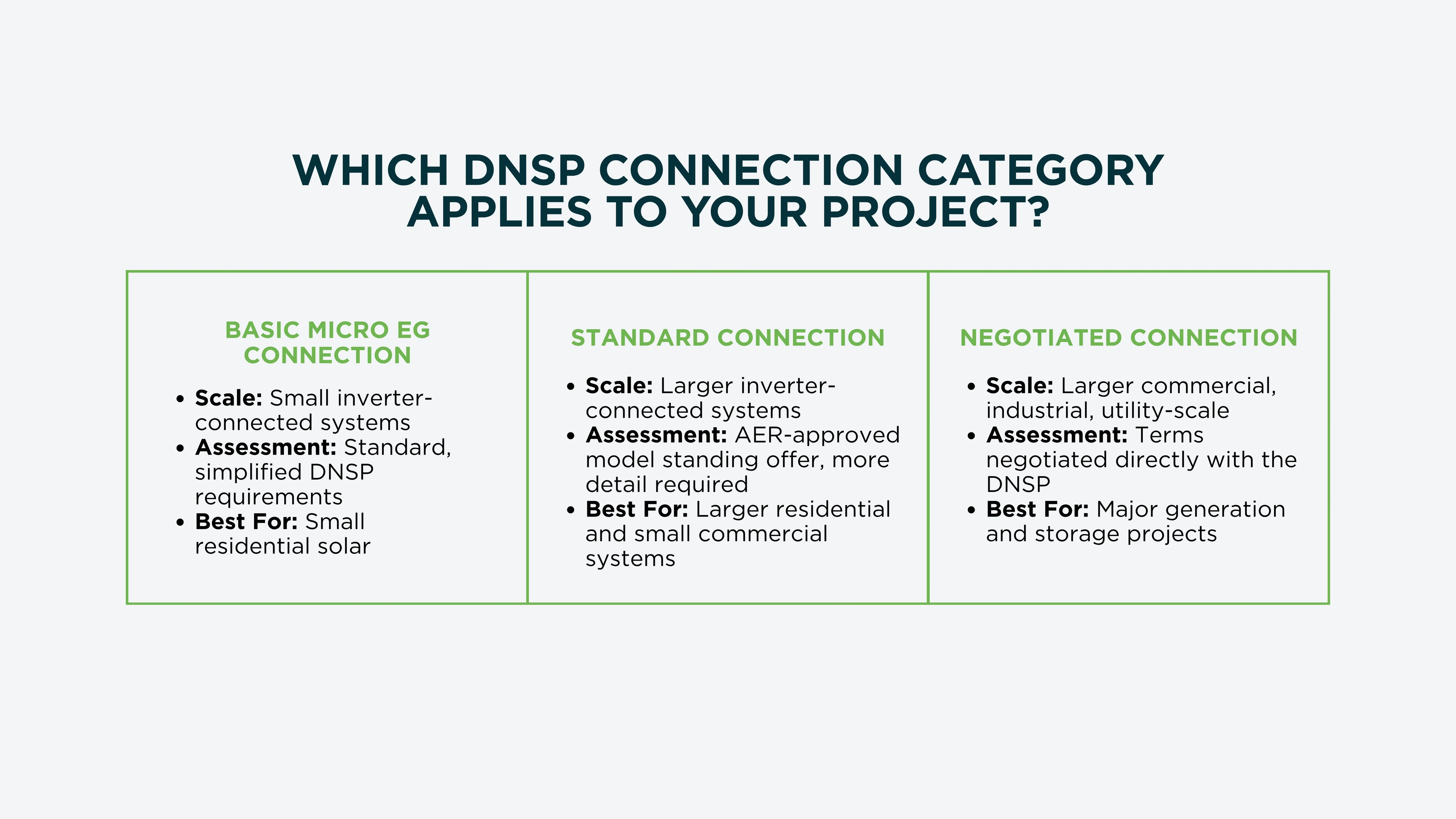
It helps to understand which connection category actually applies, since that determines how much documentation is required. Under the National Distributed Energy Resources Grid Connection Guidelines and each DNSP's own network standards, embedded generation connections in Australia generally fall into three categories:
- Basic Micro EG Connection: Covers small inverter-connected systems, typically small residential solar installations, assessed against a standard, simplified set of technical requirements published by the DNSP.
- Standard Connection: Applies to larger inverter-connected systems, still assessed against a model standing offer approved by the Australian Energy Regulator (AER), but with more detailed technical information required as part of the application.
- Negotiated Connection: Applies where a system doesn't fit the basic or standard categories, typically larger commercial, industrial, or utility-scale generation and storage. Technical requirements are negotiated directly between the proponent and the DNSP, and the documentation burden is significantly heavier.
Most inverter-connected systems, from solar to battery storage, are also governed by AS/NZS 4777.1 (installation requirements) and AS/NZS 4777.2 (inverter requirements), and DNSPs generally require any connected inverter to appear on the Clean Energy Council's inverter list.
What Are the Core Documents Every DNSP Application Needs?
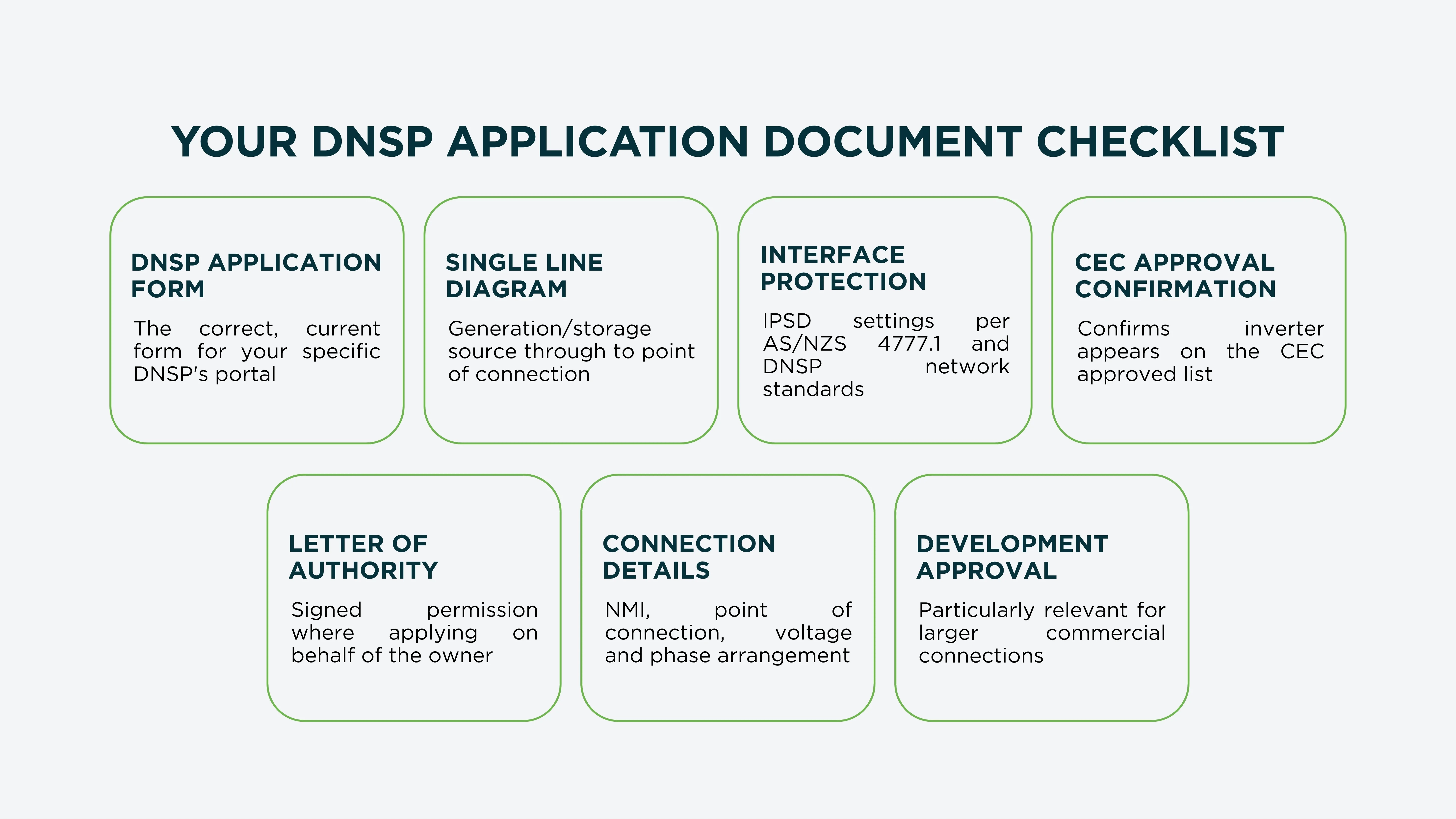
Regardless of connection size, most DNSP applications are built around the same core document set.
The DNSP Application Form
Every DNSP provides its own connection application form, typically available through an online customer portal. These forms ask for:
- Site Address
- National Metering Identifier (NMI)
- The Type and Capacity of the Proposed Generation or Storage System
- Details of the Applicant
Each DNSP's form and portal are specific to that network. Submitting through the wrong DNSP's portal, or using an outdated form version, is a common and entirely avoidable delay.
Single Line Diagram (SLD)
The single line diagram is widely regarded as the most important technical document in the submission. For a DNSP application, it needs to clearly show:
- The Generation or Storage Source
- Isolators
- Inverters
- Interface Protection Devices
- Metering Arrangements
- The Proposed Point of Connection to the Network
An incomplete or non-standard SLD is one of the most frequent reasons DNSPs return applications for correction, often adding weeks to an otherwise straightforward assessment.
Interface Protection and Settings Documentation
For systems above the smallest threshold, an Interface Protection System Device (IPSD) is typically required. Its settings need to be documented in line with AS/NZS 4777.1 and the relevant DNSP's network standard.
This includes voltage, frequency, and phase balance protection settings, which can vary depending on the connection point and aggregate capacity involved.
Equipment Datasheets and CEC Approval Confirmation
Inverter and equipment datasheets confirm the technical specifications of what's being connected. For inverter-connected systems, confirmation that the inverter model appears on the Clean Energy Council's approved list is generally required, since DNSPs commonly cross-check submitted applications against this list directly.
Letter of Authority
Where an application is submitted by an installer, developer, or consultant on behalf of the site owner, a signed letter of authority confirms the applicant has permission to lodge the application. It's a simple document, but a missing signature or unclear scope is enough to hold up an otherwise complete submission.
Site and Connection Details
This includes the NMI, the proposed point of connection, whether that's the existing switchboard or a dedicated connection point for larger systems, and confirmation of supply voltage and phase arrangement.
Evidence of Site Ownership or Development Approval
For larger commercial or negotiated connections, DNSPs often expect supporting evidence of site control or relevant planning approval status, particularly where network augmentation may be required to accommodate the new connection.
Why Does Application Completeness Matter So Much?
Most DNSPs work to defined assessment timeframes once an application is considered complete, though these vary by connection category and network.
This timeframe doesn't start until every required document has been submitted in the correct format. An incomplete pack effectively resets the clock, and for larger negotiated connections competing for limited network capacity, that delay can carry a real commercial cost.
Experienced applicants treat the document pack as one coordinated submission, not a checklist worked through independently. A single line diagram that doesn't match the equipment datasheet, or an application form listing a different capacity than the protection settings documentation, creates exactly the inconsistency that triggers a DNSP information request.
Common Reasons DNSP Applications Get Delayed or Rejected
- Incomplete or Non-Standard Single Line Diagram: Missing protection devices, unclear metering points, or diagrams that don't follow standard symbols are consistently one of the top causes of delay.
- Inverters Not on the CEC Approved List: Applications listing equipment not registered as approved grid-connect inverters can't proceed until compliant equipment is confirmed.
- Missing or Incomplete Interface Protection Details: Applications for systems requiring an IPSD are routinely sent back for clarification.
- Undeclared Existing Generation at the Same Connection Point: Failing to disclose existing generation already connected can cause problems once the DNSP cross-checks network records, sometimes well after initial approval.
- Mismatched Documents Across the Same Submission: Inconsistent capacity figures, connection point details, or equipment specifications between different documents in the pack are a common and preventable trigger for DNSP queries.
- Applying to the Wrong DNSP: Network boundaries can be geographically complex, and applications can occasionally get submitted to the wrong DNSP entirely, delaying the process before assessment even begins.
Manage Your DNSP Application with ElectraGlobe
Assembling a DNSP connection application is fundamentally a document coordination problem. Every document needs to be current, consistent with every other document in the pack, and traceable back to who produced it and when.
ElectraGlobe helps you manage that kind of coordination.
When a design changes and the SLD gets revised, your team can see immediately which related documents also need updating, rather than discovering the mismatch after a DNSP information request comes back weeks later.
Formal transmittals give you a clear, timestamped record of exactly what was submitted to the DNSP and when, which matters if a query comes back partway through the assessment period.
For engineering teams managing multiple DNSP connection applications at once, that consistency is what keeps a submission pack accurate the first time.
If you’re looking for a consultancy that can help ensure your DNSP application documents are ready to submit, connect with ElectraGlobe’s engineering team.
FAQ
What's the most common reason a DNSP grid connection application gets delayed?
An incomplete or non-standard single line diagram is consistently one of the top causes of delay. Missing protection devices, unclear metering arrangements, or a diagram that doesn't match the rest of the application pack typically triggers a DNSP information request, adding weeks to the assessment process.
Do all Australian DNSPs require the same documents for a connection application?
The core document set, application form, single line diagram, protection settings documentation, and equipment datasheets, is broadly consistent across DNSPs, since they're built around the same national standards, including AS/NZS 4777.1 and 4777.2. However, each DNSP publishes its own application form, customer portal, and network-specific technical standards, so documents need to be prepared according to the specific DNSP covering the project's location.
What's the difference between a standard connection and a negotiated connection?
A standard connection is assessed against a model standing offer approved by the Australian Energy Regulator, with a relatively defined document set. A negotiated connection applies to systems that don't fit the standard category, typically larger commercial or utility-scale projects, where technical requirements are negotiated directly with the DNSP and the documentation burden, including technical studies and protection coordination, is significantly heavier.